Tag

non sterile compounding

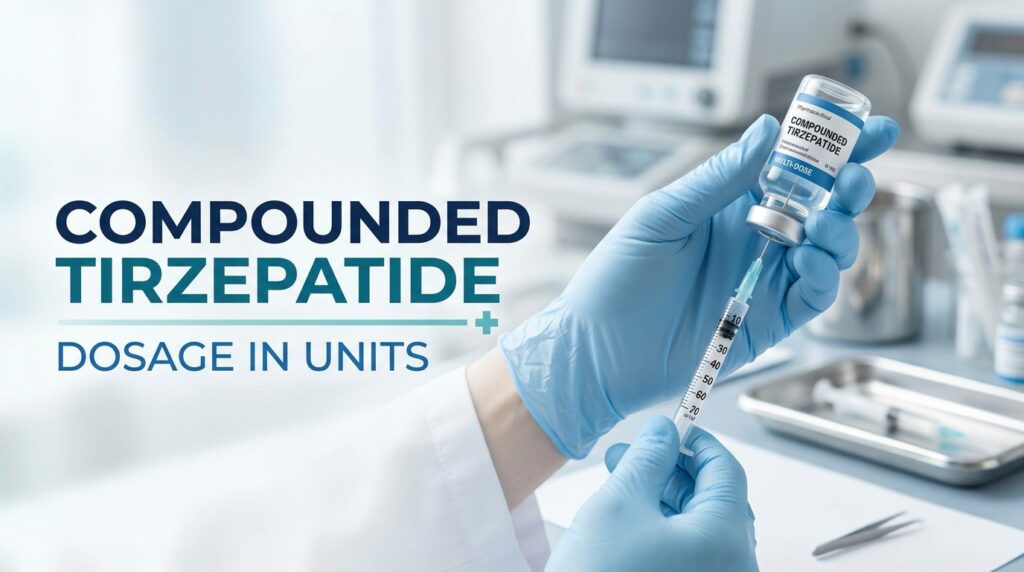
Compounded Tirzepatide Dosage in Units

Compounded Tirzepatide Dosage in Units: How to Convert mg to Units

By Compounding PharmacyNo Comments

To convert a compounded tirzepatide dose from milligrams to units, divide the dose in mg by the vial concentration in mg/mL, then multiply by 100. For example, a 2.5 mg dose from a 10 mg/mL vial is 0.25 mL, which equals 25 units on a U-100 insulin syringe. The same 2.5 mg dose from a 5 mg/mL vial is 50 units.

Because compounded vials come in different concentrations, the number of units changes from vial to vial even when the dose in mg stays the same. This guide explains the math, gives conversion tables, and covers the dosing errors providers should help patients avoid.

Why Compounded Tirzepatide Is Measured in Units

Brand tirzepatide (Mounjaro and Zepbound) comes in prefilled pens and single-dose vials with a fixed dose. Compounded tirzepatide usually comes in a multi-dose vial, and patients draw each dose with an insulin syringe.

Insulin syringes are marked in units, not milligrams. On a standard U-100 syringe:

  • 100 units = 1 mL
  • 10 units = 0.1 mL
  • 1 unit = 0.01 mL

The units on the syringe measure volume only. How much tirzepatide that volume contains depends on the concentration of the vial.

The Conversion Formula

Use these three steps:

  1. Find the concentration on the vial label, written in mg/mL.
  2. Calculate the volume: dose (mg) ÷ concentration (mg/mL) = volume (mL).
  3. Convert to units: volume (mL) × 100 = units on a U-100 syringe.

Example: The prescribed dose is 5 mg and the vial is 10 mg/mL.

5 ÷ 10 = 0.5 mL. 0.5 × 100 = 50 units.

Tirzepatide mg to Units Conversion Chart

The chart shows units on a U-100 insulin syringe for common doses and concentrations. Always use the concentration printed on the patient’s own vial.

Dose (mg) 5 mg/mL vial 10 mg/mL vial 20 mg/mL vial
2.5 mg 50 units (0.50 mL) 25 units (0.25 mL) 12.5 units (0.125 mL)
5 mg 100 units (1.00 mL) 50 units (0.50 mL) 25 units (0.25 mL)
7.5 mg 150 units (1.50 mL) 75 units (0.75 mL) 37.5 units (0.375 mL)
10 mg 200 units (2.00 mL) 100 units (1.00 mL) 50 units (0.50 mL)
12.5 mg 250 units (2.50 mL) 125 units (1.25 mL) 62.5 units (0.625 mL)
15 mg 300 units (3.00 mL) 150 units (1.50 mL) 75 units (0.75 mL)


A standard 1 mL insulin syringe holds 100 units. Doses above 100 units need either a higher concentration or more than one draw, which increases the risk of error. Pharmacies often choose a concentration that keeps each dose under 100 units.

Contact us

How Tirzepatide Is Usually Titrated

The FDA-approved labeling for brand tirzepatide for weight management (Zepbound) starts at 2.5 mg once weekly for 4 weeks. The dose then increases in 2.5 mg steps, at least 4 weeks apart. Maintenance doses are 5 mg, 10 mg, or 15 mg once weekly, and the maximum dose is 15 mg weekly.

Weeks Weekly dose Units from a 10 mg/mL vial
1 to 4 2.5 mg 25 units
5 to 8 5 mg 50 units
9 to 12 7.5 mg 75 units
13 to 16 10 mg 100 units
17 to 20 12.5 mg 125 units
21 and after 15 mg 150 units


This table shows the brand label schedule as a reference. The prescriber sets each patient’s dose and schedule, and many patients stay at a lower maintenance dose.Common Dosing Errors With Compounded GLP-1 Injections

The FDA has received reports of patients overdosing on compounded GLP-1 injections, including cases that led to hospitalization. Many errors come from confusion between units, milliliters, and milligrams. 

The most common mistakes are:

  • Reading mg as units. A patient told “5” draws 5 units instead of 50 units, or 50 units instead of 5 units.
  • Reading mL as units. A patient told “0.5” draws 50 units when 5 units was intended, or the reverse.
  • Using the old concentration. A refill arrives in a different concentration, but the patient keeps drawing the same number of units.
  • Using the wrong syringe. A U-40 or 0.3 mL syringe has different markings from a 1 mL U-100 syringe.
  • Double dosing. A patient forgets whether the weekly dose was taken.

Compounded Tirzepatide Dosage in Units

How Providers Can Prevent Dosing Errors

  1. Write the dose three ways on instructions: mg, mL, and units, for example “2.5 mg = 0.25 mL = 25 units.”
  2. Specify the syringe size and type in the prescription.
  3. Flag concentration changes whenever a refill uses a different concentration.
  4. Teach back. Ask patients to show where they will draw to on the syringe.
  5. Use a dose log so patients record the date and units of each injection.
  6. Coordinate with the pharmacy so the label, patient instructions, and prescription all match.

For patient education on injections and adherence, see How Compounding Improves Patient Adherence.

Is Compounded Tirzepatide Still Available in 2026?

The FDA removed tirzepatide from its drug shortage list on December 19, 2024. State-licensed 503A pharmacies had until February 18, 2025, and 503B outsourcing facilities until March 19, 2025, to stop compounding copies of the commercial product under the shortage policy.

Since then, federal law generally does not allow pharmacies to routinely compound drugs that are essentially copies of a commercially available product. A 503A pharmacy may compound a patient-specific version only when the prescriber determines that a change produces a clinically significant difference for that patient. Rules continue to change, so confirm current FDA guidance before prescribing. Learn more in FDA Regulation of Peptides and Compounding Pharmacies in 2026 and our 503A compounding pharmacy guide.

Contact us

FAQs

How many units is 2.5 mg of compounded tirzepatide?

It depends on the vial concentration. From a 10 mg/mL vial, 2.5 mg is 25 units. From a 5 mg/mL vial, it is 50 units. From a 20 mg/mL vial, it is 12.5 units.

How do you convert tirzepatide mg to units?

Divide the dose in mg by the concentration in mg/mL to get mL, then multiply by 100 to get units on a U-100 insulin syringe.

How many units is 5 mg of tirzepatide?

From a 10 mg/mL vial, 5 mg is 50 units. From a 20 mg/mL vial, it is 25 units.

Why did my units change when the dose stayed the same?

The refill likely came in a different concentration. The units on the syringe measure volume, so a stronger vial needs fewer units for the same mg dose.

What syringe is used for compounded tirzepatide?

Most patients use a U-100 insulin syringe, where 100 units equals 1 mL. The prescriber and pharmacy should specify the syringe size.

Is compounded tirzepatide FDA-approved?

No. Compounded drugs are not FDA-approved. Brand tirzepatide products, Mounjaro and Zepbound, are FDA-approved.

Work With a Pharmacy That Gets the Details Right

Clear labels and matching instructions prevent most dosing errors. Emerald Compounding Pharmacy works with weight management clinics on patient-specific prescriptions, clear labeling, and direct pharmacist support. Learn more about our weight loss compounding pharmacy in Tampa or call (877) 443-7711.

Become a Provider

How Compounding Pharmacies Maintain Quality Control

How Compounding Pharmacies Maintain Quality Control?

By Compounding PharmacyNo Comments

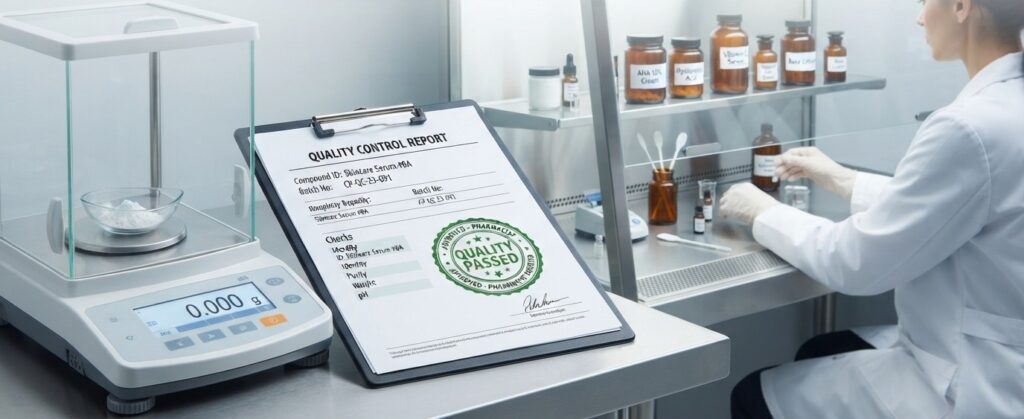
Quality control is one of the most important parts of pharmacy compounding because compounded medications are prepared for specific patient or clinical needs rather than manufactured as mass-market products. A reliable compounding pharmacy uses controlled procedures for ingredient sourcing, preparation, testing, documentation, storage, and dispensing to help maintain the quality and consistency of each formulation.

For clinics and healthcare providers, understanding these processes can make it easier to evaluate a compounding pharmacy and choose a pharmacy partner that follows appropriate professional and regulatory standards.

What Does Quality Control Mean in Pharmacy Compounding?

Quality control in compounding involves a series of checks designed to verify the identity, strength, purity, consistency, and appropriate handling of compounded medications. These controls can apply throughout the process, from receiving pharmaceutical ingredients to preparing, packaging, labeling, and releasing the finished formulation.

USP standards play an important role in pharmacy compounding. USP identifies standards for both nonsterile preparations and sterile preparations, with requirements intended to support consistency and quality in compounded medications.

A strong quality-control program may include:

  • Ingredient verification and documentation
  • Appropriate storage conditions
  • Accurate weighing and measurement
  • Equipment checks and calibration
  • Environmental monitoring
  • Personnel training
  • Preparation and labeling procedures
  • Quality testing when applicable
  • Documentation and recordkeeping

These controls create multiple checkpoints rather than relying on a single final inspection.

How Compounding Pharmacies Maintain Quality Control

Contact us

How Pharmacies Control the Quality of Ingredients

Quality control starts before a medication is compounded. Pharmacies need reliable sources for active pharmaceutical ingredients and excipients and should verify that materials meet applicable requirements.

The FDA specifically advises compounders to understand their bulk drug substance and excipient suppliers because the quality of these materials can directly affect the quality of compounded medications.

For pharmacies operating under Section 503A, FDA states that bulk drug substances must meet specific conditions, such as complying with an applicable USP or NF monograph when one exists, being a component of an FDA-approved drug when applicable, or appearing on the applicable FDA bulk drug list.

This makes supplier qualification an important part of the quality-control process.

Quality Control for Sterile Compounding

Sterile compounding requires additional controls because contamination can create significant risks when medications are administered through sterile routes.

USP standards for sterile compounding address areas such as controlled environments, personnel competency, aseptic practices, and testing. For example, USP materials describe requirements involving media-fill testing and competency assessments for personnel performing sterile compounding.

For a deeper explanation of the process, see Emerald’s guide to sterile compounding pharmacy.

Quality controls may include:

  • Controlled compounding environments
  • Appropriate personal protective equipment
  • Aseptic technique
  • Environmental monitoring
  • Personnel competency testing
  • Sterility-related testing when required
  • Proper storage and beyond-use dating procedures

These safeguards help reduce the risk of contamination and preparation errors.

Quality Control for Non-Sterile Compounding

Non-sterile preparations follow a different set of controls because they do not require the same sterile environment as injectable or other sterile products.

Quality control can involve accurate ingredient measurement, appropriate equipment, proper preparation techniques, appropriate packaging, labeling, and documentation. USP identifies <795> Pharmaceutical Compounding—Nonsterile Preparations as the standard addressing nonsterile compounding practices.

Emerald also provides information about non-sterile compounding and how these preparations can support customized medication needs.

How Compounding Pharmacies Maintain Quality Control

Contact us

How Personnel Training Supports Quality

Even the best equipment cannot replace properly trained personnel. Pharmacists and compounding staff need appropriate education and competency assessments for the types of preparations they handle.

Training can cover:

  • Accurate calculations and measurements
  • Ingredient handling
  • Equipment operation
  • Cleaning procedures
  • Aseptic technique where applicable
  • Documentation
  • Quality-control procedures
  • Identification and management of preparation errors

For sterile compounding in particular, USP materials describe competency assessments and recurring evaluations for personnel performing aseptic manipulations.

Consistent training helps make quality control part of the everyday workflow rather than something performed only after a problem occurs.

How Documentation Helps Maintain Consistency

Documentation provides a record of how a compounded medication was prepared and helps pharmacies investigate problems when necessary.

Depending on the formulation and applicable requirements, records may include:

  • Ingredient information
  • Lot numbers
  • Expiration dates
  • Calculations
  • Preparation instructions
  • Personnel involved
  • Equipment information
  • Quality-control checks
  • Final product information

Accurate documentation also creates traceability throughout the compounding process.

How Quality Control Differs Between 503A and 503B

The regulatory framework matters when evaluating a compounding pharmacy because 503A pharmacies and 503B outsourcing facilities operate under different requirements.

Under Section 503A, compounding is generally performed by a licensed pharmacist in a state-licensed pharmacy or by a licensed physician and is generally based on a valid prescription for an identified patient. Under Section 503B, outsourcing facilities are registered with the FDA and are subject to current good manufacturing practice requirements.

503A Pharmacy 503B Outsourcing Facility
Typically patient-specific compounding May compound without patient-specific prescriptions
Operates under applicable pharmacy requirements Registered with FDA as an outsourcing facility
Generally overseen primarily by state pharmacy regulators Primarily overseen and inspected by FDA
Not subject to CGMP requirements under the 503A exemption Subject to CGMP requirements

Understanding this distinction helps healthcare practices ask more informed questions when evaluating pharmacy partners.

Contact us

What Should Clinics Look for in a Compounding Pharmacy?

Healthcare practices should evaluate more than price or turnaround time when selecting a compounding pharmacy. Quality systems, regulatory compliance, communication, documentation, and the pharmacy’s ability to support the practice’s specific needs should all be considered.

Important questions include:

  • What type of compounding does the pharmacy perform?
  • What quality-control procedures are used?
  • How are ingredients sourced and verified?
  • How are personnel trained?
  • What documentation is provided?
  • How are complaints or quality concerns handled?
  • What regulatory framework applies to the pharmacy?
  • Does the pharmacy have experience supporting the type of practice being served?

Emerald’s resource on how to choose a compounding pharmacy provides additional considerations for evaluating a pharmacy.

Why Quality Control Matters for Medical Practices

For physicians, dermatology practices, wellness clinics, and other healthcare organizations, consistent pharmacy processes can make coordination easier. A pharmacy partner may need to handle customized formulations, communicate clearly with providers, and maintain appropriate documentation throughout the process.

This becomes especially relevant when practices use customized medication solutions rather than relying exclusively on commercially available formulations.

Emerald explains how custom medication solutions for medical practices can support practices that require individualized compounding services.

Quality Control Is an Ongoing Process

Quality control does not end when a compounded medication leaves the compounding area. It is an ongoing system that includes ingredient management, staff competency, environmental controls, preparation procedures, documentation, storage, and continuous evaluation.

FDA emphasizes that compounded medications must comply with applicable legal and regulatory requirements, while pharmacies and outsourcing facilities may operate under different quality standards depending on their regulatory status.

For healthcare practices, the key is to work with a pharmacy that can clearly explain its quality systems and demonstrate how those systems are integrated into daily compounding operations.

Conclusion

A reliable compounding pharmacy quality control program is built around multiple layers of verification rather than a single quality check. Ingredient sourcing, trained personnel, controlled preparation environments, accurate documentation, appropriate testing, and regulatory compliance all contribute to the overall quality of compounded medications.

For clinics considering a compounding pharmacy partner, asking detailed questions about these processes can provide a clearer picture of how the pharmacy manages quality from the beginning of the compounding process through final dispensing.

Contact us

FAQs

Is quality control required for compounded medications?

Yes. Compounding pharmacies must follow applicable federal, state, and professional requirements. The specific requirements depend on the type of compounder and the regulatory framework under which it operates.

Are sterile and non-sterile compounding quality controls the same?

No. Sterile preparations require additional controls designed to minimize microbial contamination and maintain sterility. Non-sterile preparations follow different standards and procedures.

How does a pharmacy verify its ingredients?

Pharmacies may review supplier information, certificates of analysis, lot information, applicable standards, and other documentation. FDA specifically encourages compounders to understand their bulk drug substance and excipient suppliers.

Are 503A pharmacies subject to the same requirements as 503B facilities?

No. 503A and 503B compounders operate under different federal frameworks. 503B outsourcing facilities are subject to CGMP requirements, while qualifying 503A compounding is exempt from certain federal requirements, including CGMP, under the conditions established by Section 503A.

What should a medical practice ask before choosing a compounding pharmacy?

Practices should ask about ingredient sourcing, quality-control procedures, personnel training, documentation, regulatory status, preparation capabilities, and how the pharmacy handles quality concerns or recalls.

Why Clinics Choose a Compounding Pharmacy Partner

Why Clinics Choose a Compounding Pharmacy Partner: 7 Reasons

By Compounding PharmacyNo Comments

A compounding pharmacy relationship is not a vendor transaction. It is a clinical and operational partnership that directly affects patient outcomes, practice liability, and revenue potential. That framing  from one of the most widely read pharmacy industry guides published in 2026  captures why the clinic-pharmacy partnership decision carries more weight than most procurement decisions a practice makes.

For Tampa and Florida clinics evaluating whether to build a compounding pharmacy relationship  or evaluating whether their current relationship is working  the question is not simply “should we use compounding?” It is: what are the specific, verifiable reasons that practices in this market establish pharmacy partnerships, and what operational and clinical standards make a partnership worth building?

This guide answers that question with seven specific reasons  clinical, operational, compliance, and competitive that drive Tampa and Florida clinics to establish and maintain compounding pharmacy partnerships in 2026.

What a Compounding Pharmacy Partnership Actually Is

Before examining the reasons clinics choose pharmacy partners, it is worth being precise about what the partnership model involves because the casual use of “compounding pharmacy” conflates two distinct operating models.

A 503A compounding pharmacy 

prepares medications patient-by-patient based on individual prescriptions from licensed providers. This is the model that applies to most outpatient clinic partnerships hormone therapy, weight management, dermatology, aesthetics, functional medicine, and pain management practices all operate under 503A physician-partnership relationships.

A 503B outsourcing facility 

is FDA-registered and may produce larger batches for healthcare facility in-office use without individual patient prescriptions. This model applies to surgical centers, hospitals, and in-office injection programs that pre-stock medications.

Practices operating across multiple specialties or running both outpatient and in-office programs may work with both models simultaneously. For the majority of Tampa and Florida outpatient clinical practices, the 503A physician partnership model is the relevant framework and it is the model discussed throughout this guide.

Why Clinics Choose a Compounding Pharmacy Partner

Contact us

7 Reasons Tampa and Florida Clinics Choose a Compounding Pharmacy Partner

Reason 1: Compounded Medications Fill Clinical Gaps That Commercial Products Cannot

The most fundamental reason clinics establish pharmacy partnerships is the simplest: commercially manufactured medications consistently fail to meet the full range of patient clinical needs, and compounding fills those gaps.

Doctors use compounding pharmacies when a patient needs a custom dose, a different delivery form, or a medication without certain fillers or allergens found in commercial drugs. Each of these scenarios and they occur daily in clinical practice has no commercial resolution. The only pathway to a clinically appropriate medication is a compounding pharmacy relationship.

Understanding the clinical benefits of compounded medications in the context of your specific practice protocols is the first step. Once a practice maps its patient population against the limitations of commercially available options, the cases for compounding become visible often across multiple therapeutic categories simultaneously.

The foundational insight from compounded vs commercial drugs is structural: commercial pharmaceutical manufacturing optimizes for the median patient in a controlled trial. Clinical practice manages individual patients who frequently fall outside that median. Compounding bridges the distance between those two realities and a pharmacy partner is the infrastructure that makes the bridge accessible.

Reason 2: A Single Partner Covers Multiple Therapeutic Categories

\When a single accredited pharmacy can prepare customized medications across hormone therapy, pain management, dermatology, aesthetics, and men’s health, it becomes a genuine clinical partner rather than a rotating list of vendors. For Tampa and Florida practices building multi-specialty compounding programs, the operational value of a single pharmacy relationship covering the full range of most common compounded medications rather than maintaining separate vendor relationships for each therapeutic category is substantial.

Multi-specialty consolidation means:

One credentialing process provider registration, DEA verification, and HIPAA agreement executed once, not once per specialty.

One portal prescription submission, order tracking, and Certificate of Analysis access through a single HIPAA-compliant interface across all compound categories.

One pharmacist relationship formulation consultation, protocol questions, and regulatory guidance from a team that knows your practice’s full formulary, not just one corner of it.

One quality standard every compound category held to the same USP compliance, API sourcing standard, and quality documentation protocol.

For a practice that prescribes hormone therapy, weight management compounds, aesthetic preparations, and dermatology formulations, a pharmacy partner that covers all four categories is not a convenience it is a structural operational advantage over practices managing four separate pharmacy relationships.

Reason 3: Sterile Compounding Capability Unlocks Injectable Protocols

For clinics whose protocols include any injectable compound peptide therapy, hormone injectables, weight management compounds, sterile aesthetic preparations a licensed sterile compounding pharmacy is not optional. It is the only legal pathway to patient-specific injectable compounds.

Regulators are closely watching the integrity of active pharmaceutical ingredients used in sterile compounded medicines. Prescribers benefit from choosing a pharmacy partner with documented sourcing, validated testing, and full traceability.

The clinical protocols that drive the strongest patient outcomes in weight management, hormone optimization, anti-aging, and aesthetic medicine frequently depend on sterile injectable formulations:

  • Weight management programs incorporating MIC/lipotropic injectables or B-complex compounds
  • Hormone therapy protocols prescribing testosterone or estradiol injectables at custom concentrations
  • Anti-aging and functional medicine practices offering GH secretagogue peptide protocols
  • Aesthetic clinics requiring sterile topical anesthetics and post-procedure support compounds

A sterile compounding pharmacy holding active Special Sterile Compounding licensure with verified USP Chapter 797 cleanroom infrastructure, environmental monitoring, and sterility testing is the only partner that can legally and safely prepare these compounds. Understanding are compounded medications safe establishes why sterile licensure verification is the most critical single credential in pharmacy partner selection.

Clinics that establish pharmacy partnerships with sterile-qualified facilities unlock the full range of injectable protocols that practices without such partnerships cannot offer.

Reason 4: Compliance Protection in a Tightening Regulatory Environment

The years 2025 and 2026 brought a wave of state-level tightening, including Florida SB 860. The wrong pharmacy partner now carries real compliance risk for the prescriber.

This is the compliance reality that Tampa and Florida clinics must navigate in 2026. The pharmacy partner you choose is not compliance-neutral it is either a compliance asset or a compliance liability. The distinction matters for prescriber liability, practice licensure, and patient safety simultaneously.

A compliance-asset pharmacy partner:

  • Holds active, verifiable Florida DOH pharmacy licensure not a nonresident license from another state
  • Proactively communicates regulatory changes affecting your compound categories, including GLP-1 compounding requirements
  • Operates prescription-only dispensing with complete prescription verification for every compound
  • Maintains DEA registration covering every scheduled substance in your protocols
  • Provides documentation demonstrating compliance positions not just self-reported Clear communication between the prescriber and their partner compounding pharmacy including dosing instructions, formulation details, and treatment justification helps reduce risk and ensures compliance.

For Florida clinics, a Tampa-based pharmacy partner operating under direct Florida Board of Pharmacy oversight subject to the same regulatory authority that governs your practice provides compliance alignment that nonresident pharmacies shipping from other states cannot match. Florida SB 860 compliance, Florida telehealth prescribing parity requirements, and Florida-specific controlled substance regulations are applied by a Florida-licensed pharmacy as operating standards, not as external constraints to navigate.

Reason 5: Same-Day Dispensing Eliminates Patient Care Gaps

A one to two business day turnaround is the standard for a high-performance compounding pharmacy. Anything longer should prompt questions about capacity, staffing, and operational systems.

For Tampa and Florida clinics managing active patient programs weight management protocols, hormone titration schedules, ongoing aesthetic procedure preparation medication supply continuity is a clinical operations requirement. A patient on a GLP-1 protocol who misses a dose because of pharmacy fulfillment delays does not simply experience inconvenience they experience a therapeutic gap that affects outcomes, adherence, and confidence in the practice.

Same-day dispensing from a Florida-based pharmacy partner provides:

Protocol Continuity Patients on titration schedules receive their compounds on the clinical timeline, not on a fulfillment schedule that may not align with their treatment calendar.

Urgent Prescription Support When a patient’s protocol requires an adjustment or an unexpected compound addition, same-day processing means the adjustment reaches the patient within 24 hours, not within five business days.

No Interstate Supply Chain Variability A Tampa-based pharmacy shipping same-day within Florida eliminates the temperature handling variability, customs clearance delays, and carrier network variability that affect interstate shipping from nonresident pharmacy operators.

The physician partnership program with Emerald provides same-day dispensing for prescriptions received before 2:00 PM EST with direct-to-patient shipping and order tracking through the provider portal.

Reason 6: Compounding Partnerships Drive Practice Revenue and Differentiation

In 2026, compounded medications will no longer be considered an alternative they will be a core part of how healthcare adapts to individual needs. For Tampa and Florida clinics operating in competitive healthcare markets, that shift has direct revenue implications.

Practices that offer prescription compounded medication programs occupy a clinical and commercial position that practices limited to commercially available options cannot match. The revenue drivers are specific:

Recurring Protocol Prescriptions Patients on ongoing hormone therapy, weight management, or anti-aging protocols generate recurring prescription volume. Each titration adjustment, refill, and protocol modification represents a clinical touchpoint that drives both patient retention and pharmacy prescription volume.

Patient Retention Through Clinical Differentiation Patients who receive formulations made specifically for their clinical profile at concentrations and in delivery forms that commercial products do not offer are patients who have a concrete reason to remain with a practice that commercial-product-only practices cannot replicate.

Expanded Treatable Population Custom compounding removes the ceiling imposed by commercial product limitations. Patients with allergen sensitivities, dosing tolerability issues, or formulation requirements outside commercial ranges become treatable rather than manageable.

Practice Program Development Custom medication solutions for specific practice types weight management programs, BHRT protocols, aesthetic preparation and recovery programs create structured clinical programs with defined protocols, defined outcomes, and defined patient journeys. These programs are differentiated, scalable, and marketable in ways that commercially-limited practices cannot replicate.

The right pharmacy partner and formulary depend heavily on the practice’s therapeutic focus. Specialty clinics are the fastest-growing end-user segment, posting an 8.42 percent CAGR. Tampa and Florida clinics that establish pharmacy partnerships position themselves within that growth trajectory rather than watching it from outside.

Reason 7: Operational Infrastructure That Supports Practice Scale

A compounding pharmacy partnership is an operational infrastructure decision as much as a clinical one. The pharmacy’s systems either support your practice’s ability to scale or create friction that limits it.

The operational elements that separate high-performing pharmacy partnerships from vendor relationships include:

HIPAA-Compliant Provider Portal All prescription submission, order management, Certificate of Analysis access, and tracking through a single secure interface not through fax, unsecured email, or phone-based order systems that create administrative load on practice staff.

Direct Pharmacist Access Doctors benefit from clear documentation and responsive communication from their compounding pharmacy Direct pharmacist access not tiered support routing means protocol questions, formulation consultations, and regulatory guidance reach the appropriate clinical resource without delay.

No Minimum Order Volume For practices building compounding programs incrementally starting with one therapeutic category and expanding minimum order requirements create financial and operational friction that limits the pace of program development. A partnership without minimums scales with your practice’s actual prescription volume.

Provider Credentialing Efficiency A credentialing process that takes 24 to 48 hours not weeks allows practices to activate new compound categories and bring new prescribers online without operational delay.

Quality Documentation Availability Certificates of Analysis available for every compounded preparation, accessible through the provider portal, provide the documentation chain that both clinical quality management and regulatory compliance require.

Why Clinics Choose a Compounding Pharmacy Partner

What Makes a Compounding Pharmacy Partnership Worth Maintaining

Once established, a compounding pharmacy partnership is worth maintaining when it meets three standards consistently:

Clinical Reliability Every compound arrives at the patient’s door with the potency, sterility, and beyond-use dating that the prescription and clinical protocol require. Quality documentation is available without request.

Operational Consistency Same-day dispensing, portal functionality, and pharmacist accessibility perform consistently at high volume and during demand spikes not just at the beginning of the relationship.

Regulatory Alignment The pharmacy proactively communicates regulatory changes affecting your compound categories. When the FDA updates GLP-1 compounding requirements, when Florida SB 860 creates new prescriber obligations, or when a peptide category is reclassified the information reaches you through the pharmacy relationship before it reaches you through enforcement.

Revisit the partnership periodically the compounding landscape is dynamic and partnerships worth building today may not remain the best choices in six months. Annual credential reverification, quarterly review of turnaround performance, and ongoing pharmacist communication are the maintenance activities that keep a pharmacy partnership functioning at the standard your practice and patients require.

Contact us

Why Tampa and Florida Clinics Choose Emerald Compounding Pharmacy

Emerald Compounding Pharmacy is Tampa’s Florida DOH-licensed, LegitScript-certified, sterile-qualified compounding pharmacy built for the operational and clinical requirements of Tampa and Florida medical practices across all seven reasons described above.

Reason 1 ✔ Full therapeutic formulary covering the complete range of custom compounded medications across hormone therapy, weight management, aesthetics, dermatology, peptides, pain management, and men’s health.

Reason 2 ✔ Single partner, single portal, single pharmacist relationship across all compound categories. No minimum order volume. No specialty silo.

Reason 3 ✔ Florida DOH Special Sterile Compounding qualification (#PH35337) with USP Chapter 797-compliant sterile facility verified by Florida Board of Pharmacy inspection.

Reason 4 ✔ Tampa-based, Florida DOH-licensed (not nonresident), operating under direct Florida Board of Pharmacy oversight. Proactive regulatory communication on GLP-1, peptide, and state-level regulatory developments.

Reason 5 ✔ Same-day shipping for prescriptions received before 2:00 PM EST. Direct-to-patient shipping with tracking through provider portal.

Reason 6 ✔Full therapeutic formulary supporting practice program development across weight management, BHRT, aesthetic, and specialty protocols with no commercial product ceiling.

Reason 7 ✔ HIPAA-compliant provider portal. Direct pharmacist access. No minimum orders. 24 to 48 hour provider credentialing.

Certifications & Compliance

Compounding Pharmacy License FL DOH #PH35337 | Special Sterile Compounding Qualified Active Florida DOH licensure with Special Sterile Compounding qualification verifiable at mqa-internet.doh.state.fl.us. USP Chapter 797-compliant sterile preparation for all injectable protocols.

Community Pharmacy License FL DOH #PH35074 Active Florida DOH community pharmacy licensure with Schedule II and III controlled substance dispensing authorization.

DEA Controlled Substance Registration #FE4155974 Schedules II through V Federal DEA registration covering the complete range of controlled-substance compounds relevant to Tampa and Florida clinic protocols.

LegitScript Certified Independent third-party verification of Emerald’s legal compliance, licensing, and operational transparency. Verifiable at legitscript.com.

HIPAA Compliant All patient PHI handled through Emerald’s secure, encrypted provider portal in full HIPAA compliance.

Pharmacy Technician Training Program FL DOH #RTTP1477 Florida DOH authorization for pharmacy technician training institutional expertise at every level of compounding operations.

Biomedical Waste Operating Permit #29-64-2899253 Active Florida DOH biomedical waste management authorization.

For the complete certification listing, visit the certifications page.

Contact us

Frequently Asked Questions: Why Clinics Choose Compounding Pharmacy Partners

Why do clinics choose a compounding pharmacy partner?

Clinics choose compounding pharmacy partners for seven primary reasons: access to custom formulations that commercial medications cannot provide; single-partner coverage across multiple therapeutic categories; sterile compounding capability for injectable protocols; compliance protection in Florida’s tightening regulatory environment; same-day dispensing that eliminates patient care gaps; revenue and differentiation benefits from prescription compounding programs; and operational infrastructure (portal, pharmacist access, no minimums) that supports practice scale.

What is the difference between a compounding pharmacy vendor and a compounding pharmacy partner?

A vendor relationship is transactional prescriptions submitted, medications dispensed, interaction minimal. A pharmacy partner provides proactive regulatory communication, direct pharmacist consultation for protocol questions, consistent quality documentation, and operational infrastructure that integrates into clinical workflows. The distinction matters because the pharmacy partner’s compliance posture and quality standards directly affect prescriber liability making the relationship a clinical and regulatory decision, not just a procurement one.

Why do Tampa clinics prefer a local Florida-licensed compounding pharmacy?

Tampa clinics benefit from a locally licensed Florida pharmacy because it operates under direct Florida Board of Pharmacy oversight the same regulatory authority that governs the practice. Florida-specific regulations (SB 860, telehealth prescribing parity, controlled substance monitoring requirements) are applied as operating standards by a Florida-licensed pharmacy, not navigated from outside. Same-day shipping within Florida eliminates interstate logistics variability for sterile injectables. And Florida DOH licensure is verifiable through the same database that verifies the prescriber’s own license.

How does a compounding pharmacy partnership affect practice revenue?

A pharmacy partnership affects practice revenue through recurring prescription volume from ongoing protocols (hormone therapy, weight management, anti-aging), patient retention improvements from clinical differentiation, and the ability to build structured clinical programs that commercially-limited practices cannot replicate. Practices offering prescription compounded programs in the Tampa market occupy a differentiated clinical position particularly in hormone optimization, weight management, and aesthetic medicine that drives both patient acquisition and long-term retention.

What should Florida clinics look for when choosing a compounding pharmacy partner?

Florida clinics should verify: active Florida DOH pharmacy licensure (including sterile qualification for injectable protocols), DEA registration covering relevant compound schedules, LegitScript certification, absence of FDA warning letters, prescription-only dispensing without exceptions, same-day dispensing capability, HIPAA-compliant provider portal, and direct pharmacist access for clinical consultations. All credentials should be verified through regulatory databases not accepted from self-reported pharmacy documentation.

How does a compounding pharmacy partnership support clinical compliance in 2026?

A pharmacy partner supports clinical compliance by proactively communicating regulatory changes affecting your compound categories, maintaining its own compliance posture under state and federal oversight, operating prescription-only dispensing for every compound, and providing documentation (Certificates of Analysis, API sourcing records, prescription records) that supports the prescriber’s compliance documentation obligations. In 2026’s tightening regulatory environment Florida SB 860, GLP-1 FDA updates, peptide reclassifications a pharmacy partner that communicates these changes proactively is a compliance asset, not just a supplier.

Can a single compounding pharmacy partner cover multiple clinical specialties?

Yes and for practices offering multiple compounding categories, a single multi-specialty partner is operationally superior to multiple specialty-specific vendors. A single credentialing process, single portal, single pharmacist relationship, and single quality standard across all compound categories reduces administrative overhead, ensures consistent quality, and provides the pharmacist familiarity with your full formulary that supports better clinical consultation on complex protocols.

How long does it take to establish a compounding pharmacy partnership?

Provider credentialing with a well-structured compounding pharmacy takes 24 to 48 hours covering license verification, DEA registration confirmation, and HIPAA agreement execution. Following credentialing, the provider gains immediate portal access for prescription submission and order management. The first prescription is typically processable within the first business day of active credentialing.

Register with Emerald Tampa’s Compounding Pharmacy Partner for Florida Clinics

Emerald Compounding Pharmacy provides Tampa and Florida clinics with the partnership infrastructure that all seven reasons above require Florida-licensed, LegitScript-certified, sterile-qualified, same-day dispensing, direct pharmacist access, and no minimum order volume.

  • ✔ Tampa-based Florida DOH Licensed, not nonresident
  • ✔ Special Sterile Compounding Qualified (#PH35337)
  • ✔ DEA Registered Schedules II through V (#FE4155974)
  • ✔ LegitScript Certified Verifiable at legitscript.com
  • ✔ HIPAA-Compliant Provider Portal
  • ✔ Same-day shipping received by 2:00 PM EST
  • ✔ Direct pharmacist consultation no call center routing
  • ✔ No minimum order volume
  • ✔ 24–48 hour provider credentialing

Register as a Provider with Emerald → Call: (877) 443-7711 | 5325 Primrose Lake Circle, Suite A, Tampa, FL 33647


precision beauty skin care solutions

Best Precision Beauty Skin Care Solutions in Tampa (2026)

By Aesthetic Solutions, Compounding Pharmacy

What Are Precision Beauty Skin Care Solutions?

Precision beauty skin care solutions are personalized skincare approaches that tailor treatments to an individual’s skin type, biology, and clinical needs. They focus on delivering targeted results instead of using one-size-fits-all products.

In Tampa, this approach is widely used in dermatology and compounding settings to address complex concerns such as aging, acne, and pigmentation. These solutions combine medical insight with advanced skin care solutions to improve outcomes.

  • Customized formulations based on skin analysis
  • Often supported by clinical evaluation
  • Designed for measurable, long-term results

How Precision Beauty Skin Care Solutions Work

Precision beauty skin care solutions work by combining data, clinical expertise, and customized formulations to treat specific skin concerns effectively.

The process typically includes:

  • Skin assessment: hydration, texture, sensitivity, pigmentation
  • Targeted ingredient selection: retinoids, peptides, antioxidants
  • Custom formulation: often developed in collaboration with a sterile compounding pharmacy

This method is similar to how personalized medicine works, where treatments are tailored rather than standardized. In some cases, the formulation process may involve principles related to non sterile compounding for topical products.

precision beauty skin care solutions

Contact us

Key Precision Beauty Product Categories

Precision beauty skin care solutions address multiple skin concerns through targeted categories.

Anti-aging treatments

Anti-aging solutions focus on reducing wrinkles, fine lines, and loss of elasticity.

  • Retinoid-based therapies to boost cell turnover
  • Peptide-based formulations to support collagen production
  • Clinically formulated serums for long-term skin renewal

Acne solutions

Precision acne treatments target the root causes of breakouts rather than just symptoms.

  • Customized topical medications
  • Oil-control and anti-inflammatory formulations
  • Hormonal considerations in some cases, especially when combined with therapies like bioidentical hormone replacement therapy near me

Pigmentation & melasma

Hyperpigmentation requires controlled and personalized treatment to avoid irritation.

  • Brightening agents tailored to skin tone
  • Controlled exfoliation protocols
  • Customized formulations to manage melasma effectively

Hydration & barrier repair

Skin hydration and barrier repair are essential for maintaining healthy skin function.

  • Hyaluronic acid-based formulations
  • Barrier-repair moisturizers
  • Treatments designed for sensitive or damaged skin

Discover Compounding Pharmacy Services-Weight Loss, HRT & Peptides

Advanced Ingredients Used in Precision Skincare

Precision beauty skin care solutions rely on clinically proven ingredients selected based on individual needs.

Common ingredients include:

  • Peptides to support repair and regeneration
  • Retinoids to improve skin texture and tone
  • Hyaluronic acid for deep hydration
  • Antioxidants to protect against environmental damage

These ingredients are often used in carefully measured combinations, similar to how customized therapies are developed in medical fields such as peptide therapy for weight loss.

Contact us

Benefits of Precision Beauty Skin Care Solutions

Precision beauty skin care solutions provide clear advantages over traditional skincare approaches.

Key benefits:

  • Personalization: treatments tailored to your skin
  • Improved effectiveness: targeted results
  • Reduced irritation: controlled ingredient use

These advantages align with the broader Benefits of Compounded Medications, where customization improves patient outcomes and satisfaction.

Read about Custom Compounded Medications | Skincare, Hormones & More

Precision Skincare vs Traditional Skincare

Precision skincare differs significantly from traditional skincare in terms of customization and clinical involvement.

Precision Skincare:

  • Customized formulations
  • Data-driven approach
  • Often supported by medical expertise

Traditional Skincare:

  • Mass-produced products
  • General formulations
  • Limited personalization

This distinction is similar to Compounded vs Commercial Drugs, where customized solutions offer greater flexibility and precision.

precision beauty skin care solutions

Who Should Use Precision Beauty Solutions?

Precision beauty skin care solutions are ideal for individuals who need targeted, results-driven treatments.

Suitable candidates include:

  • People with persistent acne or pigmentation
  • Individuals with signs of aging
  • Patients who have not responded to standard products

In Tampa, these solutions are often integrated with broader wellness programs such as medical weight loss tampa, where overall health improvements support better skin outcomes.

Contact us

How Long Do Precision Beauty Results Last?

Results from precision beauty skin care solutions vary depending on the treatment plan and individual response, but they are generally longer-lasting than standard skincare.

  • Initial results may appear within a few weeks
  • Continued use improves long-term outcomes
  • Maintenance plans help sustain results

Because treatments are personalized, they can be adjusted over time to maintain effectiveness.

How to Choose the Right Precision Skincare Provider in Tampa

Choosing the right provider is essential to achieving safe and effective results with precision beauty skin care solutions.

Key factors to consider:

  • Experience with customized formulations
  • Access to compounding services
  • Collaboration with healthcare professionals

Some providers in Tampa work with specialized pharmacies such as Emerald to develop personalized formulations. This ensures high standards of safety, accuracy, and consistency.

Contact us

FAQs About Precision Beauty Skin Care Solutions

What is the highest rated anti-aging skin care?

The most effective anti-aging skincare includes ingredients like retinoids, peptides, and antioxidants. Personalized formulations often deliver better results than generic products.

What is the best moisturizer for aging skin?

The best moisturizer contains hydrating and barrier-repair ingredients such as hyaluronic acid and ceramides, selected based on individual skin needs.

What is the best skin care for fine lines and wrinkles?

Treatments that include retinoids, peptides, and collagen-supporting ingredients are most effective. Precision approaches enhance results through customization.

What is the highest rated skin care line?

There is no single best skincare line for everyone. Personalized skincare solutions are increasingly preferred because they adapt to individual skin conditions.