Tag

Compounded vs Commercial Drugs

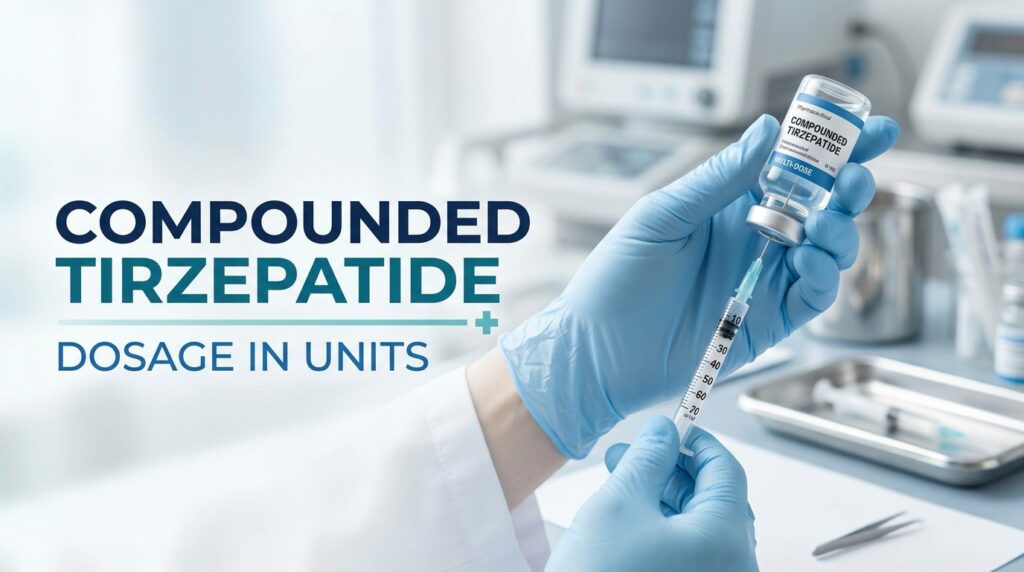
Compounded Tirzepatide Dosage in Units

Compounded Tirzepatide Dosage in Units: How to Convert mg to Units

By Compounding PharmacyNo Comments

To convert a compounded tirzepatide dose from milligrams to units, divide the dose in mg by the vial concentration in mg/mL, then multiply by 100. For example, a 2.5 mg dose from a 10 mg/mL vial is 0.25 mL, which equals 25 units on a U-100 insulin syringe. The same 2.5 mg dose from a 5 mg/mL vial is 50 units.

Because compounded vials come in different concentrations, the number of units changes from vial to vial even when the dose in mg stays the same. This guide explains the math, gives conversion tables, and covers the dosing errors providers should help patients avoid.

Why Compounded Tirzepatide Is Measured in Units

Brand tirzepatide (Mounjaro and Zepbound) comes in prefilled pens and single-dose vials with a fixed dose. Compounded tirzepatide usually comes in a multi-dose vial, and patients draw each dose with an insulin syringe.

Insulin syringes are marked in units, not milligrams. On a standard U-100 syringe:

  • 100 units = 1 mL
  • 10 units = 0.1 mL
  • 1 unit = 0.01 mL

The units on the syringe measure volume only. How much tirzepatide that volume contains depends on the concentration of the vial.

The Conversion Formula

Use these three steps:

  1. Find the concentration on the vial label, written in mg/mL.
  2. Calculate the volume: dose (mg) ÷ concentration (mg/mL) = volume (mL).
  3. Convert to units: volume (mL) × 100 = units on a U-100 syringe.

Example: The prescribed dose is 5 mg and the vial is 10 mg/mL.

5 ÷ 10 = 0.5 mL. 0.5 × 100 = 50 units.

Tirzepatide mg to Units Conversion Chart

The chart shows units on a U-100 insulin syringe for common doses and concentrations. Always use the concentration printed on the patient’s own vial.

Dose (mg) 5 mg/mL vial 10 mg/mL vial 20 mg/mL vial
2.5 mg 50 units (0.50 mL) 25 units (0.25 mL) 12.5 units (0.125 mL)
5 mg 100 units (1.00 mL) 50 units (0.50 mL) 25 units (0.25 mL)
7.5 mg 150 units (1.50 mL) 75 units (0.75 mL) 37.5 units (0.375 mL)
10 mg 200 units (2.00 mL) 100 units (1.00 mL) 50 units (0.50 mL)
12.5 mg 250 units (2.50 mL) 125 units (1.25 mL) 62.5 units (0.625 mL)
15 mg 300 units (3.00 mL) 150 units (1.50 mL) 75 units (0.75 mL)


A standard 1 mL insulin syringe holds 100 units. Doses above 100 units need either a higher concentration or more than one draw, which increases the risk of error. Pharmacies often choose a concentration that keeps each dose under 100 units.

Contact us

How Tirzepatide Is Usually Titrated

The FDA-approved labeling for brand tirzepatide for weight management (Zepbound) starts at 2.5 mg once weekly for 4 weeks. The dose then increases in 2.5 mg steps, at least 4 weeks apart. Maintenance doses are 5 mg, 10 mg, or 15 mg once weekly, and the maximum dose is 15 mg weekly.

Weeks Weekly dose Units from a 10 mg/mL vial
1 to 4 2.5 mg 25 units
5 to 8 5 mg 50 units
9 to 12 7.5 mg 75 units
13 to 16 10 mg 100 units
17 to 20 12.5 mg 125 units
21 and after 15 mg 150 units


This table shows the brand label schedule as a reference. The prescriber sets each patient’s dose and schedule, and many patients stay at a lower maintenance dose.Common Dosing Errors With Compounded GLP-1 Injections

The FDA has received reports of patients overdosing on compounded GLP-1 injections, including cases that led to hospitalization. Many errors come from confusion between units, milliliters, and milligrams. 

The most common mistakes are:

  • Reading mg as units. A patient told “5” draws 5 units instead of 50 units, or 50 units instead of 5 units.
  • Reading mL as units. A patient told “0.5” draws 50 units when 5 units was intended, or the reverse.
  • Using the old concentration. A refill arrives in a different concentration, but the patient keeps drawing the same number of units.
  • Using the wrong syringe. A U-40 or 0.3 mL syringe has different markings from a 1 mL U-100 syringe.
  • Double dosing. A patient forgets whether the weekly dose was taken.

Compounded Tirzepatide Dosage in Units

How Providers Can Prevent Dosing Errors

  1. Write the dose three ways on instructions: mg, mL, and units, for example “2.5 mg = 0.25 mL = 25 units.”
  2. Specify the syringe size and type in the prescription.
  3. Flag concentration changes whenever a refill uses a different concentration.
  4. Teach back. Ask patients to show where they will draw to on the syringe.
  5. Use a dose log so patients record the date and units of each injection.
  6. Coordinate with the pharmacy so the label, patient instructions, and prescription all match.

For patient education on injections and adherence, see How Compounding Improves Patient Adherence.

Is Compounded Tirzepatide Still Available in 2026?

The FDA removed tirzepatide from its drug shortage list on December 19, 2024. State-licensed 503A pharmacies had until February 18, 2025, and 503B outsourcing facilities until March 19, 2025, to stop compounding copies of the commercial product under the shortage policy.

Since then, federal law generally does not allow pharmacies to routinely compound drugs that are essentially copies of a commercially available product. A 503A pharmacy may compound a patient-specific version only when the prescriber determines that a change produces a clinically significant difference for that patient. Rules continue to change, so confirm current FDA guidance before prescribing. Learn more in FDA Regulation of Peptides and Compounding Pharmacies in 2026 and our 503A compounding pharmacy guide.

Contact us

FAQs

How many units is 2.5 mg of compounded tirzepatide?

It depends on the vial concentration. From a 10 mg/mL vial, 2.5 mg is 25 units. From a 5 mg/mL vial, it is 50 units. From a 20 mg/mL vial, it is 12.5 units.

How do you convert tirzepatide mg to units?

Divide the dose in mg by the concentration in mg/mL to get mL, then multiply by 100 to get units on a U-100 insulin syringe.

How many units is 5 mg of tirzepatide?

From a 10 mg/mL vial, 5 mg is 50 units. From a 20 mg/mL vial, it is 25 units.

Why did my units change when the dose stayed the same?

The refill likely came in a different concentration. The units on the syringe measure volume, so a stronger vial needs fewer units for the same mg dose.

What syringe is used for compounded tirzepatide?

Most patients use a U-100 insulin syringe, where 100 units equals 1 mL. The prescriber and pharmacy should specify the syringe size.

Is compounded tirzepatide FDA-approved?

No. Compounded drugs are not FDA-approved. Brand tirzepatide products, Mounjaro and Zepbound, are FDA-approved.

Work With a Pharmacy That Gets the Details Right

Clear labels and matching instructions prevent most dosing errors. Emerald Compounding Pharmacy works with weight management clinics on patient-specific prescriptions, clear labeling, and direct pharmacist support. Learn more about our weight loss compounding pharmacy in Tampa or call (877) 443-7711.

Become a Provider

BHRT compounding pharmacy

BHRT Compounding Pharmacy: Compounded Hormone Therapy for Medical Practices

By Compounding PharmacyNo Comments

A BHRT compounding pharmacy prepares bioidentical hormone medications, such as estradiol, estriol, progesterone, and testosterone, to the exact strength and dosage form a provider prescribes for an individual patient. Practices use one when commercially available hormone products do not fit a patient’s dose, allergies, or preferred route of administration.

Emerald Compounding Pharmacy is a Tampa, FL hormone replacement therapy pharmacy that works with menopause clinics, hormone optimization practices, primary care offices, and telehealth providers. This guide explains what compounded hormone therapy is, which hormones and dosage forms practices order most, and how to evaluate a pharmacy partner.

What Is Compounded Hormone Therapy?

Compounded hormone therapy is a hormone medication prepared by a licensed pharmacist from a patient-specific prescription. The hormones are usually “bioidentical,” meaning their molecular structure matches the hormones the body produces.

The term “bioidentical” describes the molecule, not the regulatory status. Several FDA-approved products also contain bioidentical estradiol or progesterone. What makes a medication “compounded” is that a pharmacy prepares it for one patient instead of a manufacturer producing it at scale.

For a broader look at how hormone compounding fits into patient care, read our guide to bioidentical hormone replacement therapy.

Compounded vs. FDA-Approved Hormone Products

Providers should understand both options before prescribing. Compounding does not replace FDA-approved therapy. It fills the gaps that commercial products leave.

Factor FDA-approved hormone products Compounded hormone therapy
Approval Reviewed and approved by the FDA Not FDA-approved; prepared under state pharmacy law and USP standards
Strengths Fixed, manufacturer-set doses Prescribed to the patient’s specific dose
Dosage forms Limited to what is manufactured Creams, gels, troches, capsules, and more
Inactive ingredients Fixed formula Can exclude specific allergens or excipients
Combinations Usually single hormones Some combinations, such as Bi-est, in one preparation


Compounding is most appropriate when:

  • The prescribed strength is not commercially available.
  • The patient is allergic to an inactive ingredient, such as peanut oil, dyes, or certain fillers.
  • The patient needs a dosage form that is not manufactured, such as a troche or a specific cream base.
  • A commercial product is in shortage or discontinued.

For more context, see Compounded vs. Commercial Drugs.

BHRT Compounding Pharmacy

Contact us

Hormones Practices Commonly Compound

Estradiol

Estradiol is the primary estrogen in many menopause protocols. Practices order it in transdermal creams and gels, troches, and capsules, at strengths matched to each patient’s response.

Estriol and Bi-Est

Estriol is a weaker estrogen often prescribed in combination with estradiol as Bi-est, or in topical and vaginal preparations. There is no FDA-approved estriol product in the United States, so estriol is available only through compounding.

Progesterone

Progesterone is prescribed in oral capsules, topical creams, and troches. Route matters: the evidence for endometrial protection differs between oral and topical progesterone. Our progesterone compounding pharmacy guide covers dosage forms and prescribing considerations in detail.

Testosterone

Testosterone is used in hormone therapy for men and, at much lower doses, for women. It is a Schedule III controlled substance, so prescriptions must meet federal and Florida requirements. Read our testosterone compounding pharmacy guide for the details.

DHEA

Some practices add DHEA to hormone protocols, usually in capsules or topical preparations, based on the patient’s lab work and clinical goals.

Dosage Forms for Hormone Therapy

Choosing the right dosage form affects absorption, convenience, and adherence. Emerald prepares hormone therapy as:

  • Creams: transdermal application with adjustable strength per gram.
  • Gels: quick-drying transdermal options with minimal residue.
  • Troches: dissolvable tablets for buccal absorption.
  • Capsules: precision-dosed oral hormones, with or without fillers.

Each form has trade-offs. Transdermal forms avoid first-pass liver metabolism but require consistent application. Oral capsules are simple to take but are metabolized differently. Troches offer an alternative for patients who cannot use topicals. Our pharmacists can discuss options with your clinical team. Read more about how compounding improves patient adherence.

Contact us

Safety and Quality in Hormone Compounding

Because compounded hormones are not FDA-approved, the pharmacy’s quality system is what protects your patients. In 2020, the National Academies of Sciences, Engineering, and Medicine published a report on compounded bioidentical hormone therapy that raised concerns about dose consistency and limited safety data. That report is a good reason to choose your pharmacy carefully.

When you evaluate a hormone replacement therapy pharmacy, ask:

  1. Is the pharmacy licensed in your state, and does it follow USP <795> for non-sterile preparations?
  2. Who verifies each formulation before it is dispensed?
  3. How does the pharmacy source its active ingredients, and does it keep certificates of analysis?
  4. How does it test potency and consistency across batches?
  5. Can your staff speak directly with a pharmacist?

Emerald is Florida DOH licensed (#PH35337), DEA registered for Schedules II through V (#FE4155974), LegitScript certified, and HIPAA compliant. Read How Compounding Pharmacies Maintain Quality Control and Are Compounded Medications Safe? for more.

How to Choose a BHRT Compounding Pharmacy

Beyond licensing and quality, the right partner fits your practice’s workflow. Look for:

  • A provider portal for electronic prescription submission and order tracking.
  • Fast fulfillment, so patients do not run out between refills.
  • Direct pharmacist access for formulation questions.
  • Experience with hormone protocols, including dose adjustments and combination formulas.
  • Clear policies on controlled substances such as testosterone.

Our step-by-step guide, How to Source Bioidentical Hormones for Your Practice, walks through the evaluation process. You can also read How to Choose a Compounding Pharmacy.

Practices We Support

Emerald prepares compounded hormone therapy for:

  • Menopause and women’s health clinics
  • Hormone optimization and men’s health practices
  • Primary care and internal medicine offices
  • Functional and integrative medicine practices
  • Telehealth hormone programs

BHRT Compounding Pharmacy

How to Order Compounded Hormones From Emerald

  1. Complete the provider form with your practice details.
  2. Share credentials, including DEA registration if you prescribe testosterone.
  3. Get verified and receive access to the provider portal.
  4. Submit prescriptions with the hormone, strength, dosage form, base, quantity, and directions.

Prescriptions received before 2:00 PM EST are processed and shipped the same day, and there is no minimum order volume.

Hormone Compounding for Tampa Practices

Emerald is located at 5325 Primrose Lake Circle, Suite A, Tampa, FL 33647. Tampa Bay practices get a local compounding pharmacy in Tampa that works under the same Florida rules they do, with pharmacists who are easy to reach.

Contact us

FAQs

What is a BHRT compounding pharmacy?

It is a pharmacy that prepares bioidentical hormone medications, such as estradiol, progesterone, and testosterone, to a provider’s patient-specific prescription.

Are compounded bioidentical hormones FDA-approved?

No. Compounded hormones are prepared under state pharmacy law and USP standards, not FDA approval. FDA-approved bioidentical products also exist, and compounding is used when those products do not meet a patient’s needs.

What dosage forms are available for compounded hormone therapy?

Common forms include creams, gels, troches, and capsules. The right form depends on the hormone, the dose, and the patient.

Can a hormone replacement therapy pharmacy compound testosterone?

Yes, if the pharmacy is DEA registered for Schedule III substances. Emerald is DEA registered for Schedules II through V.

Do patients need a prescription for compounded hormones?

Yes. Every compounded hormone requires a prescription from a licensed provider for a specific patient.

How do I start ordering BHRT from Emerald?

Complete the provider form, share your credentials, get verified, and submit prescriptions through the provider portal.

Partner With a Hormone Replacement Therapy Pharmacy You Can Reach

Hormone therapy depends on precise dosing and consistent refills. Emerald gives your practice both, with a pharmacist on the other end of the phone. Open a provider account or call (877) 443-7711.

Become a Provider

Are Compounded Medications Safe

Are Compounded Medications Safe? What Providers and Patients Need to Know

By Compounding PharmacyNo Comments

The safety of compounded medications is one of the most searched and most misunderstood questions in pharmacy today. The honest answer is that it depends entirely on where the medication comes from, who prepared it, and whether the pharmacy that made it operates under the quality and compliance standards that separate legitimate compounding from dangerous manufacturing.

Compounded medications can have significant safety issues  particularly when regulatory oversight is inadequate, contamination occurs, or inaccurate potency results from poor manufacturing controls. But that characterization describes the risk profile of unregulated compounding, not the risk profile of a licensed, sterile-qualified compounding pharmacy operating under USP standards, state pharmacy licensure, and LegitScript certification.

For providers prescribing compounded medications in Tampa and Florida, and for patients receiving them, the safety question is not binary. The right question is: what standards does the pharmacy preparing this medication operate under, and how do you verify them?

This article answers both questions  with the current data, the regulatory framework, and a practical verification guide for Florida providers and patients.

Understanding what a compounding pharmacy is and how it operates is the starting point. Safety standards build on that operational foundation.

Are Compounded Medications Safe

What the Research Says About Compounded Medication Safety

A 2025 peer-reviewed study published in Cureus (NCBI) by researchers at CHI Health Mercy Hospital concluded that compounded medications can have significant safety issues  including contamination and inaccurate potency  and that compounded medications should be prescribed only when FDA-approved medications cannot be used and the benefits outweigh the risks.

This is the honest scientific starting point. The risks identified in the literature are real. They include:

Potency and Dose Inaccuracy 

Without the standardized manufacturing processes and end-product testing required for FDA-approved medications, compounded preparations can deviate from their intended concentration. Underdosing reduces clinical efficacy. Overdosing creates toxicity risk. Both outcomes have been documented in published adverse event reports.

Contamination Risk  Particularly in Sterile Products 

Compounded sterile injectables  including peptide compounds, hormone injectables, and aesthetic preparations  carry contamination risk when prepared outside a properly controlled sterile environment. The 2012 fungal meningitis outbreak linked to contaminated compounded steroids from the New England Compounding Center killed more than 100 patients and triggered the passage of the Drug Quality and Security Act (DQSA), which created the modern federal compounding regulatory framework.

Beyond-Use Dating Uncertainty 

Commercial medications undergo stability testing to establish shelf life. Compounded medications rely on established USP beyond-use dating guidelines or stability data from the literature, which may not reflect the specific formulation prepared.

Gray-Market Supply Chain Risk 

A 2026 study found that 4 of 23 pharmacies audited were not licensed for sterile compounding despite dispensing sterile injectables. The GLP-1 market has generated a particularly active gray-market supply chain: by early 2025, the FDA had received more than 455 adverse event reports linked to compounded semaglutide and more than 320 linked to compounded tirzepatide, many tracing back to dosing errors from multidose vials.

These risks are real. They are also largely preventable  when the compounding is performed by a properly licensed, quality-controlled, compliant pharmacy.

Contact us

When Compounded Medications Are Safe: The Standards That Matter

The absence of FDA approval does not make a compounded medication inherently unsafe  particularly when the active ingredient has a well-established safety profile. It simply means the responsibility for quality assurance falls on the compounding pharmacy, the prescribing clinician, and state regulatory oversight.

The safety of a compounded medication is a function of four factors:

Factor 1: Pharmaceutical-Grade Active Pharmaceutical Ingredients (APIs)

The starting material matters. A legitimate compounding pharmacy sources APIs exclusively from FDA-registered suppliers  manufacturers whose facilities and materials meet federal standards for pharmaceutical-grade quality. Using non-pharmaceutical-grade chemicals  which some gray-market operators do to reduce costs  introduces impurity, potency, and contamination risks that pharmaceutical-grade sourcing eliminates.

Providers should ask: where does this pharmacy source its APIs, and can they provide documentation of supplier registration with the FDA?

Factor 2: USP Compliance  The Quality Standard That Defines Safe Compounding

The United States Pharmacopeia (USP) publishes the quality standards that define safe compounding practice:

USP Chapter 795  Non-Sterile Compounding Governs the preparation of topical creams, oral capsules, sublingual troches, liquids, and suppositories. Covers facility requirements, ingredient quality, documentation, beyond-use dating, and quality controls for preparations where sterility is not required.

USP Chapter 797  Sterile Compounding Governs the preparation of all injectable medications, ophthalmic preparations, and other sterile dosage forms. USP 797 compliance requires certified ISO-classified cleanroom infrastructure, environmental monitoring (air particle counts, microbial testing), personnel gowning and training, sterility testing of finished preparations, and strict beyond-use dating based on sterility testing outcomes.

USP Chapter 800  Hazardous Drug Handling Applies to compounding involving drugs classified as hazardous (including certain chemotherapy agents and some hormones). Requires additional containment infrastructure to protect compounding personnel and prevent cross-contamination.

A compounding pharmacy that prepares sterile injectables without a USP 797-compliant facility is not operating safely  regardless of what its website claims. Verifying USP 797 compliance means verifying active state sterile compounding licensure, which requires facility inspection by the state board of pharmacy.

Understanding the full distinction between a sterile compounding pharmacy and non-sterile compounding standards is essential for providers whose protocols include any injectable compounds.

Factor 3: Active State Pharmacy Licensure and Inspection

State boards of pharmacy license and inspect compounding pharmacies. An active state pharmacy license  particularly a sterile compounding-specific license means the pharmacy’s facility has been physically inspected by state regulators and found to meet the applicable standards.

In Florida, the Florida Department of Health issues separate licensure for compounding pharmacies with Special Sterile Compounding qualification. This license requires the pharmacy to demonstrate USP 797-compliant facility infrastructure, not just claim compliance.

Factor 4: Quality Testing and Batch Documentation

A legitimate compounding pharmacy conducts end-product quality testing  including potency testing and sterility testing for injectables  and provides Certificates of Analysis (CoA) documenting test results. Providers should be able to obtain a CoA for any compounded preparation dispensed to their patients.

Pharmacies that cannot or will not provide CoA documentation for compounded preparations are not operating at the quality standard that patient safety requires.

Are Compounded Medications Safe

Understanding the Safety Difference Between Compounded vs Commercial Drugs

Commercial FDA-approved drugs undergo premarket approval that includes clinical trials for safety and efficacy, CGMP manufacturing audits, and post-market pharmacovigilance. The FDA reviews every batch of an approved drug before it reaches market.

Compounded medications bypass premarket approval  which is why the prescription requirement for compounded medications and pharmacy licensure become the primary safety checkpoints in their place. The prescription ensures a licensed clinician has made an individualized clinical determination. The pharmacy licensure and USP compliance ensure the preparation meets pharmaceutical quality standards.

The safety gap between compounded and commercial medications is narrowest when:

  • The compounding pharmacy holds active state sterile licensure (for injectables)
  • APIs are sourced from FDA-registered suppliers
  • USP 795/797 compliance is verified through state inspection
  • End-product testing is conducted and documented
  • A valid prescription from a licensed provider is required

The safety gap is widest when any of these factors are absent.

Contact us

The Most Common Compounded Medication Safety Risks  By Category

Understanding how safety considerations vary across the most common compounded medications helps providers make category-specific risk assessments.

Sterile Injectable Compounds (Peptides, Hormone Injectables, Aesthetic Preparations) 

Highest safety verification requirement. USP 797 sterile compounding licensure is mandatory. Sterility testing is essential. Environmental monitoring records should be available. Providers should only source sterile injectables from pharmacies with active, verifiable sterile compounding licensure.

Hormone Replacement Therapy  Topical and Sublingual 

Lower sterility requirement than injectables, but potency accuracy is critical. Estradiol, progesterone, and testosterone at incorrect concentrations create real endocrine risks. Providers should verify pharmaceutical-grade API sourcing and potency testing.

GLP-1 Weight Management Compounds 

Currently the highest-risk category for quality variability due to market demand and regulatory pressure. The FDA sent 25 warning letters in June 2026 to telehealth companies making misleading claims about compounded GLP-1 products  the third enforcement wave in approximately twelve months.Semaglutide came off the FDA shortage list in February 2025 and tirzepatide in December 2024. Providers sourcing any GLP-1 compound in 2026 must work exclusively with pharmacies that demonstrate current 503A compliance and can document the patient-specific clinical justification for compounding.

Dermatology and Aesthetic Topicals 

Generally lower risk category for contamination, but potency accuracy matters clinically. Custom tretinoin concentrations, brightening compounds, and post-procedure preparations should come from pharmacies sourcing pharmaceutical-grade active ingredients with appropriate beyond-use dating.


Red Flags: How to Identify an Unsafe Compounding Pharmacy

For Tampa and Florida providers evaluating pharmacy partners, these are the warning signs that indicate a compounding operation that does not meet safety standards:

No Verifiable State Pharmacy License 

If the pharmacy’s license cannot be confirmed through the Florida DOH MQA portal or the relevant state board of pharmacy database, do not source from that pharmacy. A legitimate pharmacy welcomes license verification.

Sterile Injectables Without Sterile Compounding Licensure 

The 2026 study finding 4 of 23 pharmacies unlicensed for sterile compounding despite producing injectables identifies a real pattern. Verify sterile licensure specifically  standard pharmacy licensure does not authorize sterile compounding.

No Prescription Required 

Any pharmacy dispensing compounded prescription-strength medications without a valid patient-specific prescription is violating the prescription requirement for compounded medications and operating outside the legal framework that authorizes compounding. This is a categorical disqualifier.

“For Research Use Only” or “Not for Human Use” Labeling 

These labels do not exempt a product from prescription requirements or safety standards when the product is intended and marketed for human use. They are red flags for gray-market operation.

No Certificate of Analysis Available 

If a pharmacy cannot produce a CoA documenting potency testing and sterility testing (for injectables) for preparations it dispenses, it is not operating at the quality standard that compounding safety requires.

FDA Warning Letters on Record 

The FDA maintains a public database of warning letters issued to compounding pharmacies. Before partnering with any pharmacy, search the FDA’s warning letter database for the pharmacy’s name and address.

LegitScript Not Certified 

LegitScript certification requires a pharmacy to pass independent verification of its legal compliance, licensing status, and operational standards. Its absence does not automatically indicate an unsafe pharmacy  but its presence is a meaningful positive signal in a market where pharmacy legitimacy varies widely.

Contact us

How Tampa and Florida Providers Verify Compounding Pharmacy Safety

For providers building physician partnerships with compounding pharmacies in Tampa and across Florida, here is the complete verification checklist:

Step 1  Florida DOH MQA License Verification 

Visit mqa-internet.doh.state.fl.us. Search for the pharmacy by name and confirm active Florida pharmacy licensure, including Special Sterile Compounding qualification for any pharmacy providing injectables.

Step 2  DEA Registration Verification 

Use the DEA’s Diversion Control Division online verification to confirm active DEA registration covering the schedules relevant to your protocols.

Step 3  LegitScript Certification Check 

Visit legitscript.com and search the pharmacy by name or website. Confirm certification status is current.

Step 4  FDA Warning Letter Search 

Search the FDA’s warning letter database at fda.gov for the pharmacy name and operating address. Any recent warning letters  particularly for sterile compounding violations, misbranding, or GLP-1-related enforcement  are disqualifying.

Step 5  Request Quality Documentation 

Before initiating a partnership, request: proof of USP 795/797 compliance documentation, a sample Certificate of Analysis, and the pharmacy’s API sourcing policy. A legitimate pharmacy provides this without hesitation.

Step 6  Pharmacist Consultation Accessibility 

A pharmacy that routes clinical questions through support representatives rather than direct pharmacist access is not structured to support safe prescribing partnerships. Confirm that licensed pharmacists are directly accessible for clinical consultations.


Why Emerald Compounding Pharmacy Meets the Safety Standard for Tampa and Florida Providers

Emerald Compounding Pharmacy is Tampa-based, Florida DOH-licensed, LegitScript-certified, and sterile-qualified  meeting every verification criterion that the safety framework above requires.

Certifications & Compliance

Compounding Pharmacy License  FL DOH #PH35337 | Special Sterile Compounding Qualified Active Florida DOH licensure with Special Sterile Compounding qualifications, issued following facility inspection by the Florida Board of Pharmacy. This license confirms USP Chapter 797-compliant sterile infrastructure  the foundational safety requirement for all injectable compounds including peptides, hormone injectables, and sterile aesthetic preparations. Verifiable at mqa-internet.doh.state.fl.us.

Community Pharmacy License  FL DOH #PH35074 Active Florida DOH community pharmacy licensure with Schedule II and III controlled substance dispensing authorization  covering all controlled-substance compounding with full regulatory compliance.

DEA Controlled Substance Registration #FE4155974  Schedules II through V Federal DEA registration authorizing Emerald to handle, prepare, and dispense controlled-substance compounds across Schedule II through V  with full prescription verification for every controlled substance order.

LegitScript Certified Independent third-party verification of Emerald’s legal compliance, licensing status, and operational transparency. LegitScript certification is not self-reported  it requires active independent verification and ongoing compliance monitoring. For Tampa and Florida providers, it is one of the clearest third-party safety signals available. Verifiable at legitscript.com.

HIPAA Compliant All patient Protected Health Information is handled in full HIPAA compliance through Emerald’s secure, encrypted provider portal.

Pharmacy Technician Training Program  FL DOH #RTTP1477 Florida DOH authorization to operate an official pharmacy technician training program reflecting the institutional expertise that underlies Emerald’s compounding quality standards.

Biomedical Waste Operating Permit  #29-64-2899253 Active Florida DOH biomedical waste management authorization  evidence of compliant, inspected operations across every aspect of the pharmacy workflow.

Prescription-Only Dispensing Emerald dispenses every compounded medication pursuant to a valid, patient-specific prescription from a licensed provider. No exceptions. This is the most fundamental safety standard in compounding pharmacy practice.

For the complete certification documentation, visit our certifications page.

Are Compounded Medications Safe

Contact us

Frequently Asked Questions About Compounded Medication Safety

Are compounded medications safe?

The safety of compounded medications depends on the pharmacy that prepares them. Compounded medications from a licensed, sterile-qualified compounding pharmacy operating under USP 795/797 standards, with pharmaceutical-grade API sourcing, end-product quality testing, and active state pharmacy licensure represent a different risk profile from preparations sourced through gray-market operators without sterile licensure, prescription requirements, or quality documentation. The question providers and patients should ask is not whether compounded medications are safe in the abstract  but whether the specific pharmacy preparing their medications meets the quality and compliance standards that safe compounding requires.

Are compounded medications FDA approved?

No. Compounded medications are not FDA-approved as finished drug products. FDA approval processes are designed for drugs manufactured at scale and distributed widely, not individualized formulations prepared for a single patient at a time. However, the absence of FDA approval does not make a compounded medication inherently unsafe when the pharmacy operates under applicable USP quality standards, active state pharmacy licensure, and FDA-registered API sourcing. The safety responsibility lies with the compounding pharmacy, the prescribing clinician, and state regulatory oversight.

What are the risks of compounded medications?

The primary safety risks identified in peer-reviewed literature include potency inaccuracy, contamination (particularly in sterile injectables), and inconsistent beyond-use dating. These risks are highest in pharmacies operating without proper sterile compounding licensure, without pharmaceutical-grade API sourcing, and without end-product quality testing. They are substantially reduced in pharmacies with active USP 797 compliance, state sterile compounding licensure, and documented quality assurance processes.

How do I know if a compounding pharmacy is safe?

Verify the following directly through regulatory databases: active state pharmacy licensure (including sterile compounding qualification for injectable medications), DEA registration for the relevant controlled substance schedules, LegitScript certification, and absence of FDA warning letters. Request Certificates of Analysis and pharmaceutical API sourcing documentation before initiating a pharmacy partnership. A safe compounding pharmacy welcomes this verification process.

Is compounded semaglutide safe in 2026?

The safety of any compounded semaglutide preparation depends entirely on the pharmacy that produced it. A 2026 study found that 4 of 23 pharmacies audited were not licensed for sterile compounding despite dispensing sterile injectables, and the FDA received more than 455 adverse event reports linked to compounded semaglutide by early 2025. Compounded semaglutide from a properly licensed sterile compounding pharmacy  with pharmaceutical-grade API sourcing, USP 797 compliance, sterility testing, and a valid patient prescription  carries a substantially different safety profile from preparations sourced through gray-market operators. Providers should also verify current FDA compliance requirements, as the regulatory landscape for compounded GLP-1 medications has changed significantly in 2025-2026.

What is USP 797 and why does it matter for safety?

USP Chapter 797 is the United States Pharmacopeia standard governing sterile compounding. It requires certified ISO-classified cleanroom infrastructure, environmental monitoring, personnel training and testing, sterility testing of finished preparations, and strict beyond-use dating protocols. USP 797 compliance is the quality standard that separates a safe sterile compounding pharmacy from an operation that produces injectables without appropriate contamination controls. All injectable compounded medications  including peptides, hormone injectables, and aesthetic preparations  must be prepared in a USP 797-compliant facility.

Can I get compounded medications without a prescription safely?

No and not legally. Any pharmacy providing prescription-strength compounded medications without requiring a valid patient-specific prescription from a licensed provider is not a licensed 503A compounding pharmacy operating within the law. The prescription requirement is inseparable from the legal and safety framework for compounding. Gray-market compounded products sold without prescriptions carry the highest safety risks: no licensed prescriber has reviewed the patient’s clinical situation, no pharmacist has verified the formulation against the patient’s medication profile, and no regulatory framework requires the pharmacy to meet any safety standard.

How does LegitScript certification relate to compounding pharmacy safety?

LegitScript certification is an independently verified credential  not self-reported  that confirms a pharmacy’s active legal licensure, operational compliance with applicable pharmacy laws, and advertising transparency. It requires ongoing compliance monitoring and can be revoked for violations. For patients and providers evaluating compounding pharmacy safety, LegitScript certification provides a third-party verification signal that the pharmacy has passed an independent legitimacy review. It is recognized by Google and Bing as a pharmacy trust signal and is verifiable at legitscript.com.

How do Tampa providers verify a compounding pharmacy’s safety?

Tampa providers should verify: active Florida DOH pharmacy licensure including Special Sterile Compounding qualification (at mqa-internet.doh.state.fl.us), DEA registration through the DEA Diversion Control portal, LegitScript certification at legitscript.com, and absence of FDA warning letters through the FDA’s public database. Request Certificates of Analysis and API sourcing documentation before beginning a pharmacy partnership. Register as a provider with Emerald to begin the credentialing process with a pharmacy that meets all of these standards.


Partner with a Safe, Verified Compounding Pharmacy in Tampa

Emerald Compounding Pharmacy meets the complete safety verification standard that Tampa and Florida providers should require: Florida DOH-licensed, Special Sterile Compounding Qualified, DEA-registered, LegitScript-certified, prescription-only, and HIPAA-compliant.

  • ✔ Florida DOH Licensed  Active Tampa pharmacy, not nonresident
  • ✔ Special Sterile Compounding Qualified (#PH35337)  USP 797 compliant
  • ✔ DEA Registered  Schedules II through V (#FE4155974)
  • ✔ LegitScript Certified  Independently verified
  • ✔ Prescription-only  Every compound, no exceptions
  • ✔ HIPAA Compliant  Secure provider portal
  • ✔ Same-day shipping  Received by 2:00 PM EST
  • ✔ No minimum order volume
  • ✔ Direct pharmacist consultation

Register as a Provider with Emerald → Call: (877) 443-7711 | Tampa, FL 33647

Do Compounded Medications Require a Prescription?

Do Compounded Medications Require a Prescription? The Complete Legal 2026

By Compounding PharmacyNo Comments

For any provider prescribing compounded medications in Florida or across the United States, and for any patient who has been prescribed a compounded preparation, the prescription requirement is not a procedural formality. Without a valid prescription that meets specific legal requirements, a compounded drug loses its exemption from FDA premarket approval, Current Good Manufacturing Practice requirements, and federal labeling rules. The prescription is what keeps the entire practice of compounding legal.

This article explains the complete prescription requirement for compounded medications  the legal basis, what a valid compounding prescription must contain, how the rules differ between 503A and 503B facilities, what Florida-specific requirements apply, and what providers and patients need to understand about gray-market compounded products that circumvent prescription requirements entirely.

Understanding what a compounding pharmacy does is the starting point. The prescription requirement is the legal foundation that makes everything a compounding pharmacy does lawful.

Do Compounded Medications Require a Prescription?

Yes  for every 503A compounding pharmacy, a valid prescription from a licensed healthcare provider is required for every compounded medication dispensed, without exception.

Every field on that prescription triggers specific federal exemptions under Section 503A of the Federal Food, Drug, and Cosmetic Act (FD&C Act).Remove the valid prescription from the equation and the compounded drug is legally classified as an unapproved new drug  subject to FDA enforcement action against the pharmacy and potentially the prescriber.

Several competing sources online describe this requirement as “most of the time” or “typically.” GoodRx states that compounded medications require a prescription “most of the time,” noting that some compounds made with OTC ingredients may not require one. This nuance applies to a narrow category of OTC-ingredient compounds in specific state contexts  it does not apply to the medications that Tampa and Florida clinical providers and their patients are prescribing and receiving. For every compounded prescription-strength medication  hormones, peptides, sterile injectables, controlled substances, custom topicals  a valid prescription is legally required.

The nuance worth understanding: a 503B outsourcing facility operates under different rules. Each compounded medication at a 503A pharmacy must correspond to an individual patient prescription; compounding regulated under Section 503B is done at “outsourcing facilities” that are not necessarily licensed pharmacies and can produce larger batches without patient-specific prescriptions  but only for distribution to licensed healthcare facilities, not for dispensing to individual patients. For the overwhelming majority of provider-patient compounding relationships, the applicable framework is 503A  and the prescription requirement is absolute.

Do Compounded Medications Require a Prescription?

Contact us

The Legal Basis: Why Prescription Is Required for Compounded Medications

Section 503A of the Federal Food, Drug, and Cosmetic Act

The legal foundation for traditional compounding pharmacy practice in the United States is Section 503A of the FD&C Act. This section grants 503A-licensed pharmacies an exemption from three otherwise mandatory federal requirements:

  • FDA premarket approval of the drug as a finished product
  • Current Good Manufacturing Practice (CGMP) compliance
  • Federal labeling requirements that apply to commercially manufactured drugs

These exemptions only apply when the compounding pharmacy meets all Section 503A conditions  the most fundamental of which is that the compounding occurs pursuant to a valid prescription for an identified individual patient.

Without a patient-specific prescription from a licensed practitioner, none of the 503A exemptions apply. The pharmacy is compounding an unapproved new drug without legal authority to do so. This is not a technicality  it is the legal distinction between a licensed compounding pharmacy and an unregulated manufacturer.

What Makes a Prescription “Valid” for Compounding Purposes?

A valid prescription for a compounded medication under Section 503A must include:

  • Patient identification  full name and, for controlled substances, address
  • Prescriber identification  name, address, DEA number (for controlled substances), and valid prescriber license
  • Specific compounded formulation active ingredient(s), strength, dosage form, and quantity
  • Directions for use  instructions for the patient
  • Date of issue  within applicable prescription validity periods
  • Prescriber signature handwritten or electronic, consistent with state e-prescribing laws

A prescription that omits the patient-specific formulation specification  for example, a standing order for “any compounded hormone preparation”  does not meet 503A requirements. Each prescription must specify the compound being prepared for the named patient.

Understanding Compounded vs Commercial Medications

Commercial medications go through FDA premarket approval and can be dispensed to any patient who presents a prescription for the approved product. Compounded medications bypass FDA premarket approval specifically because they are prepared for a named individual patient on a prescription  which is why the prescription requirement is structurally inseparable from the legal authority to compound.

This also explains why compounded vs commercial medications differ fundamentally in their dispensing model: a commercial drug can be stocked and dispensed in volume; a 503A compounded preparation is always patient-specific, always prescription-driven, and always prepared after the prescription is received.


Who Can Prescribe Compounded Medications?

Compounded medications can be prescribed by any healthcare provider with active prescribing authority under their state license and within their scope of practice. In Florida, this includes:

Physicians (MDs and DOs)  Full prescribing authority across all therapeutic categories within their specialty and licensure.

Nurse Practitioners (NPs) In Florida, NPs with appropriate certification and, where required, supervising physician agreements can prescribe compounded medications within their scope.

Physician Assistants (PAs)  Florida PAs can prescribe compounded medications within their scope of practice and supervising physician agreement.

Dentists  Can prescribe compounded oral and topical preparations within their dental practice scope.

Podiatrists  Can prescribe compounded preparations relevant to podiatric practice.

Veterinarians  Can prescribe compounded preparations for animal patients. Veterinary compounding operates under the same prescription requirement.

What providers cannot do: Prescribe a compounded medication outside their scope of practice or for a patient they have not clinically evaluated. Telehealth prescribing of compounded medications is permissible in Florida under Florida’s telehealth prescribing parity framework  but the clinical evaluation requirement still applies. A prescription cannot be issued without a legitimate patient-provider clinical relationship.

A Physician Partnership with a Compounding Pharmacy Formalizes the Prescribing Process

For practices that prescribe compounded medications regularly weight management programs, hormone therapy clinics, aesthetic practices  establishing a formal provider partnership with a licensed compounding pharmacy creates the operational infrastructure that makes valid prescription management efficient and compliant. Provider credentialing, HIPAA-compliant portal access, and pharmacist consultation are all part of the partnership structure that supports ongoing valid prescribing.

Do Compounded Medications Require a Prescription?

Contact us

Prescription Requirements by Compound Category

Not all compounded medications carry the same regulatory complexity. Here is how the prescription requirement applies across the most common compounded medications categories:

Hormone Replacement Therapy Compounds

Prescription required  always. Compounded estradiol, progesterone, testosterone, DHEA at prescription concentrations, and thyroid compounds are all prescription-only. No compounded BHRT preparation can be dispensed without a valid patient-specific prescription from a licensed provider. This applies to topical creams, sublingual troches, vaginal preparations, and injectable formulations alike.

Sterile Injectable Compounds

Prescription required  always, with additional sterile pharmacy licensure requirements. All compounded injectable medications  including peptide compounds, hormone injectables, and sterile aesthetic preparations  require a valid patient-specific prescription AND must be prepared by a pharmacy holding active sterile compounding licensure under USP Chapter 797. A prescription alone does not authorize a non-sterile pharmacy to prepare an injectable compound. See our sterile compounding pharmacy page for the full licensure requirements.

Weight Management and GLP-1 Compounds

Prescription required  always. Additional FDA compliance considerations apply in 2026.

In February 2026, the FDA announced that it would take action against companies and compounding pharmacies marketing unapproved versions of GLP-1 medications to consumers meaning any entity marketing compounded GLP-1 medications without a prescription framework is operating outside the law. Since fall 2025, the FDA has sent thousands of warning letters about misleading ads and inaccurate marketing claims to companies selling compounded GLP-1s.

For compounded weight loss medications including semaglutide and tirzepatide, the prescription requirement is absolute and the pharmacy must be operating under a 503A patient-specific framework with current FDA shortage list compliance. There is no legal pathway to obtain compounded GLP-1 medications without a valid prescription from a licensed provider.

Dermatology and Aesthetic Compounds

Prescription required always. Custom tretinoin concentrations, compounded hydroquinone, BLT topical anesthetic, and all other prescription-ingredient compounds require a valid provider prescription. Some OTC-ingredient cosmeceutical formulations may not require a prescription in specific contexts but any compound containing a prescription-strength active ingredient does.

Pain Management and Controlled Substance Compounds

Prescription required always, with DEA requirements. Compounded controlled substance preparations  Schedule II through V require a valid prescription that includes the prescriber’s DEA registration number. The dispensing pharmacy must also hold DEA registration covering the relevant schedules. There is no controlled substance compounding pathway without a valid DEA-compliant prescription.


What About Compounded Medications Without a Prescription? The Gray Market Risk

The market for compounded peptides, hormone preparations, and GLP-1 compounds has generated a significant gray-market supply chain  websites and distributors offering compounded medications labeled “for research use only” or “not for human use” without requiring a prescription. Since demand remained strong for lower-priced GLP-1 medications, compounding pharmacies and outsourcing facilities began to work around restrictions, and the FDA has since taken enforcement action.

For providers and patients: any compounded medication obtained without a valid prescription from a licensed provider is not a legally compounded medication under Section 503A. It is an unapproved drug product. The “for research use only” label is not a legal exemption from the prescription requirement  it is a disclaimer that the seller uses to market compounds that cannot legally be sold for human use without a prescription.

The risks are clinical and legal. Compounds obtained outside a prescription framework have no requirement for sterility testing, no Certificate of Analysis from a regulated pharmacy, no pharmacist review of patient-specific dosing, and no prescriber liability structure that protects the patient. For providers, recommending or facilitating access to non-prescription compounded medications creates prescriber liability.

LegitScript-certified compounding pharmacies  including Emerald Compounding Pharmacy  operate on a prescription-only basis for every compound dispensed. This is not a policy choice. It is a legal requirement and a patient safety standard.

Contact us

Florida-Specific Prescription Requirements for Compounded Medications

Florida’s compounding pharmacy regulatory framework includes state-specific provisions that providers and patients in Tampa and across Florida should understand:

Florida Telehealth Prescribing Parity Florida has adopted telehealth prescribing parity, meaning providers can prescribe compounded medications through telehealth consultations with valid patient-provider clinical relationships. The prescription requirements are identical to in-person prescriptions the clinical evaluation requirement does not change based on the delivery modality.

Controlled Substance Prescribing Florida Requirements Florida’s controlled substance prescribing laws include requirements for the E-FORCSE (Electronic Florida Online Reporting of Controlled Substance Evaluation) system. Prescribers issuing controlled substance compounding prescriptions must comply with Florida’s prescription monitoring requirements.

Florida Board of Pharmacy Prescription Verification Authority The Florida Board of Pharmacy oversees prescription verification and compliance for pharmacies licensed in Florida. A pharmacy operating under Florida DOH license is subject to Florida Board of Pharmacy inspection and can face enforcement action for dispensing without valid prescriptions.

Florida SB 860 2026 Regulatory Update Florida SB 860 represents the most significant state-level tightening of compounding pharmacy regulations in recent years, with implications for prescriber obligations in pharmacy partnerships. Providers partnering with Florida-licensed compounding pharmacies should confirm their pharmacy partner has reviewed and implemented SB 860 compliance measures.

Do Compounded Medications Require a Prescription?

Why Emerald Compounding Pharmacy Operates on a Prescription-Only Basis

Emerald Compounding Pharmacy is a Tampa-based, Florida DOH-licensed compounding pharmacy that dispenses every compounded medication pursuant to a valid, patient-specific prescription from a licensed provider. This is not a policy preference it is the legal framework under which Emerald operates.

Certifications & Compliance

Compounding Pharmacy License FL DOH #PH35337 | Special Sterile Compounding Qualified Active Florida DOH compounding pharmacy licensure with Special Sterile Compounding qualifications and Schedule II and III authorization. Every sterile injectable compound peptides, hormone injectables, aesthetic preparations is dispensed under this license pursuant to a valid patient-specific prescription.

Community Pharmacy License FL DOH #PH35074 

Active Florida DOH community pharmacy licensure with Schedule II and III controlled substance dispensing authorization. All controlled-substance compounding prescriptions are processed under this license with full DEA compliance.

DEA Controlled Substance Registration #FE4155974 Schedules II through V 

Federal DEA registration authorizing Emerald to receive, prepare, and dispense controlled-substance compounding prescriptions across Schedule II through V with full prescription verification for every controlled substance order.

LegitScript Certified 

LegitScript certification requires ongoing compliance with prescription-only dispensing standards. LegitScript’s verification process confirms that Emerald does not dispense compounded medications without valid prescriptions a core component of LegitScript’s pharmacy legitimacy standards. Verifiable at legitscript.com.

HIPAA Compliant 

All patient-specific prescription information is handled in full HIPAA compliance through Emerald’s secure provider portal.

Pharmacy Technician Training Program FL DOH #RTTP1477 

Florida DOH authorization for pharmacy technician training reflecting the institutional expertise that underlies Emerald’s prescription verification and compounding quality standards.

For the complete certification documentation, visit our certifications page.

Contact us

FAQs About Compounded Medication Prescriptions

Do compounded medications always require a prescription?

Yes for all 503A compounding pharmacies, every compounded medication containing prescription-strength active ingredients requires a valid patient-specific prescription from a licensed healthcare provider. There is no legal exception to this requirement for 503A pharmacies dispensing to individual patients. Any compounded pharmacy offering prescription-strength compounds without requiring a prescription is operating outside the legal framework that authorizes compounding.

Who can prescribe compounded medications in Florida?

In Florida, compounded medications can be prescribed by physicians (MD, DO), nurse practitioners with appropriate certification and scope, physician assistants within their supervising physician agreements, dentists within their dental scope, podiatrists within their podiatric scope, and veterinarians for animal patients. Prescribing authority is limited to the provider’s active scope of practice and state licensure.

Can you get compounded medications without a prescription?

Not legally not for prescription-strength compounded medications from a licensed 503A compounding pharmacy. Products marketed as compounded medications “for research use only” or without a prescription requirement are not lawfully compounded medications under Section 503A. They are unapproved drug products. Obtaining these products carries clinical risk (no sterility testing, no pharmacist oversight) and legal risk for providers who facilitate access to them.

What must a valid compounding prescription include?

A valid 503A compounding prescription must include the patient’s full name, the prescriber’s name and contact information, the prescriber’s DEA number for controlled substances, the specific compounded formulation (active ingredients, strength, dosage form, quantity), directions for use, the date of issue, and the prescriber’s signature. Prescriptions that omit patient-specific formulation details or patient identification do not meet 503A legal requirements.

Can telehealth providers prescribe compounded medications in Florida?

Yes. Florida has adopted telehealth prescribing parity, allowing providers to prescribe compounded medications through telehealth consultations with valid patient-provider clinical relationships. The prescription requirements are identical to in-person prescriptions. The clinical evaluation and relationship requirements remain in force a telehealth consultation does not eliminate the need for a legitimate patient-provider relationship before issuing a compounding prescription.

What is the difference between 503A and 503B prescription requirements?

A 503A compounding pharmacy requires a patient-specific prescription for every compound dispensed. A 503B outsourcing facility is FDA-registered and may prepare larger batches of compounded medications without patient-specific prescriptions but only for distribution to licensed healthcare facilities for use within those facilities, not for dispensing to individual patients at home. Most provider-patient compounding partnerships operate under 503A rules.

What happens if a compounding pharmacy dispenses without a prescription?

A pharmacy dispensing prescription-strength compounded medications without a valid prescription loses its Section 503A exemption, and the compounded drug is classified as an unapproved new drug under the FD&C Act. This exposes the pharmacy to FDA enforcement action, state Board of Pharmacy disciplinary action, and potential DEA action for controlled substances. Providers who knowingly route patients to pharmacies operating without prescription requirements also carry prescriber liability.

How do providers register to prescribe compounded medications through Emerald?

Providers register as a provider with Emerald through Emerald’s provider registration process submitting active medical license information, practice details, and DEA registration for controlled-substance protocols. Credentialing takes 24 to 48 hours. Following approval, providers submit patient-specific prescriptions through Emerald’s HIPAA-compliant provider portal, with same-day processing for prescriptions received before 2:00 PM EST.


Start Prescribing Through Emerald’s Prescription-Only Compounding Program

Emerald Compounding Pharmacy operates on a prescription-only basis for every compound dispensed in full compliance with Section 503A, Florida DOH licensure requirements, and DEA controlled substance regulations.

For Tampa and Florida providers building compounding programs in hormone therapy, weight management, aesthetic medicine, or any other therapeutic category, Emerald provides the credentialed, licensed, LegitScript-certified infrastructure to make valid compounding prescriptions work efficiently.

  • ✔ Prescription-only dispensing 100% of every compound
  • ✔ Florida DOH Licensed (#PH35337 + #PH35074)
  • ✔ Sterile Compounding Qualified USP 797 compliant
  • ✔ DEA Registered Schedules II through V (#FE4155974)
  • ✔ LegitScript Certified
  • ✔ HIPAA-compliant provider portal
  • ✔ Same-day processing received by 2:00 PM EST
  • ✔ 24–48 hour provider credentialing

Register as a Provider with Emerald → Call: (877) 443-7711 | Tampa, FL 33647

Anti-Aging Peptides Tampa

Anti-Aging Peptides Tampa: Science-Backed Skin & Cellular Rejuvenation

By Compounding Pharmacy, Peptide TherapyNo Comments

Anti-Aging Peptides Tampa are short chains of amino acids that stimulate natural biological processes declining with age. They boost collagen production, reduce wrinkles, improve skin elasticity, and support muscle growth, fat loss, and cellular repair. Unlike commercial anti-aging creams, peptide therapy for anti-aging offers targeted biological effects through injectables, topical serums, and oral formulations. This guide covers best peptides for anti-aging, benefits, risks, and how to choose the right peptide for your goals.


What Are Anti-Aging Peptides Tampa?

Peptides are basically short proteins that are about 2–100 amino acids long. Anti-aging peptides tampa signal the body to produce more collagen, repair damaged cells, and slow the aging process. They work through specific biological pathways that commercial supplements cannot match.

Common types of anti-aging peptides tampa:

  • Signal peptides — stimulate collagen synthesis (e.g., palmitoyl pentapeptide-4)
  • Carrier peptides — deliver trace elements for enzymatic processes (e.g., copper peptide GHK-Cu)
  • Neurotransmitter inhibitor peptides — reduce muscle contractions (e.g., Argireline/acetyl hexapeptide-8)
  • Enzyme inhibitor peptides — prevent collagen breakdown (e.g., soy peptide)

Typical uses for anti-aging peptides tampa:

  • Wrinkle reduction — see best peptides for anti-aging for topical serums
  • Skin elasticity improvement — collagen boost for youthful appearance
  • Muscle mass preservation — prevent age-related sarcopenia
  • Wound healing — accelerate tissue repair
  • Bone density support — prevent age-related bone loss

Regulatory note: Anti-aging peptides tampa are not FDA-approved as drugs for anti-aging — they’re sold as supplements or compounded medications under 503A pharmacy regulations.

Anti-Aging Peptides Tampa

Contact us

Best Anti-Aging Peptides Tampa for 2026 (Top 10 List)

Top peptides for health, fitness, and anti-aging based on clinical research and patient outcomes:

Peptide Primary Benefit Mechanism Best For
BPC-157 Healing powerhouse Accelerates tissue repair, reduces inflammation Wound healing, injury recovery, gut health
TB-500 (Thymosin Beta-4) Flexibility booster Promotes cell migration, reduces stiffness Muscle recovery, joint flexibility, athletic performance
CJC-1295 + Ipamorelin Growth hormone stimulation Increases GH/IGF-1, improves sleep quality Anti-aging, muscle growth, fat loss
Semaglutide Weight loss + metabolic health GLP-1 agonist, suppresses appetite Best peptides for fat loss, metabolic support
GHK-Cu (Copper Peptide) Skin rejuvenation Boosts collagen, reduces oxidative stress Topical anti-aging, wrinkle reduction, scar healing
Palmitoyl Pentapeptide-4 Collagen synthesis Signals fibroblasts to produce collagen Topical serums, anti-aging peptides for skin
Acetyl Hexapeptide-8 (Argireline) Botox-like effect Reduces muscle contractions Wrinkle cream, forehead lines, crow’s feet
Epithalamin Cellular longevity Telomere extension, circadian rhythm regulation Longevity, anti-aging, sleep quality
Semax Cognitive enhancement Increases BDNF, neuroprotection Brain health, memory, focus
Selank Anxiety reduction Modulates GABA, reduces stress Mental wellness, stress management, anti-aging

Three critical benefits:

  • Targeted biological effects — unlike broad supplements
  • Multiple delivery methods — injectables, topical, oral
  • Customizable dosing — see peptide compounding pharmacy for personalized formulations

Best peptides for anti-aging skin: GHK-Cu, palmitoyl pentapeptide-4, acetyl hexapeptide-8 — all available in topical serums (see Vogue’s best peptide skincare guide).

Contact us

How Anti-Aging Peptides Tampa Work (Mechanism of Action)

Peptide therapy for anti-aging involves administration of specific peptides to stimulate natural biological processes that decline with age:

1. Collagen Synthesis (Signal Peptides)

Signal peptides bind to fibroblast receptors in skin, triggering collagen and elastin production. This reduces wrinkle depth and improves skin firmness. Example: palmitoyl pentapeptide-4 increases collagen by 30–50% in clinical studies.

2. Cellular Repair (Carrier Peptides)

Carrier peptides deliver trace elements (copper, zinc) to enzymes involved in tissue repair and antioxidant defense. Example: GHK-Cu (copper peptide) accelerates wound healing and reduces oxidative stress.

3. Muscle Relaxation (Neurotransmitter Inhibitors)

These peptides block acetylcholine release at neuromuscular junctions, reducing muscle contractions that create wrinkles. Example: Argireline produces Botox-like results without injections (see Vogue’s peptide serum comparison).

4. Hormone Regulation (Growth Hormone Secretagogues)

These peptides stimulate pituitary gland to release growth hormone (GH) and IGF-1, improving muscle mass, fat metabolism, and sleep quality. Example: CJC-1295 + Ipamorelin increases GH by 2–5x baseline.

Bottom line: Anti-aging peptides work through specific biological pathways, not broad mechanisms like commercial supplements.

Anti-Aging Peptides Tampa

Anti-Aging Peptides: Benefits vs. Risks

Benefit Risk/Side Effect Notes
Slow down aging process Injection site reactions (redness, swelling) Most common with injectables
Improve wound healing Allergic reactions (rare) Patch test for topical peptides
Prevent age-related bone loss Nausea (with GLP-1 peptides like semaglutide) Microdosing minimizes side effects
Build strength and muscle mass Cost (typically $150–$400/month) Cheaper than commercial anti-aging treatments
Reduce wrinkles and improve elasticity Limited long-term data Most studies are short-term (6–12 months)
Enhance cognitive function Regulatory uncertainty Not FDA-approved for anti-aging
Support fat loss Quality control (research chemicals vs. pharmaceutical-grade) Choose 503A compounding pharmacy

Three bold safety markers:

  • Only use pharmaceutical-grade peptides — not research chemicals
  • Consult a healthcare provider before starting peptide therapy
  • Choose licensed compounding pharmacy with USP <797> certification

For benefits of compounded medications, compounding offers purity, customization, and pharmaceutical-grade quality that supplements cannot match.

Contact us

Anti-Aging Peptides Tampa for Skin vs. Systemic Anti-Aging

Anti-aging peptides tampa  serve two distinct purposes — topical skin rejuvenation vs. systemic whole-body anti-aging:

Type Topical (Skin) Systemic (Whole-Body)
Delivery Method Serums, creams, lotions Injectables, sublingual, oral
Primary Goal Reduce wrinkles, improve elasticity, boost collagen Increase muscle mass, fat loss, organ function, longevity
Best Peptides GHK-Cu, palmitoyl pentapeptide-4, Argireline CJC-1295 + Ipamorelin, BPC-157, TB-500, semaglutide
Onset Time 4–8 weeks (visible improvement) 2–4 weeks (energy, sleep), 8–12 weeks (muscle, fat)
Examples Medik8 Liquid Peptides, SkinCeuticals P-TIOX Serum (Vogue)  Peptide therapy for weight loss, anti-aging peptides dermatology compounding pharmacy florida
Regulation Cosmeceutical (not FDA-regulated) Compounded medication (503A pharmacy, prescription-only)

Bottom line: Topical peptides = skin-specific anti-aging. Systemic peptides = whole-body rejuvenation.

For dermatology compounding pharmacy needs, topical anti-aging peptides tampa are often combined with custom skincare formulations for dermatology practices (e.g., tretinoin + GHK-Cu).


Certifications & Compliance for Anti-Aging Peptide Therapy

Credential License # Applies To Why It Matters
Compounding Pharmacy (Sterile) Fla. DOH #PH35337 USP <797> sterile + Schedule II/III Required for injectable peptides (CJC-1295, BPC-157)
Community Pharmacy Fla. DOH #PH35074 USP <795> non-sterile + Schedule II/III Required for topical serums, oral capsules
DEA Controlled Substance #FE4155974 Schedules II–V Required for peptide medications
LegitScript Certified — Digital pharmacy legitimacy Google/Bing recognized — independent verification
HIPAA Compliant — PHI safeguards + BAA Secure provider portal for prescriptions
Pharmacy Tech Training Fla. DOH #RTTP1477 Formal training authorization E-E-A-T signal for peptide expertise
Biomedical Waste Permit #29-64-2899253 Waste management compliance Inspected operations for injectables

Three bold compliance markers:

  • USP <797> for sterile injectables (peptide therapy)
  • 503A pharmacy (patient-specific prescriptions) — not 503B (outsourcing facility)
  • LegitScript Certified — gold standard for digital pharmacy legitimacy

Verify publicly:

  • Fla. DOH MQA portal: https://mqa-internet.doh.state.fl.us (search #PH35337 or #PH35074)
  • LegitScript: https://legitscript.com

As a pharmacy with peptide compounding capabilities, Emerald provides the benefits of compounded medications for anti-aging peptides tampa dermatology compounding pharmacy florida patients.

Anti-Aging Peptides Tampa

Contact us

Frequently Asked Questions (FAQs)

What are anti-aging peptides tampa?

Short chains of amino acids (2–100) that stimulate collagen production, reduce wrinkles, improve skin elasticity, and support muscle growth, fat loss, and cellular repair. They work through specific biological pathways unlike commercial supplements.

Do anti-aging peptides tampa really work?

Yes — clinical studies show 30–50% collagen increase with palmitoyl pentapeptide-4, Botox-like effects with Argireline, and 2–5x growth hormone increase with CJC-1295 + Ipamorelin.

What is the best peptide for anti-aging?

Top 3 for skin: GHK-Cu (copper peptide), palmitoyl pentapeptide-4, Argireline. Top 3 for whole-body: CJC-1295 + Ipamorelin, BPC-157, TB-500 — depends on your goals.

Are anti-aging peptides tampa safe?

Yes when sourced from licensed 503A compounding pharmacy with USP <797> certification. Avoid research chemicals — they lack quality control. Common side effects: injection site reactions, mild nausea.

How much do anti-aging peptides tampa cost?

$150–$400/month (B2B wholesale, depending on dosage/pharmacy) vs. $900+/month for commercial anti-aging treatments. Topical serums: $50–$150 (Vogue’s best peptide skincare).

Can I buy anti-aging peptides without a prescription?

Topical serums (cosmeceutical) — yes. Injectables (compounded medication) — no, requires prescription from healthcare provider under 503A pharmacy regulations.

What is the difference between peptide therapy and anti-aging supplements?

Peptide therapy = pharmaceutical-grade, targeted biological effects, prescription-only. Supplements = broad mechanisms, over-the-counter, less purity/control.

How long until I see results from anti-aging peptides?

Topical: 4–8 weeks (visible skin improvement). Injectables: 2–4 weeks (energy, sleep), 8–12 weeks (muscle, fat, collagen).

Can anti-aging peptides be combined with other treatments?

Yes — often combined with retinoids (tretinoin), vitamin C, hyaluronic acid, Botox, or laser therapy for enhanced results. See custom skincare formulations for dermatology practices for combination protocols.

Does Emerald offer anti-aging peptide formulations?

Yes — Emerald offers peptide therapy for anti-aging, anti-aging peptides tampa, best peptides for fat loss, and compounded weight loss medications through licensed sterile (USP <797>) and non-sterile (USP <795>) compounding for Tampa, and Florida patients.


Partner with Emerald — Your Anti-Aging Peptide Partner

Emerald is a Florida-licensed, LegitScript-certified pharmacy with sterile (USP <797>) capabilities for Tampa patients, aesthetic clinics, med spas, and wellness providers seeking anti-aging peptide therapy.

We prepare:

  • Topical anti-aging: GHK-Cu serums, palmitoyl pentapeptide-4, Argireline creams
  • Injectable peptides: CJC-1295 + Ipamorelin, BPC-157, TB-500, semaglutide
  • Custom formulations: anti-aging peptides dermatology compounding pharmacy florida — combined with tretinoin, vitamin C, hyaluronic acid

All to pharmaceutical-grade standards, ship same-day (<2:00 PM EST), with pharmacist consultation for dosage recommendations.

✔ Fla. DOH #PH35337 (Sterile, USP <797>)
✔ Fla. DOH #PH35074 (Non-Sterile, USP <795>)
✔ DEA #FE4155974 (Schedules II–V)
✔ LegitScript Certified | HIPAA Compliant
✔ Same-day shipping | No minimum order
✔ B2B contract pricing ($150–$400/month)

Become a Provider → (877) 443-7711 | Emerald | Tampa, FL

For anti-aging peptides tampa, peptide therapy for weight loss, or peptide compounding pharmacy services, Emerald is your trusted partner for best peptides for fat loss and custom peptide formulations.

Weight Loss Compounding Pharmacy Tampa

Weight Loss Compounding Pharmacy tampa | Custom Obesity Care USA

By Compounding Pharmacy, Medical Weight LossNo Comments

weight loss compounding pharmacy tampa, Medical providers in Tampa choose our weight loss compounding pharmacy tampa for custom compounded GLP-1 medications, peptide therapy for weight loss, and metabolic support formulations that commercial pharmacies can’t match: exact dosing, cost-effective pricing, and sterile injectables. We prepare semaglutide, tirzepatide, liraglutide, and GLP-1 + B12 combinations to USP <797> standards with same-day shipping for Florida practices seeking medical weight loss Tampa solutions.

weight loss compounding pharmacy tampa

What Is a Weight Loss Compounding Pharmacy?

A weight loss compounding pharmacy tampa is a licensed facility that prepares patient-specific prescription medications for weight management, metabolic support, and appetite suppression. Unlike commercial pharmacies with fixed GLP-1 products, we create custom formulations with provider-specified concentrations, delivery methods, and excipient controls.

Common compounded weight loss medications include:

  • Semaglutide (GLP-1 agonist) — for compounded weight loss medications
  • Tirzepatide (GLP-1 + GIP dual agonist) — best peptides for fat loss
  • Liraglutide (GLP-1 agonist) — alternative to Wegovy
  • GLP-1 + B12 combinations — enhanced metabolic support
  • Custom peptide blends — see peptide compounding pharmacy for anti-aging peptides

Regulatory standard: USP <797> (sterile injectables) for GLP-1 medications.

Unlike retail pharmacies, a weight loss compounding pharmacy tampa provides:

  • Personalized dosages — tailored to individual metabolic needs
  • Alternative delivery methods — injectables, sublingual, or oral options
  • Cost-effective pricing — typically $150–$400/month vs. $900+ for commercial GLP-1s
  • Shortage-proof — on-demand preparation when commercial products are unavailable

Contact us

Why Tampa Providers Choose Our Weight Loss Compounding Pharmacy

Emerald delivers operational advantages that Tampa-area pharmacies don’t match for medical weight loss Tampa programs:

Feature Emerald Commercial Pharmacy
Custom Dosing Yes — any concentration (e.g., semaglutide 0.25mg–2.4mg) Fixed only (manufacturer-determined)
GLP-1 Availability On-demand (no supply chain gaps) Frequent shortages (semaglutide/tirzepatide documented) 
Pricing Wholesale B2B (~$150–$400/month) Retail/PBM ($900+/month without insurance)
Delivery Methods Injectables, sublingual, oral Injectables only
Portal Online ordering + COA (provider dashboard) Phone/fax only
Consultation Direct pharmacist (dosage recommendations) No pharmacist consultation

Three critical differentiators:

  • No minimum order volume — flexible for small/medium practices
  • Fla. DOH licensed + DEA registered + LegitScript certified — full regulatory transparency
  • Same-day shipping (orders before 2:00 PM EST) — faster than competitors

Unlike Mycelium Pharmacy (telehealth-focused, not B2B provider) or Triangle Compounding (consumer-focused, no provider portal), we’re built for medical practices, wellness clinics, and med spas with B2B infrastructure.

weight loss compounding pharmacy tampa

Contact us

Custom-Compounded Weight Loss Medications We Prepare

Advanced weight loss medications carefully compounded to enhance metabolic function, suppress appetite, and support long-term weight management:

Medication Type Mechanism Provider Use
Semaglutide GLP-1 receptor agonist Regulates blood sugar, suppresses appetite, supports weight reduction Best for patients needing GLP-1 without Wegovy pricing
Tirzepatide GLP-1 + GIP dual agonist Enhances insulin production, promotes satiety, more effective weight loss Best peptides for fat loss — dual mechanism for stubborn weight
Liraglutide GLP-1 receptor agonist Similar to Saxenda — reduces cravings, improves insulin response Alternative for patients who can’t access Saxenda
GLP-1 + B12 Combination formula GLP-1 + vitamin B12 — enhanced metabolic support, offsets nutrient deficiencies Medical weight loss Tampa — supports energy during calorie restriction
Custom Peptide Blends Peptide therapy Anti-aging peptides + metabolic support — see peptide therapy for weight loss Best for patients needing hormone + metabolic balance

Three provider benefits:

  • No commercial constraints — prescribe exact concentration (0.25mg, 0.5mg, 1mg, 2mg, etc.)
  • Shortage-proof — on-demand preparation when Wegovy/Zepbound unavailable
  • Tolerability — microdosing options to minimize side effects (nausea, GI issues)

For practices offering advanced skin care solutions, custom skincare formulations for dermatology practices, and medical weight loss Tampa, we provide integrated compounding under one provider account.


Compounded vs Commercial Weight Loss Medications

Critical comparison for providers choosing a weight loss compounding pharmacy tampa:

Feature Our Compounded GLP-1 Commercial GLP-1 (Wegovy/Zepbound)
Cost $150–$400/month (B2B wholesale) $900–$1,300/month (without insurance)
Availability Always in stock (on-demand compounding) Frequent shortages (semaglutide/tirzepatide) 
Custom Dosing Yes — any concentration Fixed only (manufacturer-determined)
Insurance Coverage Often not covered (out-of-pocket) Sometimes covered (with prior auth)
Delivery Methods Injectables, sublingual, oral Injectables only
Side Effects Lower (microdosing options) Higher (fixed concentrations)

Bottom line: Returns prescribing authority to the clinician — not bounded by manufacturer decisions or supply chain issues.

For compounded vs commercial drugs, compounding offers cost savings, availability, and customization that commercial products cannot match.

Contact us

Certifications & Compliance for Weight Loss Compounding


Credential License # Applies To Why It Matters
Compounding Pharmacy (Sterile) Fla. DOH #PH35337 USP <797> sterile + Schedule II/III Required for GLP-1 injectables, peptides, IV nutrients
Community Pharmacy Fla. DOH #PH35074 USP <795> non-sterile + Schedule II/III Required for oral capsules, liquids, creams
DEA Controlled Substance #FE4155974 Schedules II–V Required for weight loss peptides, GLP-1 medications
LegitScript Certified — Digital pharmacy legitimacy Google/Bing recognized — independent verification
HIPAA Compliant — PHI safeguards + BAA Secure provider portal for prescriptions
Pharmacy Tech Training Fla. DOH #RTTP1477 Formal training authorization E-E-A-T signal for GLP-1/peptide expertise
Biomedical Waste Permit #29-64-2899253 Waste management compliance Inspected operations for injectables

Three bold compliance markers:

  • USP <797> for sterile compounding (injectables, GLP-1 medications)
  • 503A pharmacy (patient-specific prescriptions) — not 503B (outsourcing facility)
  • LegitScript Certified — gold standard for digital pharmacy legitimacy

Verify publicly:

  • Fla. DOH MQA portal: https://mqa-internet.doh.state.fl.us (search #PH35337 or #PH35074)
  • LegitScript: https://legitscript.com
  • DEA Diversion Control: https://www.deadiversion.usdoj.gov

As a weight loss compounding pharmacy tampa with full compliance, Emerald provides the benefits of compounded medications that commercial pharmacies cannot match.

weight loss compounding pharmacy tampa

Contact us

Frequently Asked Questions (FAQs)

What is a weight loss compounding pharmacy tampa?

A licensed pharmacy preparing patient-specific GLP-1 medications (semaglutide, tirzepatide, liraglutide) for weight management, appetite suppression, and metabolic support. Unlike commercial GLP-1s, compounding offers custom dosing and lower cost ($150–$400/month).

What are compounded GLP-1 medications and how do they work?

Compounded GLP-1s mimic natural hormones that regulate blood sugar and appetite. They reduce cravings, improve insulin response, and support long-term weight loss when combined with diet, movement, and medical oversight.

Who is a good candidate for compounded weight loss drugs?

Individuals who’ve tried traditional diets, exercise, and commercial medications without success. Ideal for those needing tailored doses, ingredient adjustments, or alternative delivery methods (e.g., sublingual vs. injectable).

Can you compound semaglutide and tirzepatide?

Yes — we prepare semaglutide 0.25mg–2.4mg, tirzepatide 2.5mg–15mg, and GLP-1 + B12 combinations. These are best peptides for fat loss for medical weight loss Tampa patients.

How much does compounded weight loss medication cost?

$150–$400/month (B2B wholesale, depending on dosage/pharmacy) vs. $900–$1,300/month for commercial Wegovy/Zepbound without insurance.

Is compounded weight loss medication covered by insurance?

Often not covered (compounded medications are typically out-of-pocket), but we offer competitive pricing and guidance on affordable options.

What is the difference between 503A and 503B compounding?

503A = patient-specific prescriptions (true compounding pharmacy). 503B = outsourcing facility (bulk manufacturing). We’re a 503A pharmacy — required for GLP-1 compounding.

Does Emerald offer both sterile and non-sterile compounding?

Yes — Emerald is licensed for both sterile (USP <797>, Fla. DOH #PH35337) and non-sterile (USP <795>, Fla. DOH #PH35074) compounding, serving Tampa, and Florida for medical weight loss Tampa programs.

Can you work with my lab results or hormone testing?

Yes — we partner with your provider to interpret thyroid panels, metabolic markers, and more — offering personalized treatment insights alongside your compounded medication.

How do I open a provider account?

Submit credentials + license verification. Approval in 24–48 hours. No minimum order. For peptide therapy for weight loss, GLP-1 medications, and compounded weight loss medications, we provide B2B contract pricing. 

Become a Provider →

Partner with Emerald — Tampa’s Weight Loss Compounding Partner

Emerald is a Florida-licensed, LegitScript-certified weight loss compounding pharmacy tampa with sterile (USP <797>) capabilities for Tampa medical practices, wellness clinics, med spas, and patients.

We prepare:

  • GLP-1 medications: semaglutide, tirzepatide, liraglutide, GLP-1 + B12
  • Peptide therapy: best peptides for fat loss, anti-aging peptides, peptide therapy for weight loss
  • Metabolic support: custom vitamin supplements, thyroid support, hormone balance

All to pharmaceutical-grade standards, ship same-day (<2:00 PM EST), with pharmacist consultation for dosage recommendations.

✔ Fla. DOH #PH35337 (Sterile, USP <797>)
✔ Fla. DOH #PH35074 (Non-Sterile, USP <795>)
✔ DEA #FE4155974 (Schedules II–V)
✔ LegitScript Certified | HIPAA Compliant
✔ Same-day shipping | No minimum order
✔ B2B contract pricing ($150–$400/month)

Become a Provider → (877) 443-7711 | Emerald | Tampa, FL

For weight loss compounding pharmacy needs, medical weight loss Tampa, or peptide compounding pharmacy services, Emerald is your trusted partner for custom compounded weight loss medications.

Difference Between Sterile and Non Sterile Compounding

Difference Between Sterile and Non Sterile Compounding: The Complete Guide for Patients & Providers (2026)

By Compounding PharmacyNo Comments

Difference Between Sterile and Non Sterile Compounding, In compounding pharmacy, the difference between sterile and non-sterile compounding determines patient safety, regulatory compliance, and medication quality. Sterile compounding (USP <797>) handles injectables, IVs, eye drops — must be microorganism-free. Non-sterile compounding (USP <795>) creates creams, capsules, liquids — lower risk. Understanding this distinction helps you choose the right pharmacy and treatment.


What Is Non-Sterile Compounding?

Non-sterile compounding refers to medications that do not need to be completely free of microorganisms because they are not introduced into sterile areas of the body. These medications are applied externally or taken orally and follow USP <795> standards.

Common examples:

Typical uses for non-sterile compounding:

Regulatory standard: USP <795> (non-sterile) — focuses on accuracy in dosing, stability, and consistency without requiring aseptic environment.

Difference Between Sterile and Non Sterile Compounding

Contact us

What Is Sterile Compounding?

Sterile compounding is far more complex and highly regulated. These medications must be completely free from bacteria, fungi, and microorganisms because they are introduced directly into sensitive parts of the body (bloodstream, eyes, lungs).

Sterile compounded medications include:

  • Injectable medications — like peptide therapy for weight loss
  • IV infusions — including glutathione, NAD+
  • Eye drops and ophthalmic solutions
  • Inhalation therapies
  • BLT topical anesthetic for med spa procedures

Why it matters: These bypass the body’s natural defenses — even smallest contamination can lead to serious infections. Patients seeking medical weight loss Tampa often require sterile peptide injectables.

Regulatory standards: USP <797> (sterile) + USP <800> (hazardous drugs) — requires cleanroom infrastructure, environmental monitoring, and sterility testing.

A sterile compounding pharmacy must hold separate licensure for this type of compounding — not all pharmacies qualify.


Differences Between Sterile and Non-Sterile Compounding (Comparison Table)

Aspect Sterile Compounding Non-Sterile Compounding Why This Matters
Level of Risk High — enters bloodstream, eyes, lungs Lower — oral/external Sterile errors → serious infections
Environment ISO-classified cleanrooms (controlled air quality/pressure) Standard pharmacy areas (sanitation controls) Cleanrooms reduce microbial exposure
Airflow & Equipment Laminar airflow, HEPA filtration, aseptic barriers Mortars, mixers, counting trays Advanced airflow protects sterile products
Method of Administration Injectables, IVs, eye drops, inhalation Capsules, liquids, creams, gels, suppositories Direct-entry demands higher sterility
Regulatory Standards USP <797> + USP <800> (strict documentation/testing) USP <795> Stricter rules for sterile (bypass defenses)
Staff Training Specialized aseptic training + competency testing Standard compounding training Training impacts safety/consistency
Quality Testing Air sampling, surface testing, sterility checks (mandatory) Routine cleaning, visual inspection Ongoing testing ensures sterile safety
Use Cases Chemotherapy, IV nutrients, ophthalmic, critical care, peptide therapy for weight loss Hormone therapy, dermatology compounding, pediatric, custom skincare formulations Each supports different medical needs
Cost & Time Higher cost, longer prep (equipment/compliance) More cost-effective, faster Price differences due to control level

Bold 3 critical distinctions:

  • USP <797> vs USP <795> — this is the difference between sterile and non-sterile compounding
  • Cleanroom vs Standard — critical for patient safety
  • Injection/IV vs Oral/Cream — determines which type you need

Contact us

Which Type of Compounding Do You Need?

You may need non-sterile compounding if:

  • You need customized oral or topical medication (like custom skincare formulations for dermatology practices)
  • You are sensitive to additives in commercial drugs
  • A standard dosage does not work for you
  • You require hormone therapy (bioidentical hormone replacement therapy near me)

You may need sterile compounding if:

  • Your medication is injectable or IV-based (like peptide therapy for weight loss)
  • You require ophthalmic solutions
  • Your treatment involves direct delivery into the body
  • You’re seeking medical weight loss Tampa with compounded weight loss medications

Your doctor and pharmacist work together to determine the safest option. For dermatology compounding pharmacy needs, non-sterile is typically used. For weight loss compounding pharmacy injectables, sterile is required.


Certifications & Compliance for Sterile vs Non-Sterile Compounding


Credential License # Applies To Why It Matters
Compounding Pharmacy (Sterile) Fla. DOH #PH35337 USP <797> sterile + Schedule II/III Required for injectables, IVs, BLT cream
Community Pharmacy Fla. DOH #PH35074 USP <795> non-sterile + Schedule II/III Required for creams, capsules, liquids
DEA Controlled Substance #FE4155974 Schedules II–V Required for topical anesthetics, peptides
LegitScript Certified — Digital pharmacy legitimacy Google/Bing recognized — independent verification
HIPAA Compliant — PHI safeguards + BAA Secure provider portal for prescriptions
Pharmacy Tech Training Fla. DOH #RTTP1477 Formal training authorization E-E-A-T signal for sterile/non-sterile expertise
Biomedical Waste Permit #29-64-2899253 Waste management compliance Inspected operations for both types

Three bold compliance markers:

  • USP <797> for sterile compounding (injectables, IVs, eye drops)
  • USP <795> for non-sterile compounding (creams, capsules, liquids)
  • LegitScript Certified — gold standard for digital pharmacy legitimacy

Verify publicly:

  • Fla. DOH MQA portal: https://mqa-internet.doh.state.fl.us (search #PH35337 or #PH35074)
  • LegitScript: https://legitscript.com

As a pharmacy with both sterile and non-sterile capabilities, Emerald provides the benefits of compounded medications for all treatment types. When evaluating a peptide compounding pharmacy, verify sterile licensure first.

Difference Between Sterile and Non Sterile Compounding

Contact us

Common Questions About Sterile vs Non-Sterile Compounding

What is the main difference between sterile and non-sterile compounding?

Sterile = injectables, IVs, eye drops (must be microorganism-free, USP <797>). Non-sterile = creams, capsules, liquids (oral/external, USP <795>). The key is method of administration — sterile enters body directly.

Is sterile compounding safer than non-sterile?

Both are safe when done correctly. Sterile has higher risk if contaminated (enters bloodstream), so ** stricter regulations** (USP <797> + <800>). Non-sterile is oral/external — lower infection risk.

What medications require sterile compounding?

Injectables (peptides, hormones), IV infusions (glutathione, NAD+), eye drops, inhalation therapies — any that bypass body defenses. For peptide therapy for weight loss, sterile is mandatory.

What medications require non-sterile compounding?

Topical creams (dermatology), oral capsules, liquids, suppositories, troches — applied externally or taken orally. Custom skincare formulations for dermatology practices are non-sterile.

Can a pharmacy do both sterile and non-sterile compounding?

Yes — but must hold separate licenses. Emerald has Fla. DOH #PH35337 (sterile) + #PH35074 (non-sterile). Most pharmacies specialize in one type only.

Why is sterile compounding more expensive?

Higher cost due to cleanroom equipment, HEPA filtration, sterility testing, and strict compliance (USP <797> + <800>). Non-sterile requires standard pharmacy setup — more cost-effective.

What is USP 795 vs USP 797?

USP <795> = non-sterile (creams, capsules, liquids). USP <797> = sterile (injectables, IVs, eye drops). This is the core difference between sterile and non-sterile compounding.

How do I know if my pharmacy is licensed for sterile compounding?

Check state pharmacy board (e.g., Fla. DOH MQA portal at mqa-internet.doh.state.fl.us). Look for sterile license (e.g., #PH35337 for Florida). Not all pharmacies have this.

Can contaminated sterile compounding cause infection?

Yes — even smallest contamination can lead to serious infections because sterile medications bypass natural defenses (bloodstream, eyes). Strict USP <797> rules prevent this.

Does Emerald offer both types?

Yes — Emerald is licensed for both sterile (USP <797>, Fla. DOH #PH35337) and non-sterile (USP <795>, Fla. DOH #PH35074) compounding, serving Tampa, and Florida providers and patients.

Partner with Emerald — Your Sterile & Non-Sterile Compounding Partner

Emerald is a Florida-licensed, LegitScript-certified pharmacy with both sterile (USP <797>) and non-sterile (USP <795>) capabilities for Tampa dermatology practices, aesthetic clinics, med spas, and patients.

We prepare:

  • Non-sterile: custom tretinoin, modified Kligman’s, dermatology creams, hormone capsules, Anti-aging peptides formulations
  • Sterile: BLT cream, peptide injectables, IV glutathione, post-procedure compounds, compounded weight loss medications

All to pharmaceutical-grade standards, ship same-day (<2:00 PM EST), with pharmacist consultation. For best peptides for fat loss, sterile injectables are required.

✔ Fla. DOH #PH35337 (Sterile, USP <797>)
✔ Fla. DOH #PH35074 (Non-Sterile, USP <795>)
✔ DEA #FE4155974 (Schedules II–V)
✔ LegitScript Certified | HIPAA Compliant
✔ Same-day shipping | No minimum order
✔ B2B contract pricing

Become a Provider → (877) 443-7711 | Emerald | Tampa, FL

Custom skincare formulations for dermatology practices

Custom Skincare Formulations for Dermatology Practices & Aesthetic Clinics

By Aesthetic Solutions, Compounding PharmacyNo Comments

Dermatology is a discipline of precision. No two patients share the same skin type, severity, or tolerance to actives. Yet commercial skincare offers fixed concentrations, standardized bases, and one-size formulations built for the median patient.

For dermatologists, aesthetic physicians, and med spa medical directors, this creates a gap between what’s available and what patients need.

Custom skincare formulations for dermatology practices close that gap. They let providers prescribe exact concentrations, choose delivery bases, combine actives not packaged together commercially, and eliminate allergens that reduce adherence.

This guide is for providers who want to understand what compounded skincare is, which formulations are available, why they matter clinically, and how to choose a compliant pharmacy partner.

Discover Compounding Pharmacy Services-Weight Loss, HRT & Peptides

Custom skincare formulations for dermatology practices

What Are Custom Skincare Formulations for Dermatology Practices?

Custom skincare formulations for dermatology practices are prescription medications prepared by a licensed compounding pharmacy from a patient-specific prescription. They are not cosmeceuticals and not OTC products. They are compounded pharmaceutical preparations made from pharmaceutical-grade APIs, prepared under regulated conditions, and dispensed only with a valid prescription.

Examples in dermatology:

  • 0.08% tretinoin in a non-alcoholic gel for sensitive skin
  • Modified Kligman’s formula: hydroquinone + tretinoin + corticosteroid at clinician-specified percentages
  • BLT topical anesthetic (benzocaine/lidocaine/tetracaine) at precise ratios for pre-procedure numbing

What defines compounding: it’s built to clinical specification, for a named patient, by a licensed pharmacist, under a licensed provider’s authority.

Contact us

Compounded vs. Commercial Skincare: Key Differences

Feature Custom Compounded Commercial Rx OTC Skincare
Prescription Required Yes — always Yes No
Concentration Fully prescriber-specified Fixed Fixed (subtherapeutic)
Combination Actives Multiple agents possible Limited Minimal
Delivery Base Cream, gel, ointment, serum, foam Fixed Fixed
Allergen Control Remove preservatives/dyes/fragrances No No
FDA Status Not approved as finished product (uses APIs) FDA-approved Cosmetic/OTC
Shortages Prepared on-demand Supply constraints Retail availability

Implication for providers: commercial products constrain clinical decisions; compounding returns prescribing authority to the clinician.


Compounded Formulations Available for Dermatology

A licensed compounding pharmacy with dermatology experience — including USP 795 (non-sterile) and USP 797 (sterile) capabilities — can prepare these by prescription:

Anti-Aging & Rejuvenation

  • Custom-concentration tretinoin: 0.01% to 0.3%+ in bases selected for tolerability (non-alcoholic cream, microsphere, lipid-soluble)
  • Compounded retinol/retinaldehyde: therapeutic concentrations higher than OTC cosmeceuticals
  • Peptide complexes: Argireline, Matrixyl, GHK-Cu copper peptide at effective concentrations without marketing dilution
  • Stabilized L-ascorbic acid (Vitamin C): optimized pH and anhydrous vehicles for potency
  • DMAE skin-firming: therapeutic DMAE with antioxidants/hydrators

Read About Sterile Compounding Pharmacy Guide: What You Need to Know

Hyperpigmentation & Brightening

  • Modified Kligman’s formula: independent control of hydroquinone, tretinoin, steroid potency
  • Custom hydroquinone: 2%–10%+ in prescriber-selected bases
  • Kojic + azelaic/niacinamide/alpha-arbutin: brightening without melanocyte toxicity (ideal for Fitzpatrick IV–VI)
  • Cysteamine 5%: hydroquinone alternative, well-tolerated
  • Tranexamic acid 2%–5%: anti-melanogenic via prostaglandin pathway
  • Azelaic acid custom %: maintain continuity during commercial shortages

Custom skincare formulations for dermatology practices

Acne & Rosacea

  • Clindamycin + tretinoin: exact concentrations in patient-appropriate vehicles
  • Custom benzoyl peroxide: 1%, 3%, 5% in non-comedogenic, fragrance-free bases
  • Topical spironolactone: for hormonal acne without systemic endocrine effects
  • Ivermectin + azelaic acid: single-prep rosacea treatment improves adherence
  • High-concentration niacinamide: 15%–20% in pharmaceutical vehicles

Aesthetic & Med Spa

  • BLT topical anesthetic: 20/6/4% or prescriber-specified ratios for laser, IPL, microneedling, filler, waxing
  • Custom lidocaine: tailored concentrations/vehicles for mucosal/periorbital/large-area use
  • Topical glutathione: non-injectable brightening adjunct to IV protocols
  • Post-procedure recovery: panthenol, ceramides, centella, low-strength steroid when prescribed
  • Custom SPF: for branded practice lines (requires prescription)

Contact us

Benefits for Dermatology & Aesthetic Practices

  • Prescribing without commercial constraints: prescribe 0.06% tretinoin in non-irritating cream exactly as needed
  • Continuity during shortages: alternative supply for clindamycin, tretinoin, azelaic acid
  • Allergen/excipient elimination: remove preservatives/fragrances causing contact sensitivities
  • Practice differentiation: patients show higher adherence, satisfaction, and referrals
  • Regimen simplification: combination compounding reduces daily products
  • Operational partnership: provider portal, same-day shipping, pharmacist consultation


Regulatory Requirements (Providers Must Know)

  • Prescription required — no exceptions: 503A pharmacies cannot dispense without a patient-specific prescription
  • 503A vs 503B: most dermatology/aesthetic partnerships use 503A (patient-specific); 503B is FDA-registered for batch distribution
  • USP compliance: USP 795 for non-sterile topicals; USP 797 for sterile/injectables (verify sterile licensure)
  • State licensing: pharmacy must be licensed in every state shipped (confirm Florida licensure)
  • HIPAA: ensure BAA and HIPAA-compliant portal for PHI


Why Emerald Is the Right B2B Partner

Emerald (Tampa, FL) holds all credentials providers require and supports high-volume, high-complexity dermatology/aesthetic compounding:

  • Florida DOH #PH35337: Compounding + Special Sterile Compounding + Schedule II/III
  • DEA #FE4155974: Schedules II–V
  • LegitScript Certified: independent verification of legitimacy
  • HIPAA Compliant: secure provider portal
  • Same-day shipping: orders before 2:00 PM EST
  • No minimum order: B2B contract pricing for high-volume practices

Contact us

FAQs: Custom Skincare Compounding for Dermatology Practices

What are custom skincare formulations for dermatology practices?
Prescription medications prepared by a licensed compounding pharmacy to exact clinical specs (concentration, base, combinations, allergen exclusions). Valid prescription required.

How does a dermatology practice partner with a compounding pharmacy?
Complete provider registration (credentials + license verification). Emerald onboarding: 24–48 hours. No minimum order.

Difference between compounded and commercial skincare?
Commercial = fixed FDA-approved formulations. Compounded = prescription-based, custom concentrations, combination therapy, base selection, allergen removal. Not FDA-approved as finished product.

Can a compounding pharmacy make custom-concentration tretinoin?
Yes: 0.01% to 0.3%+ in prescriber-selected bases. One of the most common dermatology compounding requests.

What formulations are available for med spas?
BLT cream, custom lidocaine, topical glutathione, post-procedure recovery, custom SPF. All require provider prescriptions.

Is a prescription required?
Yes — without exception. 503A pharmacies legally prohibited from dispensing without a patient-specific prescription.

What is BLT cream and where to source it?
Benzocaine/lidocaine/tetracaine (typically 20/6/4%) for pre-procedure numbing. Only via licensed compounding pharmacy. Emerald prepares at provider-specified ratios.

How to verify Florida licensing?
Publicly via Florida DOH MQA portal (mqa-internet.doh.state.fl.us). Emerald: #PH35337 (Compounding/Sterile) and #PH35074 (Community). DEA via DEA Diversion Control; LegitScript at legitscript.com.

Cost for dermatology compounding?
Ranges $50–$400+/month depending on complexity. Emerald offers B2B contract pricing for high-volume practices.

Shipping speed?
Same-day shipping before 2:00 PM EST. Overnight available for B2B partners. Portal tracking for real-time status.

Partner with Emerald

Emerald is a Florida-licensed, LegitScript-certified, sterile-qualified compounding pharmacy for dermatology, aesthetics, and med spas.

We prepare custom tretinoin, modified Kligman’s, BLT anesthetic, and post-procedure compounds to pharmaceutical-grade standards, ship same-day, and provide pharmacist consultation.

✔ Florida DOH #PH35337 (Sterile Qualified)
✔ DEA #FE4155974 (Schedules II–V)
✔ LegitScript Certified | HIPAA Compliant
✔ Same-day shipping (<2:00 PM EST) | No minimum
✔ B2B contract pricing for high-volume practices

Become a Provider → (877) 443-7711 | Emerald | Tampa, FL

All compounded medications require a valid prescription. Not FDA-approved finished products. Emerald complies with Florida DOH and DEA regulations.

Best peptides for fat loss

Best Peptides for Fat Loss: Top Formulations for Weight Management

By Compounding PharmacyNo Comments

What Are Fat Loss Peptides?

Fat loss peptides are specialized compounds that may support weight management, metabolism, appetite regulation, and wellness-focused body composition programs. Many patients in the United States explore peptide weight loss therapies as part of medically supervised wellness plans.

Unlike traditional weight loss approaches alone, peptide-based therapies are often personalized to support individual health goals. Some formulations are commonly discussed in medical weight management programs, wellness clinics, and peptide compounding pharmacy settings.

Common goals associated with peptide therapy include:

  • Metabolic support
  • Appetite management
  • Recovery and wellness optimization
  • Long-term lifestyle support
  • Personalized treatment strategies

Why Peptides for Fat Loss Are Growing in Popularity

Interest in the best peptides for fat loss has increased significantly because many patients are looking for personalized approaches to weight management and wellness support.

Healthcare providers and wellness clinics increasingly discuss peptides for fat burning as part of broader treatment strategies that may include:

  • Nutrition planning
  • Lifestyle coaching
  • Exercise programs
  • Hormone optimization
  • Medical supervision

Patients searching for best peptides for weight loss or peptide weight loss solutions often want flexible and individualized wellness options rather than one-size-fits-all programs.

Best peptides for fat loss

Contact us

What Are Peptides and How Do They Work?

What are peptides? Peptides are short chains of amino acids that help support communication between cells in the body. Different peptides may influence processes related to metabolism, recovery, hormone signaling, and wellness support.

Some peptide therapies are used in medically supervised programs focused on:

  • Weight management
  • Recovery support
  • Healthy aging
  • Muscle support
  • Wellness optimization

Unlike proteins, peptides are smaller structures that may interact with specific biological pathways. This targeted interaction is one reason peptide therapy continues to gain attention in wellness and medical weight management discussions.

How Do Fat Loss Peptides Work?

Fat loss peptides work by supporting biological functions connected to metabolism, appetite regulation, recovery, and energy balance. Different formulations may work through different mechanisms depending on the therapy plan and patient goals.

Potential support areas may include:

  • Appetite management
  • Metabolic function
  • Energy regulation
  • Wellness optimization
  • Recovery support

Many patients seeking peptides for fat loss and muscle gain are interested in programs that combine wellness strategies with medically guided treatment plans.

Healthcare providers typically evaluate individual health history and goals before recommending peptide therapy.

Types of Peptides Used for Fat Loss

Different categories of peptide therapies may be discussed in weight management programs depending on patient needs and treatment goals.

Metabolism-Support Peptides

Some peptide therapies are associated with metabolic support and wellness-focused weight management strategies. These formulations are commonly discussed in medical weight management programs across the United States.

Patients searching for what is the best peptide for fat loss often look for therapies that support metabolism and appetite regulation under medical supervision.


Appetite-Support Peptides

Certain peptides may be used in programs focused on appetite awareness and eating behavior support. These therapies are often combined with nutrition and lifestyle guidance.

Many patients researching best injectable peptide for weight loss are interested in personalized approaches rather than standardized treatment plans.

Recovery & Wellness Peptides

Some therapies are used to support recovery, wellness optimization, and performance-focused health programs.

Interest in muscle peptides and peptides for bodybuilding has also increased among individuals focused on recovery and overall wellness support.


Peptides Used in Medical Weight Management

Medical weight management programs sometimes include peptide-based therapies as part of broader wellness plans supervised by licensed healthcare professionals.

These programs may combine:

  • Lifestyle support
  • Nutrition planning
  • Activity guidance
  • Personalized wellness monitoring

Best peptides for fat loss

Contact us

Which Peptides Are Best for Weight Loss?

The best peptides for weight loss vary depending on the patient’s health profile, wellness goals, and provider recommendations.

Healthcare providers may evaluate factors such as:

  • Body composition goals
  • Lifestyle habits
  • Wellness objectives
  • Medical history
  • Treatment preferences

Patients often search for best peptides for fat loss female, best peptides for weight loss in women, or best peptides for fat loss and muscle gain because personalized care is an important part of successful wellness-focused treatment plans.

Rather than using a universal approach, many providers focus on individualized peptide therapy strategies designed around patient-specific needs.

Benefits of Peptide Therapy for Fat Loss

Peptide therapy may provide several advantages when integrated into medically supervised wellness programs.

Personalized Treatment Support

Compounded peptide therapy allows providers to customize treatment strategies for individual patient goals.

Wellness-Focused Weight Management

Many peptide therapies are integrated into long-term wellness and metabolic support programs rather than short-term restrictive plans.


Flexible Dosing Options

Customized therapies may allow more flexibility than standardized commercial products.

Patients looking for best peptide stack for fat loss or best peptide stack for muscle growth and fat loss often prefer personalized approaches that align with their wellness goals.

Long-Term Lifestyle Support

Peptide therapy programs are commonly combined with sustainable wellness habits including nutrition, exercise, and recovery planning.

Who May Benefit from Peptide Therapy?

Peptide therapy may be considered for adults seeking medically supervised wellness and weight management support.

Potential candidates may include individuals interested in:

  • Weight management support
  • Wellness optimization
  • Healthy aging strategies
  • Recovery-focused programs
  • Personalized metabolic support

Healthcare professionals evaluate each patient individually before recommending therapy.

Peptide Therapy vs Traditional Weight Loss Methods

Traditional weight loss programs often focus only on calorie restriction and exercise. Peptide therapy programs may take a more personalized and medically supervised approach.

Key differences may include:

Peptide Therapy Traditional Weight Loss
Personalized wellness support Generalized plans
Customized treatment options Standard programs
Medical supervision Self-directed approaches
Flexible dosing Limited customization

This personalized model is one reason peptide therapies continue gaining popularity in wellness-focused care.

Are Fat Loss Peptides Safe?

Peptide therapies should only be used under the supervision of qualified healthcare professionals and licensed pharmacies.

Patients should look for:

  • Sterile compounding pharmacy standards
  • Licensed providers
  • Prescription oversight
  • Transparent quality practices
  • Compliance-focused pharmacies

Working with a trusted peptide compounding pharmacy helps support quality and patient safety.

Possible Side Effects of Peptide Therapy

Like many therapies, peptide treatments may have potential side effects depending on the formulation, dosage, and individual response.

Possible considerations may include:

  • Digestive discomfort
  • Temporary fatigue
  • Injection-site sensitivity
  • Changes in appetite

Patients should discuss all risks and treatment expectations with their healthcare provider before beginning therapy.

Best peptides for fat loss

Contact us

Do You Need a Prescription for Peptides for Weight Loss?

Yes. Many peptide therapies used in medical weight management programs require a prescription from a licensed healthcare provider.

Prescription oversight helps ensure:

  • Proper evaluation
  • Personalized dosing
  • Safe treatment planning
  • Ongoing wellness monitoring

Patients searching for best peptides for weight loss non prescription should understand that medically supervised care is important for safety and individualized treatment support.

How to Choose a Trusted Peptide Compounding Pharmacy

Choosing the right pharmacy is an important part of safe and personalized peptide therapy.

Patients should evaluate:

  • State licensing
  • Sterile compounding compliance
  • Quality standards
  • HIPAA compliance
  • LegitScript certification
  • Prescription-based services

Trusted providers like Emerald Compounding Pharmacy emphasize compliance, personalized care, and patient-focused compounding services designed to support individualized wellness plans.

Certifications & Compliance at Emerald Compounding Pharmacy

Emerald Compounding Pharmacy Certifications reflects the company’s commitment to regulatory compliance, patient safety, and professional pharmacy standards. Emerald maintains active licensure through the Florida Department of Health and operates in accordance with state and federal pharmacy regulations.

The pharmacy also holds:

  • DEA Controlled Substance Registration
  • LegitScript Certification
  • HIPAA Compliance standards
  • Pharmacy Technician Training Program authorization
  • Special Sterile Compounding qualifications

These certifications and regulatory approvals support Emerald’s focus on compliant pharmaceutical practices, operational transparency, and customized compounding solutions for healthcare providers and patients.


FAQs About Best Peptides for Fat Loss

How long does peptide therapy take to show results?

Results vary depending on the patient, treatment plan, lifestyle habits, and overall wellness goals.

Can peptide therapy be customized?

Yes. One of the primary advantages of compounded peptide therapy is individualized treatment customization.

Are peptides used in medical weight management?

Yes. Some medically supervised wellness programs may incorporate peptide-based therapies as part of personalized treatment strategies.

What is the difference between peptides and traditional weight loss medications?

Peptide therapies are often personalized and integrated into broader wellness-focused programs, while traditional medications are typically standardized commercial products.

Can peptide therapy support long-term wellness goals?

Many providers incorporate peptide therapy into long-term wellness strategies focused on sustainable lifestyle support, recovery, and metabolic health.

What are peptides

What Are Peptides? Benefits, Uses & How They Work

By Peptide TherapyNo Comments

Peptides are short chains of amino acids that help regulate important biological functions in the body. They are commonly used in modern wellness, skincare, weight management, recovery, and hormone-support programs because they can target specific functions more precisely than some traditional therapies.

In the United States, interest in peptide therapy has grown rapidly as patients and healthcare providers explore personalized treatment approaches for metabolism, anti-aging support, performance optimization, and skin health.

What Are Peptides?

Peptides are naturally occurring compounds made from amino acids, which are the building blocks of proteins. While proteins contain long amino acid chains, peptides are shorter and designed to support targeted biological functions.

The body naturally produces peptides to help regulate:

  • Hormone production
  • Cellular repair
  • Immune function
  • Muscle recovery
  • Skin elasticity
  • Metabolism

Today, peptide therapies are used in medical and wellness settings to support personalized treatment plans. Many people researching what are peptides used for are typically looking into weight management, anti-aging support, recovery enhancement, or skin health applications.

What are peptides

Why Is Everyone Talking About Peptides?

Peptides have become increasingly popular because they are associated with targeted wellness support and personalized care strategies. Unlike generalized treatments, peptides may help support specific biological processes based on individual goals.

Healthcare providers and peptide compounding pharmacy specialists may use peptides for:

  • Weight management programs
  • Recovery and performance support
  • Healthy aging strategies
  • Skin rejuvenation
  • Hormone optimization

The rise of personalized medicine has also contributed to the growing popularity of peptide therapy across the United States.

Types of Peptides

There are multiple categories of peptides used in healthcare and wellness programs.

Common peptide categories include:

  • Therapeutic peptides
  • Anti-aging peptides
  • Metabolic support peptides
  • Recovery peptides
  • Cosmetic peptides
  • Hormone-support peptides

Some peptides are designed for medical treatment, while others focus on performance, recovery, or aesthetics. Certain peptide therapies may also be customized through specialized compounding pharmacies under physician supervision.

Contact us

How Does Peptide Therapy Work?

Peptide therapy works by sending targeted signals to specific cells or receptors in the body. These signals may help support natural biological functions such as metabolism, tissue repair, collagen production, or hormone balance.

Depending on the therapy plan, peptides may be delivered through:

  • Injections
  • Topical creams
  • Capsules
  • Sublingual formulations

Patients researching what are peptides injections used for often seek therapies related to metabolism support, anti-aging wellness, or body composition management.

A healthcare provider typically evaluates symptoms, goals, and medical history before recommending a peptide protocol.

What are peptides

Common Uses of Peptides

Peptides are used in a variety of medical and wellness applications.

Weight Management

One of the fastest-growing uses of peptides involves metabolic support and weight management. Some peptide therapy for weight loss programs aim to help regulate appetite, metabolism, and energy balance.

Patients searching for what are peptides used for weight loss are often interested in therapies that support:

  • Appetite control
  • Fat metabolism
  • Muscle preservation
  • Energy optimization

Certain wellness clinics may also discuss best peptides for fat loss as part of medically supervised treatment plans.

Skin and Anti-Aging Support

Peptides are widely used in skincare because they may support collagen production, hydration, and skin elasticity.

Many people searching what are peptides for skin want solutions for:

  • Fine lines
  • Wrinkles
  • Skin firmness
  • Texture improvement
  • Hydration support

Anti-aging peptides are commonly found in advanced skincare formulations and aesthetic wellness programs.

Muscle Recovery and Performance

Some peptides are studied for their role in recovery and tissue repair. Athletes and active individuals may explore peptide therapies to support:

  • Recovery after exercise
  • Muscle maintenance
  • Performance optimization
  • Physical endurance

These therapies are usually part of broader wellness and recovery programs supervised by healthcare professionals.

Hormone Support

Certain peptides may help support hormonal signaling and endocrine function. Peptide therapies are sometimes integrated into broader hormone optimization strategies for eligible patients.

Benefits of Peptides

The growing demand for peptide therapy is largely tied to the potential benefits of personalized biological support.

What are peptides benefits commonly associated with?

  • Targeted wellness support
  • Personalized treatment strategies
  • Recovery enhancement
  • Skin health support
  • Metabolic optimization
  • Healthy aging support

Unlike one-size-fits-all approaches, peptide therapy may offer more individualized wellness solutions depending on patient needs and physician recommendations.

How Do Peptides Work for Skin?

Peptides may support skin health by helping stimulate collagen and elastin production. These proteins play an important role in skin structure, hydration, and elasticity.

Skincare formulations containing peptides are often used to address:

  • Aging skin
  • Dryness
  • Uneven texture
  • Loss of firmness
  • Fine lines

Many advanced aesthetic programs combine peptide-based skincare with other personalized wellness treatments for more comprehensive results.

Who Can Benefit from Peptide Therapy?

Peptide therapy may benefit individuals seeking personalized wellness support under medical supervision.

Potential candidates may include people interested in:

  • Weight management support
  • Healthy aging strategies
  • Recovery optimization
  • Skin rejuvenation
  • Hormone balance support
  • Wellness performance enhancement

Because every patient is different, healthcare providers usually evaluate medical history and treatment goals before recommending therapy.

Emerald Compounding Pharmacy supports customized pharmaceutical solutions that align with individualized wellness and treatment strategies for healthcare providers and patients across the United States.

What are peptides

How Long Does It Take to See Results from Peptide Therapy?

Results from peptide therapy vary depending on the individual, treatment type, health status, and consistency of the program.

Some patients may notice improvements in:

  • Energy levels
  • Recovery
  • Appetite regulation
  • Skin appearance

within several weeks, while other outcomes may require longer-term support and physician monitoring.

Consistency and professional supervision are important factors in treatment success.

Contact us

Is Peptide Therapy Safe?

Peptide therapy may be safe when prescribed appropriately and monitored by qualified healthcare professionals. Safety depends on several factors, including dosage accuracy, medical supervision, ingredient quality, and patient health status.

Patients should only obtain peptide therapies through licensed providers and reputable pharmacies that follow regulatory and quality standards.

What Are the Risks of Taking Peptides?

Like many therapies, peptides may have potential side effects or limitations depending on the formulation and individual response.

What are peptides side effects commonly associated with?

  • Injection site irritation
  • Water retention
  • Fatigue
  • Digestive discomfort
  • Headaches
  • Hormonal fluctuations

Risks may increase when therapies are obtained from unverified sources or used without medical guidance.

Peptides vs Proteins

Peptides and proteins are both made from amino acids, but peptides are shorter chains while proteins are larger and more structurally complex.

Peptides are often designed to deliver more targeted signaling functions within the body, making them useful in specialized wellness and therapeutic applications.

Natural vs Synthetic Peptides

Natural peptides are produced naturally by the body, while synthetic peptides are laboratory-created versions designed to mimic biological activity.

Synthetic peptides are commonly used in medical and wellness therapies because they can be customized for specific treatment goals and consistency.

Are Peptides FDA Approved?

Some peptide-based medications are FDA-approved for specific medical uses, while many customized peptide therapies are prepared through compounding practices under physician supervision.

Patients researching what are peptides drugs should understand that approval status depends on the individual medication, formulation, and intended use.

Working with licensed healthcare providers and reputable pharmacies is essential when considering peptide-based therapies.

What are peptides

Certifications & Compliance at Emerald Compounding Pharmacy

Emerald Compounding Pharmacy Certifications reflects the company’s commitment to regulatory compliance, patient safety, and professional pharmacy standards. Emerald maintains active licensure through the Florida Department of Health and operates in accordance with state and federal pharmacy regulations.

The pharmacy also holds:

  • DEA Controlled Substance Registration
  • LegitScript Certification
  • HIPAA Compliance standards
  • Pharmacy Technician Training Program authorization
  • Special Sterile Compounding qualifications

These certifications and regulatory approvals support Emerald’s focus on compliant pharmaceutical practices, operational transparency, and customized compounding solutions for healthcare providers and patients.

Contact us

FAQs About Peptides

What are peptides and why are people taking them?

Peptides are amino acid chains that support biological functions. People use them for wellness goals such as weight management, recovery, skin health, and healthy aging support.

Are peptides safe for long-term use?

Long-term safety depends on the therapy type, dosage, and medical supervision. Patients should always work with qualified healthcare professionals.

Can peptides help with weight loss?

Some peptide therapies are used in medically supervised weight management programs to support appetite control, metabolism, and body composition goals.

Do peptides help with anti-aging?

Certain anti-aging peptides may support collagen production, skin elasticity, and recovery processes associated with healthy aging.

How are peptides different from proteins?

Peptides are shorter amino acid chains, while proteins are larger and more complex structures with broader biological functions.

Do you need a prescription for peptide therapy?

Some peptide therapies require a prescription and medical supervision, particularly when compounded or used for therapeutic purposes.