All Posts By

Esraa

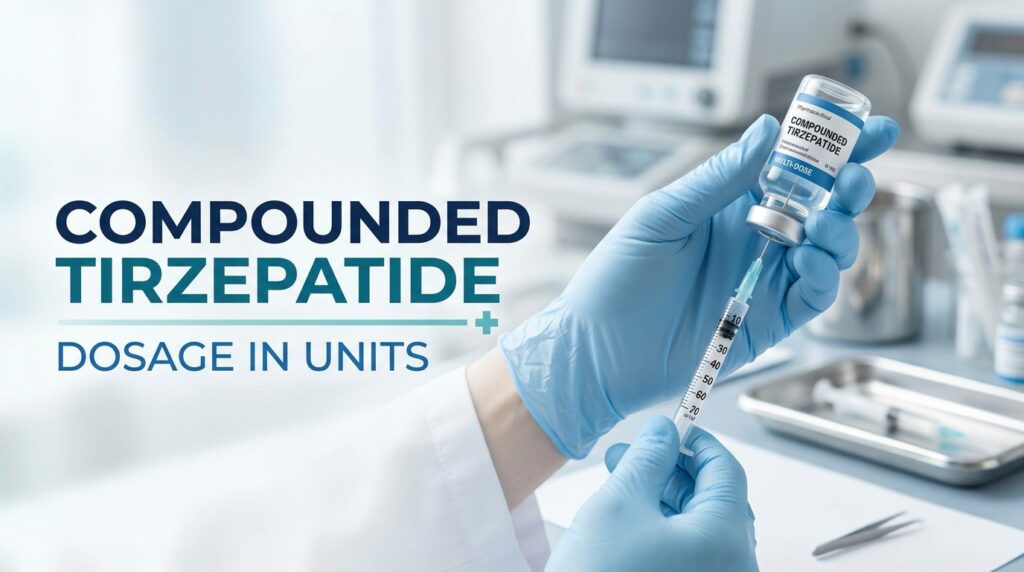
Compounded Tirzepatide Dosage in Units

Compounded Tirzepatide Dosage in Units: How to Convert mg to Units

By Compounding PharmacyNo Comments

To convert a compounded tirzepatide dose from milligrams to units, divide the dose in mg by the vial concentration in mg/mL, then multiply by 100. For example, a 2.5 mg dose from a 10 mg/mL vial is 0.25 mL, which equals 25 units on a U-100 insulin syringe. The same 2.5 mg dose from a 5 mg/mL vial is 50 units.

Because compounded vials come in different concentrations, the number of units changes from vial to vial even when the dose in mg stays the same. This guide explains the math, gives conversion tables, and covers the dosing errors providers should help patients avoid.

Why Compounded Tirzepatide Is Measured in Units

Brand tirzepatide (Mounjaro and Zepbound) comes in prefilled pens and single-dose vials with a fixed dose. Compounded tirzepatide usually comes in a multi-dose vial, and patients draw each dose with an insulin syringe.

Insulin syringes are marked in units, not milligrams. On a standard U-100 syringe:

  • 100 units = 1 mL
  • 10 units = 0.1 mL
  • 1 unit = 0.01 mL

The units on the syringe measure volume only. How much tirzepatide that volume contains depends on the concentration of the vial.

The Conversion Formula

Use these three steps:

  1. Find the concentration on the vial label, written in mg/mL.
  2. Calculate the volume: dose (mg) ÷ concentration (mg/mL) = volume (mL).
  3. Convert to units: volume (mL) × 100 = units on a U-100 syringe.

Example: The prescribed dose is 5 mg and the vial is 10 mg/mL.

5 ÷ 10 = 0.5 mL. 0.5 × 100 = 50 units.

Tirzepatide mg to Units Conversion Chart

The chart shows units on a U-100 insulin syringe for common doses and concentrations. Always use the concentration printed on the patient’s own vial.

Dose (mg) 5 mg/mL vial 10 mg/mL vial 20 mg/mL vial
2.5 mg 50 units (0.50 mL) 25 units (0.25 mL) 12.5 units (0.125 mL)
5 mg 100 units (1.00 mL) 50 units (0.50 mL) 25 units (0.25 mL)
7.5 mg 150 units (1.50 mL) 75 units (0.75 mL) 37.5 units (0.375 mL)
10 mg 200 units (2.00 mL) 100 units (1.00 mL) 50 units (0.50 mL)
12.5 mg 250 units (2.50 mL) 125 units (1.25 mL) 62.5 units (0.625 mL)
15 mg 300 units (3.00 mL) 150 units (1.50 mL) 75 units (0.75 mL)


A standard 1 mL insulin syringe holds 100 units. Doses above 100 units need either a higher concentration or more than one draw, which increases the risk of error. Pharmacies often choose a concentration that keeps each dose under 100 units.

Contact us

How Tirzepatide Is Usually Titrated

The FDA-approved labeling for brand tirzepatide for weight management (Zepbound) starts at 2.5 mg once weekly for 4 weeks. The dose then increases in 2.5 mg steps, at least 4 weeks apart. Maintenance doses are 5 mg, 10 mg, or 15 mg once weekly, and the maximum dose is 15 mg weekly.

Weeks Weekly dose Units from a 10 mg/mL vial
1 to 4 2.5 mg 25 units
5 to 8 5 mg 50 units
9 to 12 7.5 mg 75 units
13 to 16 10 mg 100 units
17 to 20 12.5 mg 125 units
21 and after 15 mg 150 units


This table shows the brand label schedule as a reference. The prescriber sets each patient’s dose and schedule, and many patients stay at a lower maintenance dose.Common Dosing Errors With Compounded GLP-1 Injections

The FDA has received reports of patients overdosing on compounded GLP-1 injections, including cases that led to hospitalization. Many errors come from confusion between units, milliliters, and milligrams. 

The most common mistakes are:

  • Reading mg as units. A patient told “5” draws 5 units instead of 50 units, or 50 units instead of 5 units.
  • Reading mL as units. A patient told “0.5” draws 50 units when 5 units was intended, or the reverse.
  • Using the old concentration. A refill arrives in a different concentration, but the patient keeps drawing the same number of units.
  • Using the wrong syringe. A U-40 or 0.3 mL syringe has different markings from a 1 mL U-100 syringe.
  • Double dosing. A patient forgets whether the weekly dose was taken.

Compounded Tirzepatide Dosage in Units

How Providers Can Prevent Dosing Errors

  1. Write the dose three ways on instructions: mg, mL, and units, for example “2.5 mg = 0.25 mL = 25 units.”
  2. Specify the syringe size and type in the prescription.
  3. Flag concentration changes whenever a refill uses a different concentration.
  4. Teach back. Ask patients to show where they will draw to on the syringe.
  5. Use a dose log so patients record the date and units of each injection.
  6. Coordinate with the pharmacy so the label, patient instructions, and prescription all match.

For patient education on injections and adherence, see How Compounding Improves Patient Adherence.

Is Compounded Tirzepatide Still Available in 2026?

The FDA removed tirzepatide from its drug shortage list on December 19, 2024. State-licensed 503A pharmacies had until February 18, 2025, and 503B outsourcing facilities until March 19, 2025, to stop compounding copies of the commercial product under the shortage policy.

Since then, federal law generally does not allow pharmacies to routinely compound drugs that are essentially copies of a commercially available product. A 503A pharmacy may compound a patient-specific version only when the prescriber determines that a change produces a clinically significant difference for that patient. Rules continue to change, so confirm current FDA guidance before prescribing. Learn more in FDA Regulation of Peptides and Compounding Pharmacies in 2026 and our 503A compounding pharmacy guide.

Contact us

FAQs

How many units is 2.5 mg of compounded tirzepatide?

It depends on the vial concentration. From a 10 mg/mL vial, 2.5 mg is 25 units. From a 5 mg/mL vial, it is 50 units. From a 20 mg/mL vial, it is 12.5 units.

How do you convert tirzepatide mg to units?

Divide the dose in mg by the concentration in mg/mL to get mL, then multiply by 100 to get units on a U-100 insulin syringe.

How many units is 5 mg of tirzepatide?

From a 10 mg/mL vial, 5 mg is 50 units. From a 20 mg/mL vial, it is 25 units.

Why did my units change when the dose stayed the same?

The refill likely came in a different concentration. The units on the syringe measure volume, so a stronger vial needs fewer units for the same mg dose.

What syringe is used for compounded tirzepatide?

Most patients use a U-100 insulin syringe, where 100 units equals 1 mL. The prescriber and pharmacy should specify the syringe size.

Is compounded tirzepatide FDA-approved?

No. Compounded drugs are not FDA-approved. Brand tirzepatide products, Mounjaro and Zepbound, are FDA-approved.

Work With a Pharmacy That Gets the Details Right

Clear labels and matching instructions prevent most dosing errors. Emerald Compounding Pharmacy works with weight management clinics on patient-specific prescriptions, clear labeling, and direct pharmacist support. Learn more about our weight loss compounding pharmacy in Tampa or call (877) 443-7711.

Become a Provider

BHRT compounding pharmacy

BHRT Compounding Pharmacy: Compounded Hormone Therapy for Medical Practices

By Compounding PharmacyNo Comments

A BHRT compounding pharmacy prepares bioidentical hormone medications, such as estradiol, estriol, progesterone, and testosterone, to the exact strength and dosage form a provider prescribes for an individual patient. Practices use one when commercially available hormone products do not fit a patient’s dose, allergies, or preferred route of administration.

Emerald Compounding Pharmacy is a Tampa, FL hormone replacement therapy pharmacy that works with menopause clinics, hormone optimization practices, primary care offices, and telehealth providers. This guide explains what compounded hormone therapy is, which hormones and dosage forms practices order most, and how to evaluate a pharmacy partner.

What Is Compounded Hormone Therapy?

Compounded hormone therapy is a hormone medication prepared by a licensed pharmacist from a patient-specific prescription. The hormones are usually “bioidentical,” meaning their molecular structure matches the hormones the body produces.

The term “bioidentical” describes the molecule, not the regulatory status. Several FDA-approved products also contain bioidentical estradiol or progesterone. What makes a medication “compounded” is that a pharmacy prepares it for one patient instead of a manufacturer producing it at scale.

For a broader look at how hormone compounding fits into patient care, read our guide to bioidentical hormone replacement therapy.

Compounded vs. FDA-Approved Hormone Products

Providers should understand both options before prescribing. Compounding does not replace FDA-approved therapy. It fills the gaps that commercial products leave.

Factor FDA-approved hormone products Compounded hormone therapy
Approval Reviewed and approved by the FDA Not FDA-approved; prepared under state pharmacy law and USP standards
Strengths Fixed, manufacturer-set doses Prescribed to the patient’s specific dose
Dosage forms Limited to what is manufactured Creams, gels, troches, capsules, and more
Inactive ingredients Fixed formula Can exclude specific allergens or excipients
Combinations Usually single hormones Some combinations, such as Bi-est, in one preparation


Compounding is most appropriate when:

  • The prescribed strength is not commercially available.
  • The patient is allergic to an inactive ingredient, such as peanut oil, dyes, or certain fillers.
  • The patient needs a dosage form that is not manufactured, such as a troche or a specific cream base.
  • A commercial product is in shortage or discontinued.

For more context, see Compounded vs. Commercial Drugs.

BHRT Compounding Pharmacy

Contact us

Hormones Practices Commonly Compound

Estradiol

Estradiol is the primary estrogen in many menopause protocols. Practices order it in transdermal creams and gels, troches, and capsules, at strengths matched to each patient’s response.

Estriol and Bi-Est

Estriol is a weaker estrogen often prescribed in combination with estradiol as Bi-est, or in topical and vaginal preparations. There is no FDA-approved estriol product in the United States, so estriol is available only through compounding.

Progesterone

Progesterone is prescribed in oral capsules, topical creams, and troches. Route matters: the evidence for endometrial protection differs between oral and topical progesterone. Our progesterone compounding pharmacy guide covers dosage forms and prescribing considerations in detail.

Testosterone

Testosterone is used in hormone therapy for men and, at much lower doses, for women. It is a Schedule III controlled substance, so prescriptions must meet federal and Florida requirements. Read our testosterone compounding pharmacy guide for the details.

DHEA

Some practices add DHEA to hormone protocols, usually in capsules or topical preparations, based on the patient’s lab work and clinical goals.

Dosage Forms for Hormone Therapy

Choosing the right dosage form affects absorption, convenience, and adherence. Emerald prepares hormone therapy as:

  • Creams: transdermal application with adjustable strength per gram.
  • Gels: quick-drying transdermal options with minimal residue.
  • Troches: dissolvable tablets for buccal absorption.
  • Capsules: precision-dosed oral hormones, with or without fillers.

Each form has trade-offs. Transdermal forms avoid first-pass liver metabolism but require consistent application. Oral capsules are simple to take but are metabolized differently. Troches offer an alternative for patients who cannot use topicals. Our pharmacists can discuss options with your clinical team. Read more about how compounding improves patient adherence.

Contact us

Safety and Quality in Hormone Compounding

Because compounded hormones are not FDA-approved, the pharmacy’s quality system is what protects your patients. In 2020, the National Academies of Sciences, Engineering, and Medicine published a report on compounded bioidentical hormone therapy that raised concerns about dose consistency and limited safety data. That report is a good reason to choose your pharmacy carefully.

When you evaluate a hormone replacement therapy pharmacy, ask:

  1. Is the pharmacy licensed in your state, and does it follow USP <795> for non-sterile preparations?
  2. Who verifies each formulation before it is dispensed?
  3. How does the pharmacy source its active ingredients, and does it keep certificates of analysis?
  4. How does it test potency and consistency across batches?
  5. Can your staff speak directly with a pharmacist?

Emerald is Florida DOH licensed (#PH35337), DEA registered for Schedules II through V (#FE4155974), LegitScript certified, and HIPAA compliant. Read How Compounding Pharmacies Maintain Quality Control and Are Compounded Medications Safe? for more.

How to Choose a BHRT Compounding Pharmacy

Beyond licensing and quality, the right partner fits your practice’s workflow. Look for:

  • A provider portal for electronic prescription submission and order tracking.
  • Fast fulfillment, so patients do not run out between refills.
  • Direct pharmacist access for formulation questions.
  • Experience with hormone protocols, including dose adjustments and combination formulas.
  • Clear policies on controlled substances such as testosterone.

Our step-by-step guide, How to Source Bioidentical Hormones for Your Practice, walks through the evaluation process. You can also read How to Choose a Compounding Pharmacy.

Practices We Support

Emerald prepares compounded hormone therapy for:

  • Menopause and women’s health clinics
  • Hormone optimization and men’s health practices
  • Primary care and internal medicine offices
  • Functional and integrative medicine practices
  • Telehealth hormone programs

BHRT Compounding Pharmacy

How to Order Compounded Hormones From Emerald

  1. Complete the provider form with your practice details.
  2. Share credentials, including DEA registration if you prescribe testosterone.
  3. Get verified and receive access to the provider portal.
  4. Submit prescriptions with the hormone, strength, dosage form, base, quantity, and directions.

Prescriptions received before 2:00 PM EST are processed and shipped the same day, and there is no minimum order volume.

Hormone Compounding for Tampa Practices

Emerald is located at 5325 Primrose Lake Circle, Suite A, Tampa, FL 33647. Tampa Bay practices get a local compounding pharmacy in Tampa that works under the same Florida rules they do, with pharmacists who are easy to reach.

Contact us

FAQs

What is a BHRT compounding pharmacy?

It is a pharmacy that prepares bioidentical hormone medications, such as estradiol, progesterone, and testosterone, to a provider’s patient-specific prescription.

Are compounded bioidentical hormones FDA-approved?

No. Compounded hormones are prepared under state pharmacy law and USP standards, not FDA approval. FDA-approved bioidentical products also exist, and compounding is used when those products do not meet a patient’s needs.

What dosage forms are available for compounded hormone therapy?

Common forms include creams, gels, troches, and capsules. The right form depends on the hormone, the dose, and the patient.

Can a hormone replacement therapy pharmacy compound testosterone?

Yes, if the pharmacy is DEA registered for Schedule III substances. Emerald is DEA registered for Schedules II through V.

Do patients need a prescription for compounded hormones?

Yes. Every compounded hormone requires a prescription from a licensed provider for a specific patient.

How do I start ordering BHRT from Emerald?

Complete the provider form, share your credentials, get verified, and submit prescriptions through the provider portal.

Partner With a Hormone Replacement Therapy Pharmacy You Can Reach

Hormone therapy depends on precise dosing and consistent refills. Emerald gives your practice both, with a pharmacist on the other end of the phone. Open a provider account or call (877) 443-7711.

Become a Provider

compounding pharmacy Tampa FL

Compounding Pharmacy in Tampa, FL for Clinics and Medical Practices

By Compounding PharmacyNo Comments

Emerald Compounding Pharmacy is a compounding pharmacy Tampa FL that prepares patient-specific sterile and non-sterile medications for clinics, medical practices, med spas, and telehealth providers. Practices send prescriptions through a secure provider portal, work directly with our pharmacists, and receive same-day shipping on prescriptions received before 2:00 PM EST.

This page explains what we compound, how ordering works, and what Tampa Bay providers should expect from a local compounding partner.

What Is a Compounding Pharmacy?

A compounding pharmacy prepares medications for an individual patient based on a prescription from a licensed provider. Compounding is used when a commercially available product does not fit the patient: the strength is not manufactured, the patient is allergic to an inactive ingredient, or the patient needs a different dosage form, such as a cream instead of a tablet.

Compounded medications are not FDA-approved products. Their safety and consistency depend on the pharmacy’s standards, which is why licensing, USP compliance, and pharmacist oversight matter when you choose a partner. For a full overview, read What Is a Compounding Pharmacy?

Compounding Services for Tampa Practices

Emerald focuses on four therapeutic areas that make up most of the prescriptions we receive from Tampa Bay providers.

Hormone Therapy

We prepare bioidentical hormone formulations, including estradiol, estriol, progesterone, and testosterone, in strengths and dosage forms that match each prescription. See our guide to BHRT compounding for providers.

Medical Weight Management

Weight management clinics use compounding for patient-specific dosing and supportive formulations within their programs. Learn more about weight loss compounding in Tampa.

Dermatology and Aesthetics

Dermatology offices and med spas order custom creams, gels, and skincare formulations with adjusted strengths, combined actives, or bases free of common irritants. See dermatology compounding in Tampa and aesthetic compounding services for Tampa clinics.

Peptide Medications

We support practices that prescribe peptides that can be lawfully compounded. Because the rules around peptides change, our pharmacists confirm compounding eligibility before preparing any order. Read more about our peptide compounding pharmacy.

Dosage Forms We Prepare

The right dosage form can improve how well a patient tolerates and follows a treatment plan. Emerald compounds:

  • Custom creams: fast-absorbing topical formulations for dermatology, hormone therapy, and pain management.
  • Custom gels: transdermal or topical gels designed for absorption with minimal residue.
  • Custom nasal sprays: intranasal formulations for systemic delivery without injections.
  • Custom troches: flavored dissolvable tablets for buccal absorption, often used in hormone therapy.
  • Custom capsules: precision-dosed oral medications, with or without fillers.
  • Skincare formulations: compounded topicals for specific dermatological needs.
  • Sterile preparations: injectable and other sterile formulations prepared under sterile compounding standards.

To see how dosage form affects outcomes, read How Compounding Improves Patient Adherence.

compounding pharmacy Tampa FL

Contact us

Sterile and Non-Sterile Compounding Under One Roof

Many Tampa practices need both types of compounding. Emerald holds a Florida Department of Health permit for special sterile compounding, so one pharmacy can handle both.

Type Standard Common examples
Non-sterile USP <795> Creams, gels, capsules, troches
Sterile USP <797> Injectables and other sterile preparations


Learn more about sterile compounding, non-sterile compounding, and the difference between sterile and non-sterile compounding.

Licenses and Compliance

Before you send a prescription to any compounding pharmacy, verify its credentials. Emerald’s are:

  • Florida DOH licensed, Special Sterile Compounding qualified (#PH35337)
  • DEA registered for Schedules II through V (#FE4155974)
  • LegitScript certified
  • HIPAA compliant, with a secure provider portal

You can review our documentation on the Certificates page. For a deeper look at how we keep every batch consistent, read How Compounding Pharmacies Maintain Quality Control.

How to Start Ordering From Emerald

Opening a provider account takes four steps:

  1. Complete the provider form. Tell us about your practice and the therapies you prescribe.
  2. Share your credentials. We verify the prescriber’s license and, for controlled substances, DEA registration.
  3. Get verified. Our team confirms your account and gives you access to the provider portal.
  4. Start prescribing. Submit patient-specific prescriptions through the portal and track each order.

There is no minimum order volume, so a practice can start with a single patient.

Why Tampa Practices Choose a Local Compounding Pharmacy

A compounding pharmacy in Tampa gives local providers advantages that a distant supplier cannot match:

  • Faster turnaround. Prescriptions received before 2:00 PM EST are processed and shipped the same day.
  • Direct pharmacist access. Your staff speaks with a pharmacist, not a call center.
  • Florida licensure alignment. A Florida-licensed pharmacy works under the same state rules as Florida prescribers.
  • Consistent communication. One team handles your formulations, refills, and questions.

Read more in Benefits of a Local Compounding Pharmacy Partner and Why Clinics Choose a Compounding Pharmacy Partner.

Who We Work With

Emerald works only with licensed prescribers. Our partners include:

  • Hormone and menopause clinics
  • Medical weight loss programs
  • Dermatology offices and med spas
  • Primary care and internal medicine practices
  • Functional and integrative medicine practices
  • Telehealth providers

Patients receive their medications through their provider’s prescription. If you are a patient, ask your provider whether a compounded medication is right for you. Read Do Compounded Medications Require a Prescription?

Serving the Tampa Bay Area

Our pharmacy is located at 5325 Primrose Lake Circle, Suite A, Tampa, FL 33647, in the New Tampa area. We work with practices across Hillsborough, Pinellas, and Pasco counties and the wider Tampa Bay region. Contact us to confirm shipping options for practices outside Florida.

compounding pharmacy Tampa FL

Contact us

FAQs

What does a compounding pharmacy in Tampa do?

It prepares patient-specific medications from a provider’s prescription when a commercial product does not meet the patient’s needs, for example, a different strength, an allergen-free formula, or another dosage form.

Can patients order directly from Emerald?

No. Emerald fills prescriptions from licensed providers. Patients receive compounded medications through their provider.

Does Emerald offer sterile compounding in Tampa?

Yes. Emerald holds a Florida special sterile compounding permit (#PH35337) and prepares sterile and non-sterile medications.

How fast are prescriptions shipped?

Prescriptions received before 2:00 PM EST are processed and shipped the same day.

Is there a minimum order for new practices?

No. There is no minimum order volume.

How do I open a provider account?

Complete the provider form, share your credentials, get verified, and start prescribing through the provider portal.

Partner With Emerald Compounding Pharmacy in Tampa

Your patients need precise medications, and your practice needs a pharmacy that responds quickly. Open a provider account to start ordering, or call (877) 443-7711 to speak with a pharmacist.

Become a Provider

Compounding Pharmacy Turnaround Time

Compounding Pharmacy Turnaround Time: How Long Compounded Prescriptions Take

By Compounding PharmacyNo Comments

Compounding Pharmacy Turnaround Time, Most non-sterile compounded prescriptions are prepared within 1 to 3 business days, then shipped in 1 to 2 days, so patients usually receive them in about 2 to 5 business days. Sterile preparations that require sterility testing can take 2 weeks or longer. At Emerald Compounding Pharmacy in Tampa, FL, prescriptions received before 2:00 PM EST are processed and shipped the same day.

What Is Compounding Pharmacy Turnaround Time?

Compounding pharmacy turnaround time is the total time between the moment a pharmacy receives a prescription and the moment the patient receives the medication. It includes prescription review, preparation, quality checks, packaging, and shipping.

A retail pharmacy pulls a finished product from the shelf. A compounding pharmacy prepares each medication for one patient from a provider’s prescription, so a few more steps are involved.

How Long Does a Compounding Pharmacy Take?

Timelines depend on the type of preparation:

Preparation type Typical preparation time Notes
Creams, gels, and ointments Same day to 2 business days Non-sterile, prepared under USP <795>
Capsules Same day to 2 business days Time depends on batch size and strength
Troches 1 to 2 business days Need time to set before packaging
Nasal sprays Same day to 2 business days Non-sterile or sterile depending on formula
Sterile preparations with short beyond-use dates 1 to 3 business days Prepared under USP <797>
Sterile preparations that require sterility testing About 14 days or more Testing must finish before release


Shipping usually adds 1 to 2 days. Temperature-sensitive medications ship in insulated packaging and may be limited to certain shipping days.

Compounding Pharmacy Turnaround Time

Contact us

The 6 Steps That Determine Turnaround Time

1. Prescription Intake

The pharmacy receives the prescription through a provider portal, e-prescribing, or fax. A complete prescription moves straight to review. A missing strength, dosage form, or quantity stops the process until someone calls the office.

2. Pharmacist Review

A pharmacist checks the formula, dose, and patient information. If the prescription includes a controlled substance, the pharmacist also verifies the prescriber’s DEA registration and state requirements.

3. Ingredient Availability

Compounding pharmacies keep common active ingredients in stock. Rare ingredients, or ingredients affected by supplier shortages, can add several days.

4. Compounding

The pharmacy prepares the medication. Simple creams and capsules can be made the same day. Troches and some specialty forms need time to set or cure.

5. Quality Checks

Every preparation is checked before release. Checks can include weight verification, appearance, and documentation review. Some sterile preparations require sterility testing under USP <71>, which uses a 14-day incubation period. Learn more in How Compounding Pharmacies Maintain Quality Control.

6. Packaging and Shipping

The medication is labeled, packaged, and shipped. Cold-chain items need insulated packaging and are often shipped early in the week so they do not sit in transit over a weekend.

Why Sterile Compounding Takes Longer

Sterile preparations, such as injectables, must be free of microorganisms. Under USP <797>, the beyond-use date a pharmacy can assign depends on how the preparation was made and whether it was tested. Preparations that need a longer shelf life often require sterility testing, and that testing must be complete before the medication is released.

For a full comparison, read Difference Between Sterile and Non-Sterile Compounding and our guide to sterile compounding.

What Causes Delays at a Compounding Pharmacy?

The most common causes of delay are:

  • Incomplete prescriptions. Missing strength, base, dosage form, quantity, or directions.
  • Unclear formulas. Combinations that need pharmacist clarification.
  • Controlled substance verification. Missing DEA numbers or prescriptions that do not meet state rules.
  • Ingredient shortages. Backordered active ingredients.
  • Sterility testing. Required for some sterile preparations.
  • Weekend and holiday timing. Cold-chain shipments that cannot ship late in the week.
  • Address or payment issues. Incorrect shipping details or pending patient payment.

Contact us

How Providers Can Speed Up Turnaround Time

Your office controls several factors that affect turnaround time:

  1. Send complete prescriptions. Include drug, strength, dosage form, base, quantity, directions, and refills.
  2. Use the provider portal. Electronic submission avoids fax errors and lets your staff track orders.
  3. Submit early in the day. At Emerald, prescriptions received before 2:00 PM EST ship the same day.
  4. Order refills before patients run out. Ask patients to request refills 7 to 10 days before their last dose.
  5. Plan around sterile timelines. Order sterile preparations that need testing well in advance.
  6. Keep credentials current. Update DEA and license information with the pharmacy before it expires.

Same-Day Shipping at Emerald Compounding Pharmacy

Emerald is a Tampa, FL compounding pharmacy that works with clinics, medical practices, and telehealth providers. To keep turnaround time short, Emerald offers:

  • Same-day processing and shipping on prescriptions received before 2:00 PM EST.
  • A secure provider portal for prescription submission and order tracking.
  • Direct pharmacist access for formulation questions, without call center routing.
  • Sterile and non-sterile compounding under one Florida special sterile compounding permit (#PH35337).
  • No minimum order volume.

A local pharmacy partner also shortens shipping time for Tampa Bay practices. Read Benefits of a Local Compounding Pharmacy Partner.

Compounding Pharmacy Turnaround Time

FAQs

How long does a compounding pharmacy take to fill a prescription?

Most non-sterile compounded prescriptions are prepared in 1 to 3 business days. Sterile preparations that require sterility testing can take 2 weeks or longer.

Why do compounded medications take longer than regular prescriptions?

A compounding pharmacy prepares each medication for one patient after a pharmacist reviews the prescription. A retail pharmacy dispenses a finished product that is already made.

Can a compounding pharmacy ship the same day?

Yes. Emerald processes and ships prescriptions received before 2:00 PM EST on the same day.

Do sterile compounded medications take longer?

Often, yes. Some sterile preparations must pass a sterility test with a 14-day incubation period before release.

How can my practice avoid compounding delays?

Send complete prescriptions through the provider portal, submit early in the day, and order refills before patients run out.

When should patients request a refill?

Ask patients to request refills 7 to 10 days before their last dose, so there is time for preparation and shipping.

Get Faster Turnaround for Your Practice

Your patients should not wait for their medications. Open a provider account with Emerald Compounding Pharmacy to submit prescriptions through our portal and get same-day shipping on orders received before 2:00 PM EST. Call (877) 443-7711 to speak with a pharmacist.

Become a Provider

How Compounding Pharmacies Maintain Quality Control

How Compounding Pharmacies Maintain Quality Control?

By Compounding PharmacyNo Comments

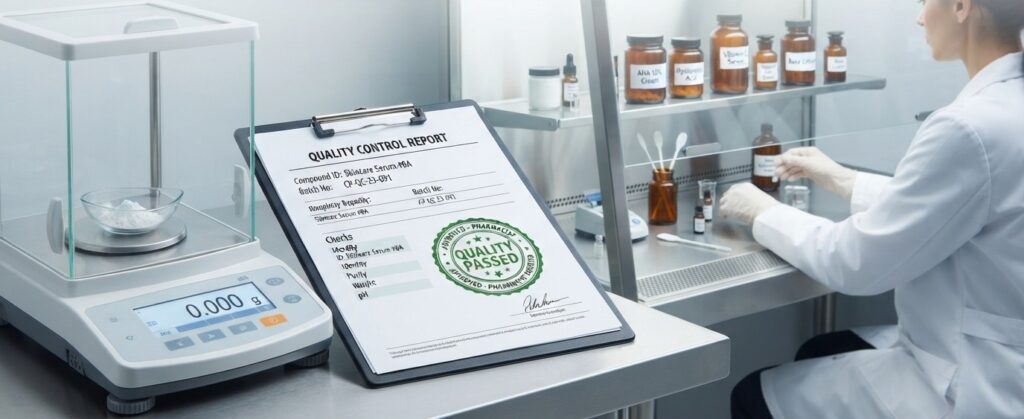
Quality control is one of the most important parts of pharmacy compounding because compounded medications are prepared for specific patient or clinical needs rather than manufactured as mass-market products. A reliable compounding pharmacy uses controlled procedures for ingredient sourcing, preparation, testing, documentation, storage, and dispensing to help maintain the quality and consistency of each formulation.

For clinics and healthcare providers, understanding these processes can make it easier to evaluate a compounding pharmacy and choose a pharmacy partner that follows appropriate professional and regulatory standards.

What Does Quality Control Mean in Pharmacy Compounding?

Quality control in compounding involves a series of checks designed to verify the identity, strength, purity, consistency, and appropriate handling of compounded medications. These controls can apply throughout the process, from receiving pharmaceutical ingredients to preparing, packaging, labeling, and releasing the finished formulation.

USP standards play an important role in pharmacy compounding. USP identifies standards for both nonsterile preparations and sterile preparations, with requirements intended to support consistency and quality in compounded medications.

A strong quality-control program may include:

  • Ingredient verification and documentation
  • Appropriate storage conditions
  • Accurate weighing and measurement
  • Equipment checks and calibration
  • Environmental monitoring
  • Personnel training
  • Preparation and labeling procedures
  • Quality testing when applicable
  • Documentation and recordkeeping

These controls create multiple checkpoints rather than relying on a single final inspection.

How Compounding Pharmacies Maintain Quality Control

Contact us

How Pharmacies Control the Quality of Ingredients

Quality control starts before a medication is compounded. Pharmacies need reliable sources for active pharmaceutical ingredients and excipients and should verify that materials meet applicable requirements.

The FDA specifically advises compounders to understand their bulk drug substance and excipient suppliers because the quality of these materials can directly affect the quality of compounded medications.

For pharmacies operating under Section 503A, FDA states that bulk drug substances must meet specific conditions, such as complying with an applicable USP or NF monograph when one exists, being a component of an FDA-approved drug when applicable, or appearing on the applicable FDA bulk drug list.

This makes supplier qualification an important part of the quality-control process.

Quality Control for Sterile Compounding

Sterile compounding requires additional controls because contamination can create significant risks when medications are administered through sterile routes.

USP standards for sterile compounding address areas such as controlled environments, personnel competency, aseptic practices, and testing. For example, USP materials describe requirements involving media-fill testing and competency assessments for personnel performing sterile compounding.

For a deeper explanation of the process, see Emerald’s guide to sterile compounding pharmacy.

Quality controls may include:

  • Controlled compounding environments
  • Appropriate personal protective equipment
  • Aseptic technique
  • Environmental monitoring
  • Personnel competency testing
  • Sterility-related testing when required
  • Proper storage and beyond-use dating procedures

These safeguards help reduce the risk of contamination and preparation errors.

Quality Control for Non-Sterile Compounding

Non-sterile preparations follow a different set of controls because they do not require the same sterile environment as injectable or other sterile products.

Quality control can involve accurate ingredient measurement, appropriate equipment, proper preparation techniques, appropriate packaging, labeling, and documentation. USP identifies <795> Pharmaceutical Compounding—Nonsterile Preparations as the standard addressing nonsterile compounding practices.

Emerald also provides information about non-sterile compounding and how these preparations can support customized medication needs.

How Compounding Pharmacies Maintain Quality Control

Contact us

How Personnel Training Supports Quality

Even the best equipment cannot replace properly trained personnel. Pharmacists and compounding staff need appropriate education and competency assessments for the types of preparations they handle.

Training can cover:

  • Accurate calculations and measurements
  • Ingredient handling
  • Equipment operation
  • Cleaning procedures
  • Aseptic technique where applicable
  • Documentation
  • Quality-control procedures
  • Identification and management of preparation errors

For sterile compounding in particular, USP materials describe competency assessments and recurring evaluations for personnel performing aseptic manipulations.

Consistent training helps make quality control part of the everyday workflow rather than something performed only after a problem occurs.

How Documentation Helps Maintain Consistency

Documentation provides a record of how a compounded medication was prepared and helps pharmacies investigate problems when necessary.

Depending on the formulation and applicable requirements, records may include:

  • Ingredient information
  • Lot numbers
  • Expiration dates
  • Calculations
  • Preparation instructions
  • Personnel involved
  • Equipment information
  • Quality-control checks
  • Final product information

Accurate documentation also creates traceability throughout the compounding process.

How Quality Control Differs Between 503A and 503B

The regulatory framework matters when evaluating a compounding pharmacy because 503A pharmacies and 503B outsourcing facilities operate under different requirements.

Under Section 503A, compounding is generally performed by a licensed pharmacist in a state-licensed pharmacy or by a licensed physician and is generally based on a valid prescription for an identified patient. Under Section 503B, outsourcing facilities are registered with the FDA and are subject to current good manufacturing practice requirements.

503A Pharmacy 503B Outsourcing Facility
Typically patient-specific compounding May compound without patient-specific prescriptions
Operates under applicable pharmacy requirements Registered with FDA as an outsourcing facility
Generally overseen primarily by state pharmacy regulators Primarily overseen and inspected by FDA
Not subject to CGMP requirements under the 503A exemption Subject to CGMP requirements

Understanding this distinction helps healthcare practices ask more informed questions when evaluating pharmacy partners.

Contact us

What Should Clinics Look for in a Compounding Pharmacy?

Healthcare practices should evaluate more than price or turnaround time when selecting a compounding pharmacy. Quality systems, regulatory compliance, communication, documentation, and the pharmacy’s ability to support the practice’s specific needs should all be considered.

Important questions include:

  • What type of compounding does the pharmacy perform?
  • What quality-control procedures are used?
  • How are ingredients sourced and verified?
  • How are personnel trained?
  • What documentation is provided?
  • How are complaints or quality concerns handled?
  • What regulatory framework applies to the pharmacy?
  • Does the pharmacy have experience supporting the type of practice being served?

Emerald’s resource on how to choose a compounding pharmacy provides additional considerations for evaluating a pharmacy.

Why Quality Control Matters for Medical Practices

For physicians, dermatology practices, wellness clinics, and other healthcare organizations, consistent pharmacy processes can make coordination easier. A pharmacy partner may need to handle customized formulations, communicate clearly with providers, and maintain appropriate documentation throughout the process.

This becomes especially relevant when practices use customized medication solutions rather than relying exclusively on commercially available formulations.

Emerald explains how custom medication solutions for medical practices can support practices that require individualized compounding services.

Quality Control Is an Ongoing Process

Quality control does not end when a compounded medication leaves the compounding area. It is an ongoing system that includes ingredient management, staff competency, environmental controls, preparation procedures, documentation, storage, and continuous evaluation.

FDA emphasizes that compounded medications must comply with applicable legal and regulatory requirements, while pharmacies and outsourcing facilities may operate under different quality standards depending on their regulatory status.

For healthcare practices, the key is to work with a pharmacy that can clearly explain its quality systems and demonstrate how those systems are integrated into daily compounding operations.

Conclusion

A reliable compounding pharmacy quality control program is built around multiple layers of verification rather than a single quality check. Ingredient sourcing, trained personnel, controlled preparation environments, accurate documentation, appropriate testing, and regulatory compliance all contribute to the overall quality of compounded medications.

For clinics considering a compounding pharmacy partner, asking detailed questions about these processes can provide a clearer picture of how the pharmacy manages quality from the beginning of the compounding process through final dispensing.

Contact us

FAQs

Is quality control required for compounded medications?

Yes. Compounding pharmacies must follow applicable federal, state, and professional requirements. The specific requirements depend on the type of compounder and the regulatory framework under which it operates.

Are sterile and non-sterile compounding quality controls the same?

No. Sterile preparations require additional controls designed to minimize microbial contamination and maintain sterility. Non-sterile preparations follow different standards and procedures.

How does a pharmacy verify its ingredients?

Pharmacies may review supplier information, certificates of analysis, lot information, applicable standards, and other documentation. FDA specifically encourages compounders to understand their bulk drug substance and excipient suppliers.

Are 503A pharmacies subject to the same requirements as 503B facilities?

No. 503A and 503B compounders operate under different federal frameworks. 503B outsourcing facilities are subject to CGMP requirements, while qualifying 503A compounding is exempt from certain federal requirements, including CGMP, under the conditions established by Section 503A.

What should a medical practice ask before choosing a compounding pharmacy?

Practices should ask about ingredient sourcing, quality-control procedures, personnel training, documentation, regulatory status, preparation capabilities, and how the pharmacy handles quality concerns or recalls.

topical compounding pharmacy

Topical Compounding Pharmacy: A Guide for Healthcare Providers

By Compounding PharmacyNo Comments

A topical compounding pharmacy prepares customized medications designed to be applied to the skin when a commercially available product does not adequately meet a patient’s specific needs. Instead of dispensing only standardized formulations, a compounding pharmacy can prepare a prescription with customized characteristics such as the dosage form, strength, ingredients, or vehicle when the formulation is appropriate and legally permissible. This makes topical compounding particularly relevant to dermatology, where treatment often needs to account for the location of the condition, patient tolerance, and the practical characteristics of the medication.

Topical compounding is not simply another way to create personalized skincare. It is a pharmaceutical process involving prescription medications and specific regulatory requirements. Under the traditional 503A compounding framework, medications are generally compounded for an identified individual patient based on a valid prescription. The FDA also makes clear that compounded drugs are not FDA-approved and are not reviewed by the agency before marketing for safety, effectiveness, or quality. For healthcare providers, understanding this distinction is essential when deciding whether a customized topical formulation is appropriate.

What Is a Topical Compounding Pharmacy?

A topical compounding pharmacy specializes in preparing medications intended for application to the skin or other topical sites according to a prescription. Depending on the formulation, a compounded topical may be prepared as a cream, ointment, gel, lotion, solution, or another appropriate dosage form. The objective is to create a medication that fits the specific prescription rather than forcing every patient into an existing commercial formulation.

This flexibility can be useful when a commercially available medication does not provide the required strength, dosage form, combination, or other characteristic needed by the patient. Dermatology literature describes compounding as a way to individualize topical treatment and create preparations that may not otherwise be commercially available. At the same time, customized formulations can have less clinical evidence than standardized FDA-approved products, so customization should have a clear clinical purpose rather than being viewed as automatically better.

How Topical Compounding Differs From Commercial Medications

Commercial medications are manufactured as standardized products for a broad patient population, while compounded medications are prepared according to a specific prescription and identified patient need. A commercial product may already provide exactly what a patient requires, in which case compounding may offer no particular advantage.

Compounding becomes more relevant when a prescriber identifies a legitimate formulation gap. For example, a patient may need a particular dosage form or strength that is not commercially available, or there may be a specific formulation consideration that makes an available product unsuitable. The important point is that a compounded medication should be selected because it addresses a genuine need, not simply because it is customized.

topical compounding pharmacy

How Does Topical Compounding Work?

The process begins with the prescriber determining that a customized topical medication is clinically appropriate. The prescription identifies the medication and relevant formulation requirements, and the compounding pharmacy evaluates whether the requested preparation can be made appropriately. The pharmacist considers the ingredients, concentration, dosage form, vehicle, preparation process, packaging, storage, and other factors before preparing the medication.

For a traditional 503A pharmacy, the prescription-based relationship is particularly important. Federal law establishes conditions under which compounded medications may qualify for certain exemptions, including the requirement that the medication generally be compounded for an identified individual patient based on a valid prescription.

The pharmacy’s role does not end with mixing ingredients. A professionally prepared topical medication requires appropriate ingredient sourcing, formulation procedures, labeling, packaging, and instructions. This is why healthcare providers should evaluate the pharmacy’s overall compounding process rather than focusing only on the number of formulations it advertises.

What Types of Topical Medications Can Be Compounded?

The types of topical medications that can be compounded depend on the prescription, ingredients, formulation requirements, pharmacy capabilities, and applicable federal and state requirements. Topical preparations may include creams, ointments, gels, lotions, and solutions, but not every requested combination or ingredient is necessarily appropriate for compounding.

Dermatology is one of the areas where customized topical medications can have a practical role. A prescriber may need to consider the treatment area, desired dosage form, concentration, patient tolerance, or availability of commercial alternatives. The formulation must still be scientifically and pharmaceutically appropriate.

Contact us

Dermatology and Customized Skin Treatments

Dermatology practices may work with a topical compounding pharmacy when a patient’s needs are not adequately addressed by an available commercial medication. Customized topical formulations can provide flexibility around dosage forms and other prescription characteristics.

The vehicle is particularly important in dermatology because a cream, ointment, gel, and lotion can behave very differently on the skin. The choice can influence how easily the medication spreads, how it feels during application, and whether the patient is likely to use it consistently. Compounding therefore involves much more than selecting an active ingredient.

For practices looking for customized dermatology solutions, Emerald Compounding Pharmacy offers resources focused on custom skincare formulations for dermatology practices, alongside its broader dermatology compounding pharmacy services.

What Are the Benefits of Topical Compounding?

The primary advantage of topical compounding is formulation flexibility. When an appropriate commercial product does not meet a patient’s needs, a compounded medication may allow the prescriber to request a different strength, dosage form, ingredient combination, or vehicle when legally and pharmaceutically appropriate.

This can be particularly useful in dermatology because topical treatment is highly dependent on the formulation itself. A patient may tolerate one vehicle better than another, or a clinician may require a dosage form that is not commercially available. Compounding can provide an additional treatment option in these situations.

There is an important limitation, however. Customized does not automatically mean more effective or safer. Compounded medications do not undergo FDA premarket review in the same way as FDA-approved commercial drugs, so providers should consider the available evidence, the clinical need, and the risks and benefits before choosing a compounded formulation.

When Is a Compounded Topical Medication Appropriate?

A compounded topical medication may be appropriate when a qualified prescriber identifies a specific patient need that cannot be adequately met by an appropriate commercially available product. The reason could involve the strength, dosage form, vehicle, ingredients, or another prescription-specific characteristic.

The decision should begin with the clinical need rather than the availability of a compounding pharmacy. If an FDA-approved medication already provides an appropriate option, there may be no reason to compound. FDA guidance emphasizes that compounded drugs should serve a medical need and that traditional compounding under section 503A is tied to individual patient prescriptions.

Providers should also consider the evidence supporting the proposed formulation. Some customized preparations have limited clinical data because each unique formulation may not have been studied in large clinical trials. This does not eliminate the role of compounding, but it reinforces the need for professional judgment and appropriate patient selection.

topical compounding pharmacy

Topical Compounding for Dermatology Practices

For dermatology practices, a compounding pharmacy can function as an extension of the practice’s medication options. The pharmacy may help prepare customized topical prescriptions when a commercial product does not adequately fit the patient’s needs.

A strong pharmacy relationship depends on clear communication. The provider should be able to communicate prescription requirements, while the pharmacy should be able to clarify formulation questions and explain practical considerations when necessary. This becomes especially important when a prescription involves a customized dosage form or multiple formulation variables.

For clinics, the best partnership is not necessarily the pharmacy that offers the longest list of products. It is the pharmacy that demonstrates appropriate regulatory awareness, reliable processes, quality controls, clear communication, and the ability to consistently support legitimate prescription requirements.

Why Does the Topical Vehicle Matter?

The vehicle is the base that carries the active medication and is an important part of a topical formulation. Creams, ointments, gels, lotions, and solutions can have different physical properties and may be better suited to different applications.

Vehicle selection can influence spreadability, texture, occlusion, absorption characteristics, stability, and patient acceptance. These factors matter because a medication that is difficult or unpleasant to use may reduce adherence even when the active ingredient itself is appropriate.

For this reason, topical compounding should be treated as pharmaceutical formulation rather than simply mixing an active ingredient into a cream. The vehicle needs to be compatible with the medication and appropriate for the intended use. A qualified compounding pharmacist can evaluate these factors as part of preparing the prescription.

Contact us

What Is 503A Compounding?

503A compounding refers to traditional pharmacy compounding that operates under specific conditions established by section 503A of the Federal Food, Drug, and Cosmetic Act. One of the central requirements is that the compounded medication generally be prepared for an identified individual patient based on a valid prescription.

The 503A framework also includes restrictions concerning compounded products that are essentially copies of commercially available drugs. FDA’s current guidance continues to emphasize that compounders must satisfy applicable conditions to qualify for the relevant exemptions.

For providers, understanding 503A is useful because it clarifies why a traditional compounding pharmacy is different from a conventional drug manufacturer. The purpose is to address individual medication needs through compounding, not to operate as an alternative manufacturer of mass-market medications.

Quality and Safety Considerations

Quality should be one of the first considerations when evaluating a topical compounding pharmacy. FDA warns that compounded medications are not FDA-approved and therefore do not undergo the same premarket review for safety, effectiveness, and quality as approved commercial drugs.

Ingredient sourcing is also important. A compounding pharmacy should use appropriate pharmaceutical ingredients and maintain processes designed to support the quality and consistency of the finished preparation. Packaging, labeling, storage, and preparation procedures are additional parts of the quality equation.

Healthcare providers should also remember that topical medications can still cause adverse reactions. Local irritation, allergy, unintended absorption, or other problems can occur depending on the ingredients and formulation. A customized medication should therefore be prescribed and used according to professional guidance rather than treated as an ordinary cosmetic product.

How to Choose a Topical Compounding Pharmacy

When choosing a pharmacy partner, healthcare providers should look beyond pricing and product lists. A practice should evaluate the pharmacy’s licensing, compounding framework, ingredient sourcing, quality processes, formulation capabilities, communication, and ability to support the practice’s workflow.

Useful questions include:

  • What types of topical formulations can the pharmacy prepare?
  • How are ingredients sourced and documented?
  • What quality-control procedures are followed?
  • How does the pharmacy handle formulation questions?
  • What information is provided about storage and application?
  • Is the pharmacy appropriately licensed for the states it serves?
  • How are prescription changes and refills handled?

Transparency is especially important. A legitimate compounding pharmacy should not describe compounded medications as FDA-approved. FDA has specifically warned that representing a compounding pharmacy or its compounded products as “FDA-approved” or “FDA-licensed” is misleading.

Topical Compounding Pharmacy vs. Commercial Medications

The choice between a compounded topical and a commercial medication should depend on the patient’s needs and the available treatment options. Commercial FDA-approved medications have undergone the applicable FDA review process, while compounded drugs do not undergo the same premarket review.

A compounded medication can be useful when a commercial product cannot adequately meet a specific patient need. That may involve formulation, strength, dosage form, or another clinically relevant characteristic. But customization alone is not enough to justify compounding.

For providers, the best approach is to consider the patient’s needs, available commercial alternatives, evidence, risks, and the pharmacy’s ability to prepare the requested formulation appropriately. This keeps compounding where it belongs: as a specialized option for legitimate individualized medication needs.

topical compounding pharmacy

Contact us

FAQs About Topical Compounding Pharmacy

Do compounded topical medications require a prescription?

Traditional 503A compounding generally involves preparing a medication for an identified individual patient based on a valid prescription. The exact requirements can vary depending on the type of compounding and applicable federal and state law.

Are compounded topical medications FDA approved?

No. Compounded medications are not FDA-approved in the same manner as commercially manufactured FDA-approved drugs. FDA does not conduct the same premarket review of compounded medications for safety, effectiveness, and quality.

Can a pharmacy customize the strength or dosage form?

A pharmacy may be able to customize certain characteristics of a topical medication when the prescription, ingredients, formulation, and applicable requirements support doing so. The exact options depend on the specific medication and pharmacy.

Why do dermatologists use compounded topicals?

Dermatologists may use compounded topical medications when a patient’s specific needs cannot be adequately met by an available commercial formulation. The reason may involve the dosage form, strength, ingredients, vehicle, or another formulation consideration.

What should a clinic ask a compounding pharmacy?

Clinics should ask about licensing, ingredient sourcing, quality procedures, formulation capabilities, prescription requirements, communication, storage instructions, and the states in which the pharmacy is appropriately licensed to operate.

Conclusion

A topical compounding pharmacy can provide healthcare providers with an important option when a patient’s medication needs cannot be adequately addressed by an available commercial product. Its value lies in the ability to prepare individualized topical formulations while considering factors such as dosage form, strength, ingredients, and vehicle.

For dermatology practices, the right compounding partner should combine formulation expertise with strong quality processes, regulatory awareness, transparent communication, and reliable prescription support. Compounding should not be viewed as automatically better than an FDA-approved commercial medication. Instead, it should be considered when there is a legitimate clinical reason for customization and when the benefits and limitations have been appropriately evaluated.

For practices seeking customized dermatology formulations, Emerald Compounding Pharmacy provides compounding solutions designed to support healthcare providers and individualized patient needs.

how long for peptides to work for skin​

How Long for Peptides to Work for Skin?

By Peptide TherapyNo Comments

how long for peptides to work for skin​, Peptides can begin supporting changes in the skin within several weeks, but the timeline depends heavily on the specific peptide, formulation, concentration, skin concern, and consistency of use. Some people may notice improved hydration or a smoother feel relatively early, while changes involving fine lines, firmness, or overall skin appearance generally require longer and more consistent use. There is no single number of days that applies to every peptide skincare product because “peptides” describes a broad family of ingredients rather than one standardized treatment. Current research supports the potential of some topical peptides for improving aspects of skin aging, but the strength of evidence varies considerably between individual peptide ingredients and formulations. A 2026 systematic review of randomized controlled trials found that peptide interventions can improve some skin-aging measures, while effects on elasticity and skin density were less consistent, highlighting why results should be evaluated according to the specific product rather than assuming every peptide serum will produce the same outcome.

For practical skincare expectations, it is more useful to think in stages than to expect an immediate transformation. During the early weeks, changes may involve hydration, softness, or surface appearance. With continued use, some peptide formulations may produce more noticeable improvements in the appearance of fine lines, texture, or firmness. One 2025 randomized controlled trial of a specific topical cyclized hexapeptide-9 formulation evaluated twice-daily use over 56 days and reported improvements in several wrinkle measurements, with some effects increasing over time. However, that result applies to the tested formulation and should not be generalized to every peptide product.

What Are Peptides in Skincare?

Peptides are short chains of amino acids that are used in skincare formulations for different cosmetic purposes, particularly products designed around skin appearance, hydration, firmness, and visible signs of aging. They are not one single ingredient with one predictable effect. Different peptide sequences can have different proposed mechanisms and may be incorporated into creams, serums, lotions, or other topical formulations. This distinction matters when asking how long peptides take to work because the timeline depends partly on what the specific peptide is intended to do and whether the finished formulation allows the ingredient to remain stable and interact appropriately with the skin. Research on topical peptides has also highlighted challenges such as peptide stability and skin permeability, which means the presence of a peptide on an ingredient list does not by itself establish how effective or fast-acting a product will be.

Skincare peptides are also different from the broader category of peptide therapies discussed in medical settings. A topical cosmetic peptide serum is not automatically equivalent to an injectable peptide formulation or a compounded medication. These products can have completely different intended uses, regulatory classifications, routes of administration, formulations, and evidence requirements. For consumers and healthcare professionals evaluating peptide-based skincare, understanding the exact product and its intended use is therefore more useful than treating all peptide products as interchangeable. For a broader explanation of peptides and their applications, see our guide to what are peptides.

How Do Peptides Work on the Skin?

Peptides used in skincare are designed to interact with biological processes associated with the skin, although the proposed action varies significantly by peptide. Some are investigated for their relationship with extracellular matrix components and signaling pathways, while others are formulated to support the appearance of firmness, smoothness, or hydration. The important point is that a peptide does not simply “rebuild collagen” the moment it is applied to the skin. Skin aging is a complex biological process involving changes in collagen, elastin, hydration, barrier function, pigmentation, and environmental damage, so visible improvement generally requires repeated exposure and time. Research also shows that topical peptide performance can be influenced by stability and penetration, making formulation an important part of the equation rather than treating the peptide ingredient alone as the entire product.

This is one reason marketing claims about peptides should be interpreted carefully. The FDA distinguishes cosmetic products from drugs based largely on intended use and claims. A cosmetic may be intended to cleanse, beautify, or alter appearance, while claims that a product treats disease or affects the structure or function of the body can cause the product to fall under drug requirements. FDA specifically notes that claims about increasing collagen production or otherwise affecting the structure of the skin can change how an anti-aging product is regulated.

how long for peptides to work for skin​

Contact us

When Can You Start Seeing Results From Peptides?

Early changes from a peptide skincare product may become noticeable after several weeks of consistent use, but the exact timing varies and should not be treated as a guaranteed schedule. Hydration and surface smoothness can sometimes be noticed sooner because they are influenced by the overall formulation, including moisturizers and other supporting ingredients, rather than by the peptide alone. Improvements in the appearance of fine lines, firmness, or texture generally require more time because these concerns involve longer-term changes in skin appearance. Clinical research can provide useful timeframes for individual formulations, but those results should not be converted into a universal promise for every peptide serum or cream.

A useful way to evaluate progress is to establish a baseline before starting a product. Take photographs under similar lighting, use the product consistently according to its directions, and assess the same concern over time rather than judging the product from day to day. A 2025 clinical trial of a specific cyclized hexapeptide-9 formulation used twice-daily application for 56 days and observed measurable changes in several wrinkle parameters during that period. This provides an example of how peptide research may evaluate results over approximately eight weeks, but it does not mean every peptide product requires exactly eight weeks or will produce the same results.

What Results Can Peptides Provide for Skin?

Peptide skincare products may be formulated to support improvements in the appearance of hydration, smoothness, fine lines, wrinkles, firmness, or overall skin texture, but the expected result depends on the peptide and the complete formulation. Evidence from clinical studies is mixed because peptide products use different sequences, concentrations, delivery systems, study designs, and outcome measurements. A 2026 systematic review and meta-analysis covering 19 randomized controlled trials and 1,341 participants found evidence of benefits in some skin-aging outcomes, including hydration and brightness, while effects on elasticity and skin density were inconsistent. The review also concluded that additional larger studies with standardized outcomes are needed.

This means the best way to evaluate a peptide product is to connect the ingredient to a specific skin goal. Someone primarily concerned about dehydration should not use the same expectations as someone trying to address visible wrinkles. Similarly, a product designed around cosmetic appearance should not be expected to function like a prescription dermatology treatment. Peptides can be one part of a broader skincare strategy, but sunscreen, moisturization, cleansing, and other evidence-supported ingredients may also have an important role depending on the person’s skin concerns. The presence of peptides does not eliminate the need for a complete skincare routine.

How Long Do Peptides Take to Improve Hydration?

Hydration-related improvements can sometimes be among the earlier changes noticed when using a peptide-containing skincare product, but the improvement may come from the overall formulation rather than the peptide alone. Many peptide serums and creams also contain humectants, emollients, occlusives, or other ingredients that influence how hydrated and comfortable the skin feels. As a result, a smoother or more hydrated appearance after starting a peptide product should not automatically be attributed exclusively to the peptide. The most meaningful evaluation comes from considering the full ingredient system and the product’s intended cosmetic benefit.

Current research provides evidence that peptide interventions can affect skin hydration, although the 2026 systematic review found that the strength of evidence varies depending on the type of peptide and route of administration. Importantly, that review included both oral and topical peptide interventions, so its findings should not be interpreted as proof that every topical peptide serum will produce a particular hydration result within a fixed period.

For practical use, hydration should be evaluated alongside comfort, dryness, tightness, and visible surface texture. If a product causes irritation or disrupts the skin barrier, that can make the skin appear worse even when the formula contains a potentially useful peptide. Consistent use of a well-formulated product and appropriate moisturization may therefore be more important than repeatedly changing products in search of an immediate result.

How Long Do Peptides Take to Improve Fine Lines and Wrinkles?

Fine lines and wrinkles generally require a longer evaluation period than simple surface hydration because they are influenced by multiple factors, including intrinsic aging, cumulative ultraviolet exposure, skin structure, facial movement, hydration, and genetics. Some peptide formulations have produced measurable improvements in clinical studies after several weeks of repeated use. For example, a 2025 randomized, double-blind clinical trial evaluated a specific topical cyclized hexapeptide-9 formulation for 56 days and reported reductions in several measurements of crow’s-feet and forehead wrinkles. The researchers also reported time-dependent improvement with continued use in some outcomes.

That study is useful for understanding why peptide skincare should be assessed over weeks rather than days, but it should not be interpreted as evidence that every peptide product will reduce wrinkles within eight weeks. The systematic review published in 2026 also found only a modest overall pooled effect for wrinkle reduction and noted that results varied across interventions.

For someone evaluating a peptide product specifically for wrinkles, a reasonable approach is to maintain consistent use for several weeks while controlling other variables. Avoid changing several products at once because it becomes difficult to determine which ingredient produced a particular change. Photographs taken under consistent lighting can also reveal gradual changes that are difficult to notice when looking in the mirror every day.

How Long Do Peptides Take to Improve Skin Firmness?

Firmness is usually a longer-term skincare goal because it relates to the overall appearance and structure of the skin rather than simply its immediate moisture level. Peptides are often included in anti-aging formulations because of their potential relationship with extracellular matrix processes, but the clinical evidence for improved elasticity and density is less consistent than some marketing language suggests. The 2026 systematic review found inconsistent effects on elasticity and skin density across the included peptide studies, which is an important reason to avoid promising a fixed timeline for firming results.

The formulation itself can also affect the visible result. A product that temporarily increases hydration may make skin appear smoother or more plump, while a longer-term change in the appearance of firmness would require a different type of evidence. This distinction is particularly important when comparing cosmetic peptide products because a temporary surface effect and a biological change are not necessarily the same thing. When evaluating a peptide formula, look for evidence related to the exact ingredient and finished product rather than relying only on a general statement that “peptides stimulate collagen.”

Sun protection also matters when the goal is maintaining the appearance of youthful skin. Ultraviolet exposure contributes significantly to photoaging, so using a peptide product while neglecting daily sun protection can undermine a broader skin-aging strategy.

how long for peptides to work for skin​

How Long Do Peptides Take to Improve Skin Texture?

Texture improvements may become noticeable gradually as skin becomes better hydrated and the overall routine becomes more consistent, but the timeline depends on what is causing the uneven texture in the first place. Dryness, accumulated dead skin cells, acne, scarring, pigmentation, irritation, and photoaging can all contribute to an uneven appearance, and a peptide product may not address every one of these causes. A peptide-containing product may therefore make the skin feel smoother without necessarily resolving deeper or more persistent texture concerns.

This is another reason why the question “how long do peptides take to work?” does not have one universal answer. If the product’s main contribution is hydration and barrier support, the skin may feel more comfortable relatively early. If the intended benefit is related to the appearance of wrinkles or firmness, evaluation should take place over a longer period. If texture is caused by an underlying dermatological condition, a cosmetic peptide product may not be the appropriate primary treatment.

The best approach is to identify the specific texture concern before choosing the product. For professional skincare settings, customized formulations may also be considered when a clinician determines that a particular combination of ingredients is appropriate. Emerald’s custom skincare formulations for dermatology practices provide a relevant example of how compounded topical solutions can be developed for practice-specific needs when a prescription formulation is appropriate.

Contact us

Why Do Peptide Results Vary From Person to Person?

Peptide skincare results vary because the skin itself, the product formulation, the specific peptide, application habits, and the target concern all differ between individuals. Age, baseline skin condition, sun exposure, genetics, existing skincare routines, and consistency can influence what someone notices and how quickly they notice it. Even two people using products containing the same peptide may experience different results because the finished products can have different concentrations, supporting ingredients, delivery systems, stability, and application instructions. Clinical trial outcomes describe the participants and formulation studied; they are not guarantees for every person who purchases a product containing the same ingredient.

Consistency is particularly important when evaluating gradual cosmetic changes. Applying a product sporadically makes it difficult to compare results with the routine used in a clinical study. At the same time, using more product than recommended does not necessarily make a peptide work faster and may increase the risk of irritation depending on the complete formula.

Expectations also influence how results are perceived. A person looking for dramatic lifting should not evaluate a peptide serum using the same criteria as someone looking for modest improvements in hydration or surface smoothness. A realistic baseline and a defined evaluation period make it easier to determine whether the product is delivering a meaningful cosmetic benefit.

Does the Type of Peptide Affect How Fast It Works?

Yes. Different peptides can have different structures, proposed mechanisms, stability characteristics, concentrations, and delivery properties, so their results cannot be expected to occur at the same speed. Research on topical peptides has specifically identified stability and skin permeability as important challenges, meaning that a peptide’s presence in a formula does not automatically indicate how much of it reaches the relevant skin environment or how long it remains available.

Some peptide categories are marketed around collagen-related signaling, others around the appearance of firmness or wrinkles, and still others may be included primarily as part of a broader formulation. The evidence supporting each ingredient can also differ substantially. A clinical trial involving one specific peptide cannot automatically establish the effectiveness or timeline of another peptide simply because both are classified as peptides.

This distinction is particularly important when reading skincare marketing. Statements such as “peptides work in seven days” or “this peptide rebuilds collagen instantly” are much broader than what most clinical evidence can establish. A more reliable evaluation considers the exact peptide, concentration where available, formulation, study population, duration of use, and measured outcomes. This evidence-based approach is more useful than judging products solely by the word “peptide” on the label.

Do Topical Peptides Work Faster Than Oral Peptides?

Topical and oral peptides should not be directly compared using one universal timeline because they are different routes of administration and may target different biological processes. Topical peptides are applied directly to the skin, while oral peptide interventions are absorbed through the gastrointestinal system and undergo systemic processing. The 2026 systematic review of peptide interventions included both routes and found that some benefits were more pronounced in oral polypeptide studies, while effects on other skin-aging measures were inconsistent.

This distinction also matters for SEO and consumer terminology because “peptide skincare,” “collagen peptides,” “peptide therapy,” and “peptide compounding pharmacy” can refer to very different products. A topical cosmetic peptide serum should not be presented as equivalent to a prescription compounded peptide medication. Similarly, evidence involving oral collagen peptides should not automatically be used as evidence for a topical cosmetic peptide.

When researching peptides for skin, identify the route of administration first. Then look at the exact ingredient and the evidence supporting that particular use. This prevents a common mistake in peptide marketing: taking evidence from one type of peptide intervention and applying it to a completely different product.

How Often Should You Use Peptides for Skin?

The appropriate frequency depends on the individual product’s formulation and directions, so there is no universal rule that peptide skincare must be used once or twice daily. Clinical research often specifies an exact application schedule, and that schedule should be considered part of the study rather than a recommendation for every peptide product. For example, the 2025 cyclized hexapeptide-9 clinical trial used twice-daily application for 56 days, but that does not mean every peptide serum should automatically be applied twice a day.

Following the manufacturer’s directions is generally more appropriate than increasing application frequency in an attempt to accelerate results. More frequent application does not necessarily mean faster improvement, particularly when the limiting factor is the biology of the skin rather than the amount of product applied. If a peptide product is part of a dermatology regimen or is a compounded prescription formulation, the prescribing clinician’s instructions should take priority.

Consistency is more important than constantly changing the routine. A product should generally be given enough time to evaluate its intended cosmetic benefit unless irritation or another adverse reaction requires earlier reassessment.

What Can Make Peptides Work More Effectively?

A peptide product works within the context of the entire skincare routine, so the surrounding routine can influence the final appearance of the skin. Gentle cleansing, appropriate moisturization, and daily sun protection can help maintain the skin environment while a peptide product is being evaluated. This does not mean these steps make every peptide “stronger,” but they address other factors that influence skin appearance and photoaging. A peptide serum cannot compensate for uncontrolled ultraviolet exposure, persistent irritation, or a skincare routine that damages the skin barrier.

Product quality and formulation are also important. A peptide can be scientifically interesting but still perform poorly if it is unstable, poorly formulated, or unable to reach the skin effectively. The 2025 clinical trial of cyclized hexapeptide-9 specifically discussed stability and permeability as challenges in topical peptide development, illustrating why formulation science matters alongside the ingredient itself.

For professional skincare practices, formulation can become even more relevant when a clinician needs a customized topical preparation. In those cases, the objective is not simply to find a product containing a popular peptide but to determine whether a specific compounded formulation is appropriate for an individual clinical need. Emerald’s precision beauty skin care solutions and advanced skin care solutions are relevant examples of the broader role of customized topical formulations.

Contact us

Can Peptides Work With Retinol and Other Skincare Ingredients?

Peptides can be included in skincare routines that also contain other ingredients, but compatibility depends on the complete formula and the individual’s skin tolerance. There is no universal requirement to avoid peptides simply because another active ingredient is being used. In practice, the more important questions are whether the overall routine is appropriate for the skin concern, whether the individual products are formulated to work together, and whether the routine causes excessive dryness or irritation.

Research has compared specific peptide formulations with retinol, but that does not mean peptides and retinol are interchangeable. In the 2025 randomized trial mentioned earlier, a particular cyclized hexapeptide-9 serum and a retinol serum were directly compared over 56 days. The study reported improvements in several wrinkle measurements with the peptide formulation, but this was a controlled investigation of a specific product and cannot be generalized to every peptide or retinol product.

When combining active products, introduce changes gradually and avoid adding several new products at the same time. This makes it easier to identify irritation or determine which product is associated with a perceived improvement. For people with persistent skin conditions or prescription treatments, a dermatologist or other qualified healthcare professional can help determine whether a combination is appropriate.

When Should You Stop or Reassess a Peptide Product?

A peptide skincare product should be reassessed if there is persistent irritation, worsening symptoms, an unexpected reaction, or no meaningful improvement after a reasonable evaluation period. “No results” should not automatically lead to using more product because increased frequency or quantity does not guarantee better outcomes. The appropriate reassessment period depends on the product’s intended purpose, the evidence supporting its specific formulation, and the skin concern being evaluated.

For cosmetic goals such as hydration or surface smoothness, changes may be assessed relatively early. For concerns such as fine lines and visible aging, a longer evaluation period is generally more informative because gradual changes can be difficult to observe from one day to the next. Clinical studies commonly evaluate these outcomes over multiple weeks rather than immediately after application.

If a product is causing significant or persistent irritation, waiting longer is not necessarily appropriate. Likewise, if someone is using a peptide-containing product to address acne, dermatitis, pigmentation, or another medical condition, the question becomes more than simply how long a cosmetic ingredient takes to work. FDA notes that products intended to treat disease or affect the structure or function of the body may fall under drug requirements depending on their intended use and claims.

Are Peptide Skincare Products Safe?

The safety of a peptide skincare product depends on the specific ingredient, formulation, concentration, manufacturing quality, intended use, and individual skin response. The 2026 systematic review found that peptide interventions were generally well tolerated across the included randomized trials, with minimal adverse events reported, but the authors also emphasized the need for larger studies and more standardized evidence. That is encouraging but should not be interpreted as proof that every peptide product is appropriate for every person.

Regulatory status also matters. In the United States, cosmetics generally do not require FDA premarket approval, although companies are responsible for product safety and cosmetic labeling must comply with applicable requirements. FDA explains that products making claims to treat disease or affect the structure or function of the body may be considered drugs rather than ordinary cosmetics.

Consumers should therefore evaluate the product rather than assuming that the word “peptide” guarantees safety or effectiveness. Look at the ingredient list, directions, manufacturer information, intended use, and evidence supporting the specific product. For prescription or compounded dermatology formulations, professional oversight is especially important because these products are not simply equivalent to over-the-counter cosmetic serums.

Cosmetic Peptides vs Compounded Peptide Formulations

Cosmetic peptide products and compounded peptide formulations are different categories and should not be treated as interchangeable. A cosmetic peptide product is generally marketed for purposes such as cleansing, beautifying, or altering appearance, while a compounded preparation may be created under a prescription-based healthcare framework for a specific patient or clinical purpose. FDA explains that intended use and claims are important when determining whether a product is a cosmetic, drug, or both.

For dermatology practices, the distinction becomes particularly important when considering customized topical formulations. A compounded dermatology medication may be appropriate when a prescriber determines that an individualized formulation is needed, but it must be prepared within the applicable legal and professional framework. Compounded medications should not be presented as automatically safer or more effective than FDA-approved or commercially available treatments.

Emerald Compounding Pharmacy serves healthcare providers with customized compounding solutions, including dermatology-focused formulations. Its peptide compounding pharmacy resources can help providers distinguish the broader category of peptide-based formulations from ordinary cosmetic skincare products. The appropriate formulation depends on the clinical purpose, prescription requirements, ingredients, and applicable compounding standards rather than simply whether a product contains a peptide.

What Should You Look for in a Peptide Skincare Product?

When evaluating a peptide skincare product, start with the exact ingredient and intended purpose rather than the general marketing term “peptides.” Look for transparent product information, clear directions, appropriate storage instructions, and claims that match the product’s regulatory category. Evidence is particularly useful when it relates to the exact peptide and finished formulation rather than simply citing research on an unrelated peptide. The 2026 evidence review demonstrates why this distinction matters: results differed across peptide interventions and some outcomes showed more consistent evidence than others.

It is also worth considering the entire formula. A peptide does not operate in isolation, and the vehicle, supporting ingredients, stability, packaging, and application instructions can all influence how the product performs. If the primary concern is wrinkles, evaluate evidence for wrinkle-related outcomes. If the goal is hydration, look for evidence and formulation characteristics relevant to hydration rather than assuming that every anti-aging peptide produces the same effect.

Finally, be cautious about dramatic claims. FDA states that cosmetic claims must be truthful and not misleading, and claims that a skincare product changes the structure or function of the skin can have regulatory consequences. A credible approach to peptide skincare focuses on realistic expectations, evidence, formulation quality, and consistent use rather than promising overnight transformation.

Contact us

FAQs About Peptides for Skin

How long does it take for peptides to work on skin?

Many peptide skincare products need several weeks of consistent use before meaningful cosmetic changes can be evaluated. Hydration and surface smoothness may be noticed earlier, while visible changes in fine lines, wrinkles, or firmness generally require a longer period. The exact timeline depends on the peptide, formulation, concentration, application schedule, skin concern, and individual response. Clinical evidence should be interpreted according to the specific formulation studied rather than applied universally to every peptide product.

Can peptides work in one week?

A peptide product may make skin feel more hydrated or smoother within a relatively short period, particularly when the formula also contains moisturizing ingredients, but one week is generally too short to judge longer-term changes such as wrinkle reduction or improved firmness. Cosmetic appearance can fluctuate from day to day because of hydration, sleep, environmental exposure, and other factors. A longer and consistent evaluation period provides a more reliable assessment.

How long should you use peptides before expecting results?

For gradual concerns such as visible signs of aging, evaluating a peptide product over several weeks is more meaningful than judging it after a few applications. One clinical study of a specific topical peptide evaluated results after 56 days, demonstrating the type of timeframe used in controlled research. However, there is no universal “eight-week rule” for all peptide products.

Do peptides permanently change the skin?

Peptide skincare should not be assumed to produce permanent changes. Cosmetic improvements generally depend on continued skincare, environmental protection, and the underlying aging process. When evaluating a peptide product, focus on the documented cosmetic benefits of the specific formulation rather than assuming that temporary or gradual improvements will permanently alter the skin.

Are peptides better than retinol?

There is not enough evidence to say that peptides are universally better than retinol. They are different categories of skincare ingredients, and their evidence bases, mechanisms, formulations, and tolerability profiles differ. A 2025 clinical trial directly compared one specific cyclized hexapeptide-9 formulation with retinol and found improvements with the peptide formulation in several measured wrinkle outcomes, but the findings cannot be generalized to every peptide or every retinol product.

Should peptides be used every day?

Use a peptide product according to its specific directions rather than assuming that more frequent application will produce faster results. Consistent use is generally more useful for evaluating gradual cosmetic changes than intermittent use. If the peptide is part of a prescription or compounded dermatology treatment, follow the prescribing clinician’s instructions.

Can peptides help with wrinkles?

Some peptide formulations have demonstrated improvements in wrinkle-related measurements in clinical studies, but results vary by peptide and formulation. A 2025 randomized trial of a specific cyclized hexapeptide-9 formulation reported improvements in several forehead and crow’s-feet measurements after 56 days. A 2026 systematic review found a modest overall effect on wrinkle reduction across peptide interventions and noted variability between studies.

Are peptide creams FDA approved?

Ordinary cosmetic products and ingredients generally do not receive FDA premarket approval, with important exceptions such as color additives. However, if a product makes claims that cause it to be legally considered a drug, different requirements apply. FDA specifically explains that claims involving treatment or effects on the structure or function of the skin can change the regulatory classification of a product.

What is the best way to evaluate peptide skincare results?

Choose one clear skin goal, use the product consistently according to its directions, document your baseline, and compare your skin over several weeks rather than judging it every day. Keep other routine changes limited so you can better understand what is contributing to the result. If the product causes persistent irritation or the concern is medical rather than cosmetic, consult an appropriate healthcare professional rather than simply increasing the amount or frequency of the peptide product.

When should you talk to a dermatologist or healthcare professional?

Professional advice is appropriate when the skin concern involves persistent acne, inflammation, significant pigmentation, dermatitis, scarring, sudden changes, or a suspected medical condition. It is also useful when considering prescription or compounded formulations because these products have different considerations from ordinary cosmetic peptide serums. A healthcare professional can help determine whether a peptide-containing product is appropriate for the specific concern and whether another evidence-supported treatment would be more suitable.


compounded dermatology medications

Compounded Dermatology Medications: Uses, Benefits, and What Providers Should Know

By Compounding PharmacyNo Comments

Compounded dermatology medications give dermatology practices an option when a commercially available medication does not adequately meet a patient’s individual needs. Instead of dispensing a standard manufactured product, a compounding pharmacy can prepare a medication according to a specific prescription and formulation when the applicable requirements are satisfied. This can be useful when a patient needs a different strength, dosage form, combination of active ingredients, or formulation characteristics that are not commercially available. FDA explains that compounded drugs can serve an important medical need, but they are not FDA-approved products and must be prepared within the applicable legal and professional framework.

For dermatology practices, the concept is particularly relevant because skin conditions can vary significantly from one patient to another. One patient may need a topical formulation that combines multiple ingredients, while another may need a different concentration or dosage form because of intolerance to an ingredient in a commercially available product. However, customization should never be confused with unlimited formulation freedom. The pharmacy still needs to follow applicable requirements for prescriptions, ingredients, compounding procedures, and quality. This guide explains how compounded dermatology medications work, where they may fit into dermatology practice, and what providers should consider when choosing a compounding pharmacy.

What Are Compounded Dermatology Medications?

Compounded dermatology medications are customized preparations made by a compounding pharmacy according to a prescription and the patient’s specific clinical needs. They may be prepared as creams, ointments, gels, lotions, solutions, capsules, or other dosage forms depending on the medication and prescription. The purpose is generally to create a formulation that addresses a need that cannot be adequately met by a commercially available product. Under Section 503A, compounding by a state-licensed pharmacy generally involves a valid prescription for an identified individual patient.

The idea is similar to tailoring clothing rather than buying something directly off the rack. A commercially manufactured medication is designed for a broad patient population, while a compounded preparation can be customized when there is a legitimate patient-specific reason to do so. That might involve changing the dosage form, adjusting the strength, combining ingredients when appropriate, or removing an ingredient that a patient cannot tolerate. The exact options depend on the prescription, the ingredients involved, the pharmacy’s capabilities, and the applicable regulations.

This distinction is important because the word “compounded” does not mean “stronger,” “better,” or automatically more effective. It simply describes how the medication is prepared. The clinical value comes from whether the customized formulation addresses a legitimate patient need that cannot be adequately met by an available commercial product.

compounded dermatology medications

Why Dermatology Practices Use Compounded Medications

Dermatology practices may use compounded medications when customization provides a practical clinical advantage for an individual patient. Skin conditions can involve different areas of the body, different severities, different tolerability issues, and different treatment preferences, so one standardized formulation may not always be appropriate for every patient. A compounded medication can sometimes allow the prescriber and pharmacist to work toward a formulation that better fits the patient’s particular circumstances.

For example, a patient may have difficulty tolerating an inactive ingredient found in a commercially available topical product. Another patient may need a combination of active ingredients in one preparation rather than applying several separate products. In other situations, the issue may be dosage form: a patient may have a reason to use a cream, gel, lotion, or another formulation rather than the commercially available form. These situations illustrate why dermatology is a field where customized medication preparation can have a useful role.

Still, the presence of a clinical preference does not automatically justify compounding. FDA’s 503A framework restricts compounding of drugs that are essentially copies of commercially available products under specified circumstances. FDA’s guidance explains that a compounded drug should not simply be routinely substituted for a commercially available product without the circumstances required by the law.

Contact us

Common Types of Compounded Dermatology Medications

Compounded dermatology medications can take many forms, but topical preparations are among the most relevant for dermatology practices. Depending on the prescription and applicable requirements, a compounding pharmacy may prepare creams, ointments, gels, lotions, solutions, or other formulations. The exact formulation is determined by the patient’s needs and the prescriber’s instructions rather than by a universal list of products available from every pharmacy.

Common categories may include customized preparations used in areas such as acne management, hyperpigmentation, inflammatory skin conditions, irritation, and other dermatologic concerns. Some practices may also work with pharmacies on formulations involving multiple active ingredients or different concentrations when an appropriate commercial alternative does not meet the patient’s needs. The important point is that the medication should be considered on a case-by-case basis rather than assuming that a compounded formulation is automatically appropriate for a particular diagnosis.

A dermatology practice should also distinguish between a medication’s active ingredients and its formulation. Two products may contain similar active ingredients but behave differently because of their vehicle, concentration, dosage form, or other formulation characteristics. That is one reason provider-pharmacy communication is so important when developing customized dermatology preparations.

Compounded Topical Medications for Dermatology

Compounded topical medications can allow dermatology providers to customize the vehicle, strength, or combination of ingredients when legally and clinically appropriate. Topical compounding may involve creams, gels, ointments, lotions, or solutions designed for application to the skin. The formulation can matter because the vehicle influences how a medication is applied and experienced by the patient, while the prescribed concentration determines the amount of active ingredient in the preparation.

For dermatology practices, this can be particularly useful when patients have different tolerability requirements. Some patients may prefer a lighter formulation, while others may require a different vehicle for a particular body area or treatment plan. A pharmacist can work from the prescription to prepare the formulation according to the specified requirements rather than relying on a one-size-fits-all commercial product.

However, topical does not mean risk-free. FDA has issued safety communications concerning certain compounded topical products, including an April 2025 alert concerning potential risks associated with compounded topical finasteride products. This is a useful reminder that customized topical medications still require appropriate prescribing, formulation, labeling, patient counseling, and quality controls. Dermatology practices should therefore evaluate the pharmacy and formulation rather than assuming that topical compounding requires little regulatory or clinical attention.

Common Dermatology Conditions Treated With Compounded Medications

Compounded medications may be considered across a range of dermatologic conditions when an individualized formulation is medically appropriate. Depending on the patient’s condition and prescription, dermatology compounding may be used for customized preparations related to acne, inflammatory skin conditions, pigmentation concerns, and other specialized treatment needs. The specific ingredients and combinations should always be determined by the prescribing clinician and the pharmacy based on the patient’s circumstances and applicable regulations.

The potential advantage is flexibility rather than a guaranteed improvement in treatment outcomes. For example, if a patient cannot tolerate an ingredient in a commercially available formulation, a pharmacist may be able to prepare a suitable alternative when the prescription and regulatory requirements permit it. Likewise, when several compatible ingredients are clinically appropriate and can legally be combined, a customized formulation may simplify the patient’s topical routine.

This is also where practices should avoid making broad marketing claims. A compounded dermatology medication should not be described as automatically more effective than an FDA-approved commercial product. FDA emphasizes that compounded drugs do not undergo the agency’s premarket review for safety, effectiveness, and quality. The strongest rationale for compounding is therefore a legitimate patient-specific need, not the assumption that customization itself guarantees better results.

How a Dermatology Prescription Is Compounded

The compounding process starts with the prescription and the pharmacy’s review of the formulation requirements. The pharmacist needs enough information to understand what medication is being requested, including the ingredients, strength, dosage form, quantity, directions, and other relevant prescription details. The pharmacy then evaluates the formulation and ingredients before preparing the medication according to its procedures and applicable requirements.

Ingredient sourcing is an important part of this process. FDA states that 503A compounders may only use bulk drug substances that meet specific requirements, including applicable USP or National Formulary monographs, being components of FDA-approved drug products under specified conditions, or appearing on the FDA’s 503A bulks list when the relevant requirements are met. FDA also states that bulk substances must be accompanied by a valid certificate of analysis and come from an establishment registered with FDA under Section 510.

The process does not end when the formulation is mixed. Appropriate labeling, documentation, quality procedures, storage information, and communication with the prescriber are all important parts of responsible compounding. For a dermatology practice, having a clear prescription workflow can make the relationship much more efficient and reduce avoidable questions or delays.

compounded dermatology medications

503A Rules for Compounded Dermatology Medications

Many pharmacy-based customized dermatology preparations fall within the 503A framework when the applicable requirements are satisfied. Section 503A applies to human drug compounding by a licensed pharmacist in a state-licensed pharmacy or federal facility, or by a licensed physician who is not operating as a 503B outsourcing facility. Among other conditions, 503A generally requires compounding based on a valid prescription for an identified individual patient.

The 503A framework also includes restrictions on compounding medications that are essentially copies of commercially available drug products. FDA’s current guidance explains that a compounded drug may be considered essentially a copy when it contains the same active pharmaceutical ingredient or ingredients in the same, similar, or easily substitutable strength and can be used by the same route of administration, subject to the applicable exceptions and policies.

This matters for dermatology because a practice should not assume that any commercially available topical medication can simply be reproduced by a compounding pharmacy. There needs to be an appropriate basis for the compounded formulation under the applicable rules. A good pharmacy should be able to explain the regulatory basis for the preparation rather than simply accepting every requested formulation without review.

Contact us

Are Compounded Dermatology Medications FDA-Approved?

No, compounded dermatology medications are not FDA-approved products. FDA explains that compounded drugs do not undergo the same premarket review for safety, effectiveness, and quality that FDA-approved medications undergo. That does not mean lawful compounding has no role in healthcare, but it does mean that providers should communicate accurately about what a compounded medication is and what FDA approval does and does not mean.

This distinction becomes particularly important when patients compare compounded medications with commercial products. An FDA-approved dermatology medication has gone through the FDA’s drug approval process for its specific indication, formulation, and conditions of use. A compounded medication is prepared for a particular clinical need under the applicable compounding framework and does not carry the same FDA approval status.

For providers, accurate communication protects both the patient and the practice. Statements such as “FDA-approved compounded cream” can be misleading because FDA does not approve compounded drugs in the same way it approves commercially manufactured medications. Instead, providers should describe the preparation accurately and explain why compounding is being considered when appropriate.

Safety and Quality Considerations

Quality control is one of the most important considerations when selecting a compounding pharmacy. FDA notes that compounded drugs can present risks because they do not undergo FDA premarket review and because problems with compounding practices can result in contaminated or otherwise poor-quality medications. FDA maintains inspection, recall, and risk-alert resources specifically to help identify problems involving compounded drugs.

For dermatology practices, quality considerations should include ingredient sourcing, formulation procedures, documentation, storage requirements, labeling, and appropriate quality assurance. The pharmacy should also have processes for reviewing prescriptions and identifying potential formulation problems before preparation. If a preparation involves sterile compounding, additional sterile-compounding requirements become relevant.

FDA’s current compounding risk alerts illustrate why practices should stay informed. In August 2026, FDA reminded compounders not to use dietary-supplement-grade glutathione for injectable preparations. The agency has also previously issued an alert concerning risks associated with compounded topical finasteride. These examples reinforce a simple point: the quality of the ingredient and the way a medication is compounded matter just as much as the name of the active ingredient.

Compounded Dermatology Medications vs Commercial Products

The choice between a compounded dermatology medication and a commercially manufactured product should be based on the patient’s needs rather than the assumption that one category is universally superior. Commercial medications benefit from FDA premarket review, standardized manufacturing, and established labeling. Compounded medications offer customization but do not undergo the same FDA approval process. The right option depends on whether the patient has a legitimate need that cannot be adequately addressed by an available commercial product.

Factor Compounded Dermatology Medication Commercial FDA-Approved Product
Customization Can be customized when appropriate Standardized formulation
FDA premarket approval No Yes
Patient-specific prescription Generally required for 503A Depends on the medication
Formulation flexibility Potentially greater Fixed commercial formulation
Quality review Pharmacy and applicable regulatory standards FDA premarket review plus manufacturing requirements
Best use case Specific patient need not adequately met by available product Standard treatment where an appropriate product is available

This comparison should not be interpreted as a recommendation for one category over the other. FDA specifically recognizes that compounded drugs can serve an important medical need while also explaining that they carry different risks from FDA-approved products. For dermatology practices, the key question should be whether compounding solves a genuine formulation or patient-specific problem.

How Dermatology Practices Can Choose a Compounding Pharmacy

Choosing a compounding pharmacy should involve more than comparing price or turnaround time. Dermatology practices should evaluate the pharmacy’s licensing, compounding capabilities, ingredient sourcing, quality procedures, prescription workflow, provider communication, and experience with dermatologic formulations. A pharmacy that works regularly with dermatology practices may also understand the practical differences between topical vehicles and the information providers need to include in prescriptions.

A useful evaluation starts with basic questions. Is the pharmacy properly licensed in the relevant states? Does it clearly explain whether it operates under 503A or another regulatory framework? Can it explain where its bulk ingredients come from and what documentation accompanies them? Does it have established procedures for quality assurance and prescription review?

Practices should also look at how the pharmacy communicates. If a pharmacist has a question about a formulation, there should be a straightforward way for the prescriber to discuss it. That kind of communication can be particularly valuable when a prescription involves multiple ingredients, a specialized dosage form, or a formulation that requires clarification.

For additional guidance, practices can review Emerald’s resources on dermatology compounding pharmacy and custom skincare formulations for dermatology practices.

Contact us

Why Provider-Pharmacy Communication Matters

Good communication between a dermatology provider and compounding pharmacist can make customized medication preparation more accurate and efficient. A prescription may contain multiple formulation details, and the pharmacist may need clarification about strength, dosage form, quantity, directions, or the intended application site. When the pharmacy has a clear communication process, questions can be resolved before the medication is prepared rather than creating delays after the prescription has already entered the workflow.

This relationship is especially useful when a practice frequently prescribes customized formulations. Over time, the pharmacy can become familiar with the practice’s prescription patterns and communication preferences while still reviewing each prescription according to applicable professional and regulatory requirements. The relationship should remain centered on the individual patient’s needs rather than becoming an automatic process for reproducing the same formulation regardless of clinical circumstances.

For dermatology practices, this can also support better coordination between the prescriber, pharmacist, and patient. Patients may have questions about how to apply a topical medication, how it should be stored, or how the compounded formulation differs from a commercial product. Clear instructions and consistent communication can help reduce confusion and make the treatment process easier to follow.

What to Know Before Prescribing a Compounded Dermatology Medication

Before prescribing a compounded dermatology medication, providers should confirm that there is a legitimate patient-specific reason for compounding and that the formulation is appropriate under the applicable rules. The provider should have a clear understanding of the desired active ingredients, strength, dosage form, quantity, directions, and any relevant patient considerations. If the formulation is unusual or contains multiple active ingredients, communication with the compounding pharmacist can help identify potential issues before preparation.

Providers should also remember that compounded medications are not automatically interchangeable with commercial products. A compounded formulation should have a clear clinical rationale, and the pharmacy should have an appropriate regulatory basis for preparing it. FDA’s current guidance and bulk-substance requirements should be considered when questions arise about specific ingredients or formulations.

A practical checklist for dermatology practices includes:

  • Confirm the patient’s specific clinical need.
  • Determine whether a suitable commercial product already meets that need.
  • Provide complete prescription instructions.
  • Confirm the pharmacy’s licensing and compounding framework.
  • Ask about ingredient sourcing when appropriate.
  • Understand applicable quality and USP standards.
  • Establish a clear provider-pharmacist communication process.
  • Give the patient appropriate instructions for use and storage.

Taking these steps makes compounding a deliberate clinical decision rather than simply an alternative way to obtain a medication.

Conclusion

Compounded dermatology medications can provide valuable customization when a commercially available product does not adequately meet an individual patient’s needs. Topical creams, gels, ointments, lotions, and other formulations can be prepared according to a prescription when the pharmacy and preparation meet the applicable requirements. For dermatology practices, the greatest advantage is flexibility, but that flexibility comes with the responsibility to select appropriate formulations, use qualified pharmacy partners, and communicate accurately about the regulatory status of compounded drugs.

FDA’s current guidance makes several points particularly important: 503A compounding generally requires a valid prescription for an identified patient, bulk drug substances must meet specific requirements, and compounded drugs are not FDA-approved products.

For providers, the best approach is straightforward: identify the patient need, evaluate whether compounding is appropriate, choose a qualified pharmacy, and maintain clear communication throughout the process. When those pieces work together, compounded dermatology medications can serve as a practical option for individualized care without confusing customization with FDA approval or assuming that every formulation is appropriate for every patient.

compounded dermatology medications

Contact us

FAQs About Compounded Dermatology Medications

Are compounded dermatology medications safe?

Compounded dermatology medications can be appropriate when they are prescribed and prepared correctly, but they are not subject to the same FDA premarket review as FDA-approved drugs. Safety therefore depends on factors including the specific formulation, ingredient quality, pharmacy practices, prescription, and appropriate use. FDA maintains risk alerts and inspection information because poor-quality compounding can create significant patient risks.

Are compounded dermatology medications FDA-approved?

No. Compounded drugs are not FDA-approved. FDA does not review them for safety, effectiveness, and quality before marketing in the same way it reviews FDA-approved medications. A compounded medication can still be prepared lawfully under the applicable federal and state framework when the required conditions are met.

What dermatology medications can be compounded?

The specific medications and formulations depend on the pharmacy, prescription, ingredients, and applicable regulations. Dermatology compounding may involve customized topical creams, ointments, gels, lotions, and other dosage forms. However, pharmacies cannot simply compound any formulation requested, and 503A rules place restrictions on ingredients and products that are essentially copies of commercially available medications.

Does a compounded dermatology medication require a prescription?

For a pharmacy operating under Section 503A, compounding generally occurs after receipt of a valid prescription for an identified individual patient. This patient-specific requirement is one of the central characteristics of the 503A framework. Other compounding pathways, such as 503B outsourcing facilities, operate under different requirements.

How should a dermatology practice choose a compounding pharmacy?

A practice should evaluate the pharmacy’s licensing, regulatory framework, ingredient sourcing, quality procedures, dermatology compounding capabilities, prescription workflow, and provider communication. It is also useful to ask how the pharmacy handles formulation questions and what standards apply to the preparation. Choosing a pharmacy should be based on the practice’s clinical requirements and the pharmacy’s ability to meet them consistently.

503A compounding pharmacy

503A Compounding Pharmacy: Rules, Requirements & Quality Standards

By Compounding PharmacyNo Comments

A 503A compounding pharmacy is a state-licensed pharmacy that compounds medications under Section 503A of the Federal Food, Drug, and Cosmetic Act. Unlike a conventional pharmacy that primarily dispenses commercially manufactured medications, a 503A pharmacy can prepare customized medications when a patient’s specific needs cannot be met by an available FDA-approved product. The key point is that 503A compounding is not simply a different business model or a label pharmacies can choose to use. To qualify for the federal exemptions associated with Section 503A, compounding must meet specific legal requirements, including requirements involving prescriptions, bulk drug substances, and how compounded medications are prepared and dispensed. FDA continues to update its policies and evaluate bulk drug substances, so understanding the current rules matters for physicians, clinics, and healthcare organizations working with compounding pharmacies.

What Is a 503A Compounding Pharmacy?

A 503A compounding pharmacy is generally a state-licensed pharmacy that prepares customized medications for individual patients under the conditions established by Section 503A. One of the most important requirements is that compounding generally occurs after the pharmacy receives a valid prescription for an identified individual patient. This patient-specific model is what separates 503A compounding from the broader distribution model associated with FDA-registered 503B outsourcing facilities. FDA explains that Section 503A provides exemptions from certain federal requirements when the statutory conditions are satisfied, allowing pharmacists and physicians to compound customized medications for patients whose needs cannot be met by commercially available products.

Think of a 503A pharmacy as a customization service within the prescription system rather than a small version of a pharmaceutical manufacturer. A physician may identify a patient who needs a different dosage form, strength, combination, or ingredient configuration that is not commercially available, and the pharmacy can prepare a medication specifically for that patient when the legal requirements are met. However, the prescription alone is not the entire regulatory picture. The pharmacy must also comply with applicable rules governing the ingredients it uses, compounding practices, labeling, and other federal and state requirements. For healthcare providers, understanding this distinction is essential when deciding whether a 503A compounding pharmacy is the appropriate pharmacy partner.

503A compounding pharmacy

Contact us

How Does 503A Compounding Work?

503A compounding generally begins with a valid prescription for an identified individual patient. The pharmacist then compounds the medication according to the prescription and applicable professional and regulatory standards. This model allows medications to be customized when commercially available products do not adequately meet a patient’s needs, but it does not give pharmacies unlimited freedom to create any formulation requested by a provider. FDA specifically states that Section 503A compounding must be based on a valid prescription, with limited circumstances allowing certain quantities to be compounded before the prescription is received.

The patient-specific requirement is particularly important for medical practices. A clinic may work with a compounding pharmacy to prepare customized medications for its patients, but the relationship should be structured around legitimate prescriptions and appropriate clinical needs. Providers should also understand that 503A pharmacies generally cannot use the exemption simply as a way to manufacture large quantities of a product and distribute it broadly like a conventional drug manufacturer. Section 503A is designed around individualized compounding, which is why the federal rules also address products that are essentially copies of commercially available drugs.

For providers evaluating a pharmacy, this makes prescription workflow an important part of due diligence. A pharmacy should be able to explain how prescriptions are received, reviewed, compounded, documented, and dispensed. Emerald’s resource on how to choose a compounding pharmacy can also help practices build a broader evaluation framework.

503A vs 503B: What Is the Difference?

The primary difference between 503A and 503B compounding is the regulatory framework and distribution model. A 503A pharmacy generally compounds for identified individual patients pursuant to prescriptions, while a 503B outsourcing facility can compound medications without patient-specific prescriptions under certain conditions and may distribute compounded medications as office stock. 503B facilities are registered with FDA and are subject to current good manufacturing practice requirements, while pharmacies operating under 503A are regulated primarily through state pharmacy oversight and are not subject to the same CGMP framework when operating within the 503A exemptions.

Feature 503A Compounding Pharmacy 503B Outsourcing Facility
Primary model Patient-specific compounding Larger-scale compounding
Patient-specific prescription Generally required Not always required
FDA registration Not required as a 503B facility Required
CGMP requirements Not applicable in the same way as 503B Applicable
Primary oversight State pharmacy regulators, with FDA oversight in certain circumstances FDA
Office-stock distribution Generally restricted by the 503A framework Permitted under applicable conditions

Neither category is automatically “better.” The appropriate model depends on what a healthcare practice needs and how the medication is being supplied. A physician who needs customized prescriptions for individual patients may work with a 503A pharmacy, while a healthcare organization seeking certain compounded medications for office stock may have reasons to evaluate a 503B outsourcing facility. Understanding the distinction prevents providers from assuming that an FDA-registered outsourcing facility and a traditional 503A pharmacy operate under identical rules.

Contact us

What Are the Requirements for a 503A Pharmacy?

A 503A compounding pharmacy must satisfy several federal conditions if it wants its compounded drugs to qualify for the exemptions under Section 503A. The most recognizable requirement is the patient-specific prescription, but the rules go much further. FDA explains that bulk drug substances used under 503A must satisfy specific requirements, including having an applicable USP or National Formulary monograph when one exists, being a component of an FDA-approved drug under the applicable conditions, or appearing on FDA’s 503A bulks list when the other conditions do not apply.

The pharmacy must also pay attention to the source of its active ingredients. FDA states that bulk drug substances must be accompanied by a valid certificate of analysis and must have been manufactured by an establishment registered with FDA under Section 510 of the FD&C Act. This means a pharmacy cannot simply purchase an ingredient from any supplier and assume that the ingredient is acceptable for use in a compounded medication. FDA specifically encourages compounders to know their bulk drug substance suppliers because the quality and regulatory status of those ingredients are important parts of the compounding process.

In practice, compliance is therefore a chain rather than a single checkpoint. The pharmacy needs the right prescription, appropriate ingredients, compliant sourcing, suitable compounding procedures, accurate labeling, and appropriate professional oversight. State pharmacy laws can add additional requirements on top of federal rules, meaning that a provider should also consider the pharmacy’s state licensing and scope of practice.

What Bulk Drug Substances Can a 503A Pharmacy Use?

A 503A pharmacy cannot freely use any chemical or active pharmaceutical ingredient simply because a supplier sells it. FDA has established specific criteria for bulk drug substances used in 503A compounding. If an applicable USP or NF monograph exists, the substance must meet that framework; if there is no applicable monograph, the substance may need to be a component of an FDA-approved drug or appear on FDA’s 503A bulks list, depending on the circumstances.

This issue has become especially important with peptide medications and other substances promoted through wellness and longevity markets. FDA maintains a process for evaluating nominated bulk drug substances, and the agency continues to update its policies and lists. In January 2025, FDA finalized an interim policy describing how it handles certain nominated bulk substances while the agency continues developing the 503A bulks list. The policy distinguishes between different categories of nominated substances and explains that substances do not automatically become eligible for compounding simply because someone has submitted a nomination.

For healthcare providers, this is an important reason to ask a pharmacy about the regulatory basis for a specific ingredient rather than accepting a general statement that the pharmacy “offers compounded medications.” The exact active ingredient matters. So does its source, dosage form, route of administration, and the regulatory conditions under which it is being used.

Can 503A Pharmacies Compound Peptides?

Some peptide-related substances may be considered within FDA’s compounding framework, but a 503A pharmacy cannot assume that every peptide is eligible for compounding. FDA evaluates bulk drug substances individually, and some peptide substances have raised specific safety concerns. These concerns can involve peptide-related impurities, aggregation, difficulties with characterization, limited safety information, or potential immunogenicity depending on the substance and route of administration.

FDA’s current materials identify several peptide-related substances with significant safety concerns for certain compounding uses. For example, the agency has identified concerns involving GHRP-2, GHRP-6, ipamorelin acetate, and other substances. That does not mean every peptide is treated identically, but it does show why providers should not use the word “peptide” as though it automatically determines regulatory status. A substance’s presence on a website, research discussion, or supplier catalog is not enough to establish that it can legally be compounded for patients.

The regulatory landscape is also actively evolving. In July 2026, FDA’s Pharmacy Compounding Advisory Committee discussed several nominated substances for potential inclusion on the 503A Bulks List, including BPC-157-related substances, KPV, TB-500, MOTS-C, Semax, Epitalon, and others. Advisory committee consideration is part of FDA’s evaluation process; it should not be interpreted as automatic approval or authorization to compound those substances.

Practices interested in peptide-related compounding can also review Emerald’s peptide compounding pharmacy resource for additional context.

What Standards Apply to 503A Compounding?

503A pharmacies must follow applicable professional and pharmacy-compounding standards in addition to the federal requirements of Section 503A. USP compounding standards can be particularly important depending on whether a medication is sterile or non-sterile and the type of preparation involved. The federal framework specifically references applicable USP or NF monographs and the USP chapter on pharmacy compounding when determining whether bulk drug substances satisfy certain 503A requirements.

For a healthcare provider, this means that evaluating a pharmacy should involve more than checking whether the pharmacy has a state license. The practice should consider the pharmacy’s compounding capabilities, quality procedures, ingredient sourcing, documentation, and the standards relevant to the medication being prepared. Sterile preparations, for example, require a different level of process control than non-sterile formulations.

This is where the distinction between sterile and non-sterile compounding becomes useful. Emerald’s resources on sterile compounding pharmacy and the difference between sterile and non-sterile compounding provide additional background for providers evaluating pharmacy capabilities. The exact standards that apply depend on the preparation, setting, and applicable regulatory requirements, so practices should avoid assuming that one standard covers every compounded medication.

What Does FDA Oversight Look Like for 503A Pharmacies?

State boards of pharmacy generally have primary responsibility for day-to-day oversight of state-licensed pharmacies that are not registered as 503B outsourcing facilities. FDA can also conduct surveillance or for-cause inspections of state-licensed pharmacies. This creates an important difference between 503A and 503B oversight, because 503B facilities are primarily overseen and inspected by FDA under their federal registration framework.

This does not mean that 503A pharmacies operate without federal oversight. Federal requirements still apply, including provisions concerning insanitary conditions and other activities regulated under federal law. FDA can take action when it identifies problems, and the agency continues to monitor compounding practices, promotional materials, and safety issues involving compounded medications.

For physicians and clinics, understanding this oversight structure can prevent a common misunderstanding: a 503A pharmacy does not need to be an FDA-registered 503B outsourcing facility to legally compound under Section 503A. These are separate regulatory categories. A provider should instead verify that the pharmacy is properly licensed, operates within its legal scope, and follows the requirements applicable to its compounding model.

503A compounding pharmacy

Contact us

Why Is a 503A Pharmacy Important for Healthcare Providers?

A 503A compounding pharmacy can give healthcare providers access to customized medication options for individual patients when a commercially available medication does not adequately meet a patient’s needs. Customization may involve dosage form, strength, flavoring, or other formulation characteristics when clinically appropriate and legally permitted. The value is not simply that the medication is “custom,” but that the compounding process can be tailored to a documented patient-specific need.

For clinics, the relationship can also become part of the broader patient-care workflow. Providers may need clear prescription submission procedures, dependable communication, appropriate documentation, and a pharmacy that understands the clinical needs of the practice. A strong pharmacy relationship should feel less like sending an order into a black box and more like working with a specialized healthcare partner that understands what information is needed to prepare the medication correctly.

Emerald’s article on physician partnership with compounding pharmacies explores this relationship from a provider perspective. Practices can also review custom medication solutions for medical practices when building a pharmacy strategy around individualized patient care.

How Should Providers Choose a 503A Compounding Pharmacy?

Choosing a 503A compounding pharmacy should involve more than comparing prices or delivery times. Providers should first verify that the pharmacy is properly licensed and determine whether its services match the clinical needs of the practice. From there, the practice can evaluate ingredient sourcing, prescription workflows, compounding capabilities, quality procedures, communication, geographic coverage, and the pharmacy’s ability to provide appropriate documentation.

A practical evaluation should include questions such as:

  • Is the pharmacy properly licensed in the states where it operates?
  • Does it clearly explain its 503A status?
  • How does it verify bulk drug substance suppliers?
  • What documentation accompanies active ingredients?
  • How are prescriptions reviewed before compounding?
  • Which USP standards apply to the preparations?
  • Does the pharmacy compound sterile, non-sterile, or both?
  • How does the pharmacy handle quality assurance?
  • How does it communicate with providers about prescriptions and formulation questions?

Providers should also be cautious about pharmacies making broad claims such as “FDA-approved compounded medications.” FDA clearly states that compounded drugs are not FDA-approved products and are not subject to the same premarket review for safety, effectiveness, and quality as approved drugs. Clear and accurate communication is therefore an important part of evaluating a pharmacy partner.

Conclusion

A 503A compounding pharmacy operates under a specific federal framework designed primarily around individualized patient care. The model generally requires a valid prescription for an identified patient and places important restrictions on the ingredients that can be used in compounding. FDA’s current requirements for bulk drug substances, supplier documentation, USP standards, and patient-specific prescriptions are central to understanding how 503A pharmacies operate.

For healthcare providers, the biggest takeaway is that 503A is not simply another name for a compounding pharmacy. It represents a particular legal pathway with specific requirements. Understanding the difference between 503A and 503B, checking the pharmacy’s licensing and processes, and asking how specific ingredients qualify for compounding can help practices make better-informed decisions.

Because FDA continues to update its compounding policies and evaluate bulk drug substances, providers should also avoid relying on outdated lists or assumptions. The regulatory status of a particular ingredient can require careful, current review, especially for peptide-related substances. For practices working with customized medications, choosing a pharmacy that communicates clearly about its regulatory framework and compounding practices is an important part of responsible pharmacy partnership.

FAQs About 503A Compounding Pharmacies

What is the main purpose of a 503A compounding pharmacy?

The main purpose of a 503A pharmacy is to prepare customized medications for individual patients when their medical needs cannot be adequately met by commercially available medications. The federal framework generally requires a valid prescription for an identified patient, which keeps 503A compounding centered on individualized treatment rather than broad commercial distribution.

Is a 503A pharmacy FDA-approved?

No. A 503A pharmacy itself is not an “FDA-approved pharmacy.” State boards of pharmacy generally oversee state-licensed pharmacies, while FDA has federal authority over certain aspects of compounding and can conduct surveillance or for-cause inspections. Compounded medications themselves are also not FDA-approved products.

Can a 503A pharmacy compound peptides?

It depends on the specific peptide and the applicable FDA requirements. 503A pharmacies are subject to restrictions on bulk drug substances, and FDA has identified safety concerns involving certain peptide substances. Providers should verify the current FDA regulatory status of the specific ingredient rather than assuming that every peptide can be compounded.

Contact us

What is the difference between a 503A pharmacy and a regular pharmacy?

A 503A pharmacy is a state-licensed pharmacy that compounds customized medications under the conditions of Section 503A. A pharmacy may also dispense commercially manufactured medications, but its 503A compounding activities must satisfy the federal compounding framework. The important difference is the legal requirements that apply when the pharmacy prepares a customized compounded medication.

What should a provider ask a 503A compounding pharmacy?

Providers should ask about state licensing, prescription requirements, ingredient sourcing, bulk drug substance documentation, applicable USP standards, quality procedures, sterile or non-sterile capabilities, and provider communication workflows. They should also ask the pharmacy to explain the regulatory basis for any specialized ingredient or formulation they plan to prescribe.

FDA Regulation Peptides Compounding Pharmacies 2026: What You Need to Know

By Compounding PharmacyNo Comments

FDA Regulation Peptides Compounding Pharmacies 2026, Peptide therapies have become an important topic for healthcare providers, weight management clinics, wellness practices, and compounding pharmacies. But in 2026, the regulatory landscape is more complicated than simply asking whether a pharmacy can compound a particular peptide. FDA regulation of peptides in compounding pharmacies depends on the specific substance, the pharmacy’s regulatory pathway, the source of the ingredient, and the conditions under which the medication is compounded. FDA continues to update its policies and evaluate peptide substances, making it important for providers to rely on current regulatory information rather than older peptide lists or online marketing claims.

What Does FDA Regulation Mean for Compounded Peptides?

Compounded peptides are not FDA-approved drugs. FDA does not review compounded medications for safety, effectiveness, or quality before they are marketed in the same way it reviews FDA-approved drugs. However, compounding can be legally performed under specific conditions established by federal law, including Sections 503A and 503B of the Federal Food, Drug, and Cosmetic Act.

This distinction is especially important with peptides because not every peptide available online is eligible for use in a compounded medication. A peptide being sold by a supplier or discussed in research does not automatically make it appropriate for human compounding. Providers should look at the specific regulatory status of the peptide, its intended use, the source of the bulk drug substance, and whether the pharmacy is operating under 503A or 503B requirements.

For practices considering a peptide compounding pharmacy, the right question is therefore not simply “Do you compound peptides?” Instead, providers should ask which peptides the pharmacy compounds, under what regulatory pathway, and what federal requirements support the preparation.

fda regulation peptides compounding pharmacies 2026

Contact us

503A vs. 503B Peptide Compounding

The biggest regulatory distinction is between 503A pharmacies and 503B outsourcing facilities. A 503A pharmacy generally compounds for an identified individual patient based on a valid prescription, while a 503B outsourcing facility operates under a different federal framework and can compound certain medications without patient-specific prescriptions. The requirements governing bulk drug substances also differ between the two pathways.

503A 503B
Generally patient-specific Can compound without individual prescriptions under applicable conditions
State-licensed pharmacy or physician FDA-registered outsourcing facility
Subject to 503A bulk substance requirements Subject to 503B bulk substance requirements
Prescription-based compounding is central More manufacturing-like framework

For 503A compounding, FDA states that bulk drug substances generally must meet one of several conditions, such as having an applicable USP/NF monograph, being a component of an FDA-approved drug when the relevant requirements apply, or appearing on the FDA 503A bulks list. Bulk substances must also meet requirements concerning documentation and supplier registration.

For 503B facilities, bulk substances generally must either appear on the FDA 503B bulks list or be used to compound a drug appearing on the FDA drug shortage list at the applicable time.

Which Peptides Can Be Compounded?

There is no universal list saying that every peptide can be compounded. FDA evaluates bulk drug substances under specific regulatory frameworks, and its lists are updated as the agency evaluates substances and available evidence. This means that the regulatory status of a peptide can change over time and should be checked against current FDA information.

This is particularly relevant to peptides frequently discussed in wellness and longevity settings. FDA has evaluated substances such as BPC-157, CJC-1295, ipamorelin, GHRP-6, GHK-Cu, and other peptide-related substances because of questions involving safety information, peptide impurities, aggregation, characterization, or potential immunogenicity.

In 2026, FDA is actively continuing its evaluation of peptide-related substances. For example, the Pharmacy Compounding Advisory Committee considered BPC-157-related substances, TB-500-related substances, KPV, MOTS-c, Semax, Epitalon, and other substances during July 2026 meetings. FDA has stated that advisory committee discussions are part of its evaluation process and do not themselves represent a final determination that a substance is permitted for compounding.

For providers, this means that availability is not the same as regulatory eligibility.

FDA Safety Concerns With Certain Peptides

FDA has raised specific safety concerns about several peptide bulk drug substances. These concerns can involve limited human safety information, peptide-related impurities, aggregation, difficulties in characterizing the substance, or potential immunogenicity depending on the peptide and route of administration.

For example, FDA has identified concerns involving substances such as GHRP-6 and ipamorelin acetate, including potential immunogenicity related to aggregation and peptide-related impurities. FDA has also stated that for some substances there is not enough safety information to determine whether a compounded preparation could cause harm through certain routes of administration.

This is why healthcare providers should be cautious with broad claims such as “all peptides are safe” or “all peptides can be compounded.” The regulatory and clinical evidence is different from one peptide to another.

Providers can also review Emerald’s existing resource on what peptides are for general background before evaluating the regulatory side of peptide therapy.

Contact us

2026 FDA Updates on GLP-1 Peptide Compounding

GLP-1 medications remain one of the most important areas of peptide compounding regulation in 2026. On April 30, 2026, FDA proposed excluding semaglutide, tirzepatide, and liraglutide from the 503B bulk drug substance list, stating that it had not identified a clinical need for outsourcing facilities to compound these substances from bulk drug substances. FDA invited public comments before making a final determination.

FDA also clarified in April 2026 that compounders must satisfy specific requirements under Sections 503A and 503B. Under 503A, for example, a compounded drug generally must be prepared for an individual patient based on a prescription, and compounders must consider FDA’s policies regarding products that are essentially copies of commercially available drugs.

These developments are particularly relevant for medical weight management practices. Emerald’s existing resources on GLP-1 compounding pharmacies and compounded weight loss medications can provide additional context, but providers should always confirm the latest FDA position before making prescribing or pharmacy-partnership decisions.

Retatrutide and Cagrilintide Require Special Attention

Retatrutide and cagrilintide cannot be used in compounding under federal law according to FDA’s current guidance. FDA states that these substances are not components of FDA-approved drugs and have not been found safe and effective for any condition.

This is an important distinction because these peptides can appear frequently in online discussions about weight loss and metabolic health. FDA has also taken enforcement action involving companies distributing retatrutide and other APIs to compounders when those substances were not eligible for compounding under the applicable federal framework.

Healthcare providers should therefore avoid assuming that a substance is legally compoundable simply because another website, supplier, or pharmacy appears to offer it.

What Should Providers Ask a Peptide Compounding Pharmacy?

Providers should verify the pharmacy’s regulatory pathway, the peptide’s eligibility, the ingredient source, and the pharmacy’s quality procedures before establishing a relationship. A pharmacy should be able to explain whether it operates under 503A or 503B and provide a clear explanation of the regulatory framework applicable to the specific preparation.

A useful provider checklist includes:

  • Is the pharmacy operating under 503A or 503B?
  • What is the regulatory basis for compounding this specific peptide?
  • Where does the bulk drug substance come from?
  • Does the ingredient meet applicable FDA requirements?
  • Is a patient-specific prescription required?
  • What USP standards apply to the preparation?
  • What quality-control procedures are used?
  • Is the medication sterile or non-sterile?
  • Does the pharmacy make any unsupported claims about FDA approval?

Providers can also review Emerald’s resources on how to choose a compounding pharmacy and physician partnerships with compounding pharmacies when evaluating a pharmacy relationship.

Why Current FDA Information Matters in 2026

Peptide compounding regulation is evolving, so information that was accurate several years ago may no longer reflect the current FDA position. FDA continues to update its compounding policies, evaluate bulk drug substances, hold advisory committee meetings, and issue warnings concerning products that do not meet federal requirements.

The 2026 evaluation of BPC-157, TB-500, MOTS-c, KPV, Semax, Epitalon, and other peptide-related substances demonstrates how actively this area is developing. Some substances that were previously categorized in FDA’s evaluation framework have been moved or reconsidered following withdrawn nominations, while FDA continues reviewing others through its advisory committee process.

For providers and pharmacies, the best approach is to treat FDA peptide regulation as a current compliance issue, not a static list.

fda regulation peptides compounding pharmacies 2026

Contact us

Conclusion

FDA regulation of peptides in compounding pharmacies in 2026 depends on the specific peptide, the compounding pathway, and the applicable federal requirements. A prescription does not automatically make every peptide eligible for compounding, and the fact that a product is commercially available online does not establish FDA approval or legal eligibility.

The distinction between 503A and 503B, FDA’s bulk drug substance requirements, and the agency’s ongoing evaluation of peptide safety are all important for healthcare providers. The recent 2026 developments involving GLP-1 medications and the continued evaluation of peptides such as BPC-157 and TB-500 show why providers should rely on current FDA information when selecting a compounding pharmacy or considering a peptide medication.

FAQs About FDA Regulation of Peptides

Are compounded peptides FDA-approved?

No. Compounded drugs are not FDA-approved, and FDA does not review them for safety, effectiveness, or quality before marketing in the same way it reviews approved drugs. Lawful compounding can still occur when the applicable federal and state requirements are satisfied.

Can a pharmacy compound any peptide prescribed by a doctor?

No. The peptide must meet the applicable requirements for the relevant compounding pathway. The pharmacy must also comply with federal requirements concerning bulk drug substances and other applicable conditions.

Are BPC-157 and CJC-1295 FDA-approved?

No. They should not be described as FDA-approved drugs. FDA has evaluated these and other peptide substances because of regulatory and safety concerns, including issues involving peptide characterization, impurities, and immunogenicity.

Can retatrutide be compounded?

FDA currently states that retatrutide cannot be used in compounding under federal law. It is not a component of an FDA-approved drug and has not been found safe and effective for any condition.

What should a clinic verify before working with a peptide compounding pharmacy?

Clinics should verify the pharmacy’s 503A or 503B status, the specific peptide’s regulatory basis, ingredient sourcing, prescription requirements, applicable USP standards, and quality-control procedures. They should also check current FDA guidance because peptide regulations and FDA evaluations can change over time.